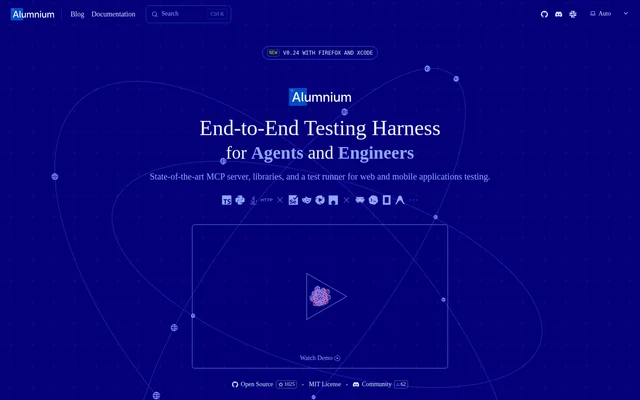
What is Alumnium?
Alumnium is an open-source end-to-end testing harness for web and mobile applications. It gives coding agents an MCP server for testing workflows and gives engineers client libraries for adding natural-language steps to existing automated tests. A separate test runner lets teams rerun scenarios saved as Markdown without having to ask a coding agent to recreate the flow each time.
What Alumnium can do
Alumnium turns descriptions of user actions and expected results into application interactions and checks. Engineers can combine those descriptions with ordinary test code rather than writing the whole test in natural language. When a coding agent uses the MCP server, Alumnium handles the detailed UI work and returns a concise summary of what changed.
- Alumnium drives application workflows described in plain language.
- Alumnium checks whether the application matches an expected result.
- Alumnium retrieves data as part of an existing test.
- Alumnium runs saved Markdown scenarios locally or in CI.
How Alumnium works
Alumnium offers two setup paths. To use it with a coding agent, an engineer installs the binary, chooses a supported AI provider, configures credentials if needed, and connects the MCP server. The page shows examples for Claude Code, Codex, and Grok Build. The engineer then describes the flow and its expected outcome in a prompt.
Alumnium also provides Java, Python, and TypeScript libraries that work with Selenium, Playwright, or Appium. An engineer initializes the client with the driver or page already used by the test and adds natural-language steps alongside existing code. The suite still runs through its usual framework, with Alumnium handling those steps and checks.
Who Alumnium is for
Alumnium is for software engineers who maintain automated tests or use coding agents to verify application behavior. The client libraries fit teams that already have a test suite and want to add natural-language steps selectively. The MCP path fits workflows that start with a prompt and may later need to run again as a saved Markdown scenario.
- Verify a browser workflow from a prompt that specifies the expected result.
- Add a natural-language check to an existing Selenium or Playwright test.
- Use Appium to add natural-language steps to a mobile test.
- Rerun a saved regression scenario in CI.
Alumnium pricing and plans
Alumnium is available as free, open-source software under the MIT License. The product page lists installation options rather than subscription plans. The binary is available through shell and PowerShell installation scripts and through package managers such as npm and pip. The client libraries can be installed through the package managers used by their respective languages.
Strengths and limitations of Alumnium
Alumnium can extend an existing test stack instead of replacing it. For coding-agent workflows, the MCP server keeps low-level UI interactions out of the agent's context and returns concise change summaries. Both workflows require configuration: teams choose a supported AI provider and then either connect a compatible coding agent or initialize a client with an existing automation driver.
- Alumnium requires a supported AI provider.
- Some provider configurations require credentials.
- The MCP workflow requires an MCP-compatible coding agent.
- The client workflow requires a Selenium, Playwright, or Appium driver.
Alumnium FAQ
What is Alumnium?
Alumnium is an open-source end-to-end testing harness for web and mobile applications. It includes an MCP server for coding agents, client libraries for existing automated tests, and a runner for scenarios saved as Markdown.
Is Alumnium free?
Alumnium is available as free, open-source software under the MIT License. The product page lists installation scripts and package managers for obtaining it and does not list paid plans. Setup requires selecting a supported AI provider.
Does Alumnium work with Selenium, Playwright, and Appium?
Alumnium works with Selenium, Playwright, and Appium through its Java, Python, and TypeScript client libraries. Engineers initialize the client with their existing driver or page, then add natural-language actions, checks, and data retrieval alongside their test code.
How do coding agents use Alumnium?
Alumnium connects to compatible coding agents through its MCP server. An engineer describes a user flow and the expected result in plain language, and the coding agent uses Alumnium to interact with the application and verify the result.
Can Alumnium run tests in CI?
Alumnium can rerun scenarios saved as Markdown locally or in continuous integration using its test runner. Engineers can ask a coding agent to save a successful scenario as Markdown and then use that file for repeat runs.
From the community
No reviews yet
Be the first to review this tool. What you write helps the next person choose.