What is Amazon Forecast?
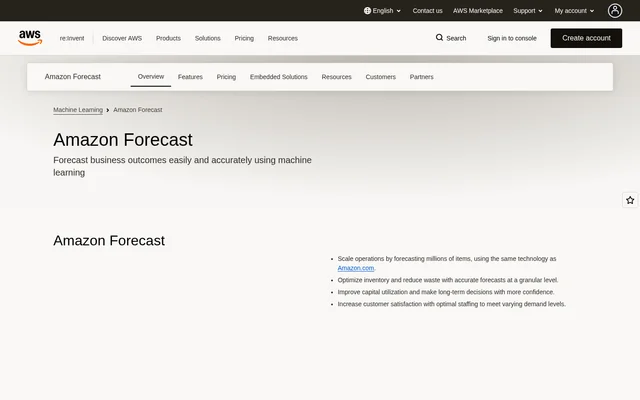
Amazon Forecast is an AWS service that uses machine learning to forecast business metrics over time. AWS says the service uses the same forecasting technology as Amazon.com and can forecast millions of items. The examples on the product page range from product demand for inventory decisions to staffing needs and visitor traffic for operations planning.
What Amazon Forecast can do
Amazon Forecast supports different measures of demand depending on the planning problem. In retail, the service provides product demand forecasts at specified probability levels. In workforce planning, the forecast interval is 15 minutes, so planners can account for periods of high and low demand when making staffing decisions.
- Amazon Forecast can forecast demand for millions of items.
- Amazon Forecast can estimate staffing needs in 15-minute increments.
- Amazon Forecast can forecast foot traffic, visitor counts, and channel demand.
How Amazon Forecast works
Amazon Forecast applies machine learning to time-series forecasting for business metrics. For forecasts that need to run repeatedly, AWS describes a no-code workflow built with AWS CloudFormation and AWS Step Functions. The product page links to guidance for setting up that workflow but does not lay out the configuration steps.
Who Amazon Forecast is for
Amazon Forecast is intended for teams that need to make operating decisions before demand is known. Retail inventory teams can use forecasts to balance stock availability against waste. Workforce planners can use forecasts to anticipate changing staffing needs, while travel operators can use traffic and visitor forecasts to plan operating costs.
- Retail inventory teams can forecast product demand to improve stock availability and inventory turns.
- Workforce planners can use forecast demand to plan staffing for busy and quiet periods.
- Travel operators can use visitor and channel demand forecasts to plan operating costs.
Amazon Forecast pricing and plans
Amazon Forecast is presented with the AWS Free Tier as a way to get started on AWS. The accompanying AWS Pricing overview describes pay-as-you-go billing for most AWS services, but it does not list Amazon Forecast rates, paid plans, or free usage allowances. The general AWS pricing model does not establish what a specific forecasting workload would cost.
Amazon Forecast strengths and limitations
Amazon Forecast combines large-scale item forecasting with detail suited to specific planning decisions, such as probability levels for product demand and short intervals for staffing. The product page also describes a route to recurring forecasts without writing code. The supplied pages provide less detail on workflow setup and on the cost of running forecasts.
- The documented recurring workflow setup uses AWS CloudFormation and AWS Step Functions.
- The supplied pricing overview does not list Amazon Forecast rates.
- The AWS Free Tier reference does not specify an Amazon Forecast usage allowance.
Getting started with Amazon Forecast
Amazon Forecast lists AWS account signup through the AWS Free Tier as a starting point. For teams that need recurring forecasts, the product page links to guidance for setting up a no-code workflow with AWS CloudFormation and AWS Step Functions. AWS also lists expert support options for development and enterprise programs.
Amazon Forecast FAQ
What is Amazon Forecast?
Amazon Forecast is an AWS time-series forecasting service that uses machine learning to analyze business metrics. The service can forecast millions of items and supports use cases such as retail inventory planning, workforce scheduling, and travel demand forecasting.
Is Amazon Forecast free?
Amazon Forecast is listed alongside the AWS Free Tier as a way to get started, but the supplied pages do not specify an Amazon Forecast free allowance or service-specific rates. The general AWS Pricing page describes pay-as-you-go billing for most AWS services.
Can Amazon Forecast predict retail product demand?
Amazon Forecast can forecast retail product demand at specific probability levels. Retail inventory teams can use those forecasts to plan stock, with the goals of reducing waste, increasing inventory turns, and improving in-stock availability.
Can Amazon Forecast help with workforce planning?
Amazon Forecast can forecast staffing needs in 15-minute increments. Workforce planners can use those forecasts to plan staffing for periods of high and low demand, with the goal of matching staffing levels to changing customer demand.
Can Amazon Forecast run recurring forecasts without code?
Amazon Forecast supports a no-code setup for recurring workflows using AWS CloudFormation and AWS Step Functions. AWS describes those services as the way to set up repeatable workflows and provides a link to setup guidance on the product page.
From the community
No reviews yet
Be the first to review this tool. What you write helps the next person choose.