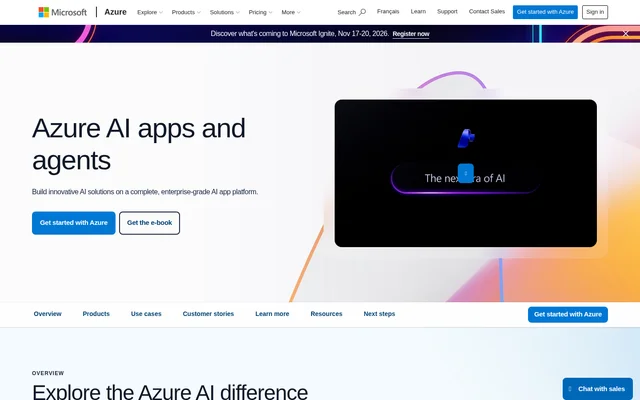
What is Azure AI?
Azure AI is an enterprise AI application and agent platform for developers and organizations building AI-enabled software. Azure AI brings together services for model selection, application development, data access, deployment, and governance. The website presents these capabilities as a connected product portfolio rather than a single-purpose chatbot or content generation application.
Azure AI includes Microsoft Foundry for bringing AI applications and agents into production, Azure Machine Learning for the machine learning lifecycle, and developer tools such as GitHub Copilot. Supporting services include managed databases, application hosting, API management, and security tools for protecting AI workloads.
What Azure AI can do
Azure AI supports the development and management of AI applications across models, agents, data, and infrastructure. The catalog includes foundation, open, task, and industry-specific models. Alongside model access, Azure AI provides orchestration, evaluation, and monitoring capabilities for teams developing applications that use organizational knowledge or automate business processes.
- Azure AI offers more than 11,000 models through Foundry Models.
- Azure AI supports agent and multi-agent orchestration with tracing and debugging.
- Azure AI provides context for retrieval-augmented generation and workflow automation.
- Azure AI supports native vector search within its database offerings.
- Azure AI includes evaluations, safety filters, and security controls.
- Azure AI supports AI-assisted coding, testing, and operations.
How Azure AI works
Azure AI connects model and agent development with data services and application infrastructure. Microsoft Foundry provides a catalog of models, agents, and tools, while Foundry IQ connects agents to a context layer for data, memory, and retrieval-augmented generation pipelines. Azure API Management supports securely exposing AI models to application developers.
Azure AI offers deployment paths through Azure Kubernetes Service, Azure App Service, Azure Container Apps, and Azure Functions. The website also describes serverless GPUs and cloud-to-edge deployment. Foundry Local manages models, agents, and their components on Windows and MacOS devices, while edge deployment supports running AI models locally with privacy and offline access.
Who Azure AI is for
Azure AI serves developers building applications and agents, as well as organizations applying AI to customer engagement, business operations, and employee experiences. The stated use cases include personalized customer interactions, knowledge automation, content creation, training, and research. Developer-focused services also extend AI assistance across the software development lifecycle, from ideation through operations.
- Azure AI supports customer-facing agents and product assistants.
- Azure AI enables knowledge and business process automation.
- Azure AI supports employee content creation and training tools.
- Azure AI enables agentic innovation labs and AI-powered research.
Azure AI strengths and governance capabilities
Azure AI combines application development resources with data, deployment, and operational controls. This breadth supports projects that need models, organizational context, and application hosting within the same service portfolio. Azure AI also includes continuous observability, governance, safety guardrails, and tools for detecting and responding to AI threats from agent creation through runtime.
Getting started with Azure AI
Azure AI provides links to Azure onboarding and individual product pages for exploring the relevant services. Development resources include customizable solution accelerators, code templates with step-by-step tutorials, and a gallery of ready-to-use AI application templates. These resources provide starting points for teams moving from a use case toward application development.
Azure AI FAQ
What is Azure AI?
Azure AI is an enterprise AI platform for building, optimizing, and governing AI applications and agents. Azure AI combines model access, agent orchestration, databases, developer tools, deployment services, and safety controls.
What models are available through Azure AI?
Azure AI offers more than 11,000 models through Foundry Models, including foundation, open, task, and industry-specific models. The listed model creators include Microsoft, OpenAI, DeepSeek, Mistral, Meta, NVIDIA, and Hugging Face.
Can Azure AI build and manage AI agents?
Azure AI supports agent creation through Foundry Agent Service and provides agent and multi-agent orchestration frameworks, tracing, and debugging tools. Foundry Control Plane adds visibility, governance, and control for AI agents, models, and tools.
Does Azure AI support local or edge deployment?
Azure AI supports cloud-to-edge deployment, including running AI models locally with privacy and offline access. Foundry Local manages models, agents, and their components on Windows and MacOS devices.
What can businesses use Azure AI for?
Azure AI supports personalized customer experiences, customer-facing agents, product assistants, and business process automation. Other stated uses include employee content creation and training, agentic innovation labs, and AI-powered research and discovery.
Does Azure AI support organizational data and RAG?
Azure AI supports retrieval-augmented generation and native vector search for applications using organizational data. Foundry IQ connects agents to a context layer for data, memory, and RAG pipelines, while Azure database services support storing and searching vectorized data.
From the community
No reviews yet
Be the first to review this tool. What you write helps the next person choose.