What is BabyAGI?
BabyAGI is an experimental open-source framework for building autonomous agents that can extend their capabilities through functions. BabyAGI is intended for experienced developers exploring these ideas, rather than production deployment. The repository describes the project as a way to share ideas and encourage discussion, with a function-management framework at its core.
BabyAGI uses functionz to store, manage, and execute functions from a database. The framework maintains a graph of imports, dependent functions, and authentication secrets. The original task-planning BabyAGI has moved to a separate archive repository; the current repository focuses on the experimental self-building approach.
What BabyAGI can do
BabyAGI combines function registration, dependency management, execution tracking, and a browser dashboard. Developers can organize related functions into packs and use metadata to describe requirements and relationships. Built-in AI functions support descriptions, embeddings, and function selection, while experimental agents explore generating new functions when existing functions cannot satisfy a request.
- BabyAGI stores and executes registered functions from a database.
- BabyAGI tracks function imports, dependencies, and required secret keys.
- BabyAGI records execution inputs, outputs, timing, and errors.
- BabyAGI provides a dashboard for updating functions and inspecting dependencies.
- BabyAGI supports triggers that run functions in response to events.
- BabyAGI generates function descriptions and embeddings through an included AI function pack.
- BabyAGI includes experimental agents that reuse or generate functions.
How BabyAGI works
BabyAGI is installed with pip install babyagi and imported into a Python application. Developers register functions with the register_function decorator and declare dependencies through metadata. The documented setup creates an application with create_app and runs a local server, making the dashboard available in a browser at the configured dashboard path.
BabyAGI automatically loads essential function packs and manages their dependencies. Developers can load custom packs from a file path, add secret keys through code or the dashboard, and inspect execution history. The experimental agent examples load draft function packs and configure an OpenAI API key before processing requests or generating tasks.
Who BabyAGI is for
BabyAGI is for experienced developers who want to experiment with autonomous agents, reusable functions, and code-generating workflows. The repository presents the framework as an exploratory project rather than a finished production system. Example agents demonstrate how existing functions can be selected, new requests broken into reusable components, and generated functions made available in the dashboard.
- BabyAGI supports experiments with self-building coding agents.
- BabyAGI helps developers organize related functions into reusable packs.
- BabyAGI exposes execution histories for debugging function interactions.
- BabyAGI demonstrates generating functions for tasks derived from a user description.
BabyAGI licensing and access
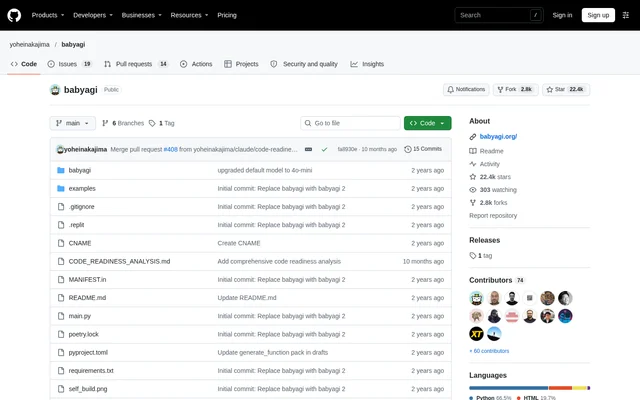
BabyAGI is an open-source project released under the MIT License and distributed as an installable Python package. The repository provides a pip installation command, dashboard setup instructions, and usage examples. BabyAGI documentation describes package installation and application setup rather than a hosted subscription service or a set of paid product plans.
BabyAGI strengths and limitations
BabyAGI brings function storage, dependency tracking, secret management, and execution monitoring into a shared framework. The dashboard makes these relationships and execution records visible, while function packs provide a way to organize reusable code. These capabilities support experimentation, but the repository explicitly warns that BabyAGI is not meant for production use.
- BabyAGI draft features may not function as intended and require significant improvements.
- BabyAGI generated code is minimal and may need improvement.
- BabyAGI triggers can cause unintended recursion or conflicts if managed carelessly.
- BabyAGI setup requires installing a Python package and running application code.
BabyAGI FAQ
What is BabyAGI?
BabyAGI is an experimental open-source framework for self-building autonomous agents. BabyAGI uses a database-backed function framework to store, manage, and execute functions, with dependency tracking, execution logs, and a browser dashboard for experienced developers.
Is BabyAGI free?
BabyAGI is available as an open-source project under the MIT License. BabyAGI can be installed with pip, and the repository provides Python examples for launching the dashboard and registering functions. The documentation does not describe paid BabyAGI subscription plans.
How do you install BabyAGI?
BabyAGI can be installed with pip install babyagi. Developers then import babyagi, create an application with create_app, and run the application to access the local browser dashboard. The repository also provides examples for registering functions and loading custom function packs.
Can BabyAGI generate code?
BabyAGI includes experimental agents that reuse existing functions or generate new functions from user requests. BabyAGI can break requests into smaller reusable components, but the repository warns that generated code is minimal, may need improvement, and may not function as intended.
Is BabyAGI suitable for production use?
BabyAGI is explicitly not intended for production use. BabyAGI is presented as an experimental framework for experienced developers to explore ideas, and the documentation warns that draft features require significant improvements and should be used with caution.
What does the BabyAGI dashboard do?
BabyAGI provides a dashboard for registering, deregistering, and updating functions, viewing dependencies, managing secret keys, and configuring triggers. BabyAGI also exposes execution logs containing inputs, outputs, and execution times to help developers monitor and debug function behavior.
From the community
No reviews yet
Be the first to review this tool. What you write helps the next person choose.