What is Beam?
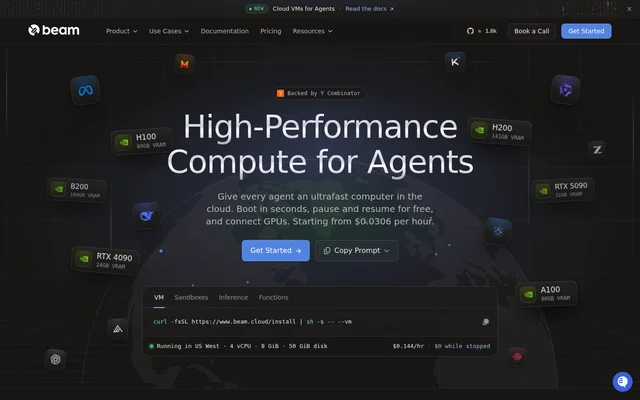
Beam is a cloud compute service for running AI agents, isolated code execution, and custom model inference. Beam provides persistent Linux virtual machines, sandboxes, and GPU resources for developers building agent-powered applications. The service combines agent environments and inference infrastructure rather than requiring developers to manage their own servers or Kubernetes cluster.
Beam describes its infrastructure as persistent, forkable microVMs virtualized on bare metal. Developers can expose services, isolate network access, attach GPU resources, and pause environments between tasks. Beam also provides durable disks, storage volumes, and a visual infrastructure canvas called Stacks.
What Beam can do
Beam supports both long-lived agent environments and temporary execution tasks. Persistent VMs retain repositories and tools between sessions, while sandboxes run untrusted code in isolated environments. GPU inference and training workloads can run on the same service, with serverless and reserved hardware options available.
- Beam preserves RAM and running processes during stateful pause and resume.
- Beam provides MCP tools to create VMs, fork environments, and run commands.
- Beam lets agents screenshot, click, and type in a Linux desktop.
- Beam supports custom images, shared volumes, and VM snapshots.
- Beam deploys open models through vLLM behind OpenAI-compatible URLs.
- Beam can automatically pause idle VMs and wake them when invoked.
How Beam works
Beam exposes workflows through its CLI, Python SDK, and MCP server. The coding-agent example creates a VM, synchronizes application files, runs tests, and exposes a protected application port. The desktop example connects to a named VM through the SDK and sends screenshot, mouse, and keyboard commands.
Beam separates access controls from the code running inside a VM. An egress proxy substitutes real API keys for outbound requests without exposing those secrets inside the machine. Hostname rules restrict outbound destinations, while private URLs and temporary share links control access to exposed applications. Persistent VM IP addresses support custom domains and allowlisting.
Who Beam is for
Beam serves developers building coding agents, computer-use agents, hosted agent applications, and machine learning workloads. The examples focus on environments that need persistent state, isolated execution, or GPU access. Beam also supports reinforcement learning workflows that start parallel environments from the same saved filesystem state.
- Coding-agent builders can retain repositories and development tools across sessions.
- Computer-use developers can automate a full Linux desktop.
- Agent developers can execute generated code in isolated sandboxes.
- Machine learning teams can run parallel rollouts and GPU inference.
Beam pricing and plans
Beam uses pay-as-you-go pricing across VMs, sandboxes, and serverless compute. VMs start at $0.0306 per hour and are billed per second while running, with no compute charges while stopped. The pricing page lists sandboxes from $0.319 per hour and H100s from $1.83 per hour.
Beam bills serverless workloads by the millisecond only while code runs. CPU and RAM charges differ between CPU-only workloads and workloads attached to a GPU. Persistent local storage is charged according to usage. Beam also lists on-demand clusters, reserved dedicated machines, and BYOC among its infrastructure options.
Beam strengths and limitations
Beam combines persistent agent environments, desktop automation, isolated execution, and GPU inference within one cloud service. Stateful pause and resume supports workloads that need to retain memory without continuously paying for running compute. The published limits and billing distinctions remain relevant when choosing storage capacity, sharing applications, or estimating workload costs.
- Beam charges for running compute and used persistent storage.
- Beam limits local persistent disks to 100Gi per machine.
- Beam share links last an hour.
Beam FAQ
What is Beam?
Beam is a cloud compute service for AI agents, isolated code execution, and model inference. Beam provides persistent Linux VMs, sandboxes, GPU resources, and tools for managing environments through a CLI, Python SDK, or MCP.
Is Beam free?
Beam is a paid, pay-as-you-go service, with VMs starting at $0.0306 per hour. Beam does not charge for VM compute while stopped, but used persistent storage is billed. Serverless workloads are billed by the millisecond while code runs.
Does Beam support MCP?
Beam provides an MCP server with 100+ tools for managing cloud environments. Beam MCP tools can create and fork VMs, run commands, capture desktop screenshots, click, and type, allowing agents to operate compute environments and Linux desktops.
Can Beam run open models with vLLM?
Beam supports deploying open models with vLLM on GPUs behind an OpenAI-compatible URL. Beam inference endpoints can scale to zero, and the website includes a Python deployment example using the vLLM integration.
How does Beam protect API keys and network access?
Beam uses an egress proxy so real API secrets are not exposed inside the VM. Beam also provides hostname egress rules, hardware-isolated microVMs, private application URLs, and temporary share links for controlling network and application access.
Can Beam pause agents without losing their state?
Beam supports stateful VM pause and resume that preserves RAM and running processes. Beam can automatically pause idle VMs and wake them when their URL is invoked, with no compute charges while the VM is stopped.
From the community
No reviews yet
Be the first to review this tool. What you write helps the next person choose.