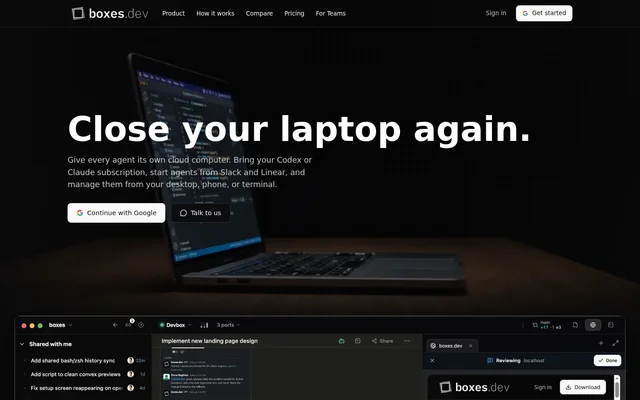
What is boxes.dev?
boxes.dev is a cloud development environment for running coding agents on separate Linux computers called devboxes. Individual developers and engineering teams can run native Codex or Claude Code with their existing subscriptions or API keys. Each agent receives a copy of the development environment rather than another checkout on the same local machine.
boxes.dev keeps agent work in the cloud, allowing a thread to continue after the developer disconnects or closes a laptop. Desktop, mobile, web, and terminal clients provide access to that work. boxes.dev is an independent product and states that it is not affiliated with OpenAI, Codex, Anthropic, or Claude Code.
What boxes.dev can do
boxes.dev combines isolated development machines with ways to launch, supervise, and share coding-agent work. Each devbox has its own filesystem, processes, ports, and database state. Developers can review changes and interact with agents across devices, while collaboration features expose live sessions and running applications to teammates.
- boxes.dev runs native Codex and Claude Code on separate Linux devboxes.
- boxes.dev starts agents from Slack, Linear, schedules, or API calls.
- boxes.dev supports thread reading, request approvals, diff reviews, and terminal access.
- boxes.dev supports SSH and IDE-over-SSH with VS Code and JetBrains.
- boxes.dev shares live transcripts, diffs, screenshots, and app preview URLs.
- boxes.dev automatically puts idle devboxes to sleep.
How boxes.dev works
boxes.dev begins setup with a prompt pasted into Claude Code or Codex inside the project folder. The coding agent examines environment files, local databases, and tools outside the repository, then drafts a setup plan. The developer reviews what will be uploaded before approving the migration. A second agent executes the approved plan and checks that the application runs remotely.
boxes.dev captures the resulting filesystem and memory in a template snapshot. New agents receive fresh devboxes started from that snapshot. Slack mentions can start work and return results in-thread, while Linear assignments return updates and outputs to the issue. Scheduled runs and API calls provide additional launch paths, and existing threads remain available in the workspace for continued iteration.
Who boxes.dev is for
boxes.dev serves developers working on side projects, small teams running agents daily, and engineering organizations deploying cloud coding agents across a team. The stated use cases include parallel development tasks, recurring reviews, and application testing. Mobile access also supports developers who need to inspect progress, approve requests, or review diffs away from their desks.
- Developers can run separate tasks without sharing local ports or database state.
- Teams can assign Linear issues to agents and receive outputs or pull requests.
- Developers can schedule commit reviews, recurring Slack updates, and nightly application QA.
- Teammates can inspect live agent sessions and preview running applications before merging code.
boxes.dev pricing and plans
boxes.dev offers a free trial with 20 compute hours, followed by paid plans with included hours. Starter costs $19 per user per month with 50 hours, Pro costs $99 with 250 hours, and Max costs $249 with 600 hours. Teams pricing is custom. Starter, Pro, and Max list additional compute at $0.60 per hour.
boxes.dev bills awake machine time by the second and automatically sleeps idle devboxes. Sleeping devboxes are free, and extra hours are purchased as prepaid credit with optional automatic purchasing. Codex or Claude Code access comes from the developer’s existing subscription or API key; boxes.dev states that it does not sell tokens.
boxes.dev strengths and limitations
boxes.dev separates agent tasks at the computer level, letting agents change dependencies, run applications, or modify database schemas without affecting other devboxes. Persistent cloud execution and access across devices support work that continues unattended. Shared sessions and preview URLs support collaboration, while team controls include access management, audit logs, spend limits, and concurrency limits.
- boxes.dev requires developers to supply their own Codex or Claude Code subscription or API key.
- boxes.dev plans place limits on simultaneously awake devboxes.
- boxes.dev uploads setup resources to managed cloud machines, with uploads encrypted before leaving the local machine.
boxes.dev FAQ
What is boxes.dev?
boxes.dev is a cloud development environment that gives each coding agent a separate Linux computer. Developers can run native Codex or Claude Code with their existing subscription or API key and manage agents through desktop, mobile, web, or CLI clients.
Is boxes.dev free?
boxes.dev offers a free trial with 20 hours of compute, alongside paid plans with included compute hours. Sleeping devboxes are free, and idle machines sleep automatically. Paid usage covers awake machine time, while Codex or Claude Code subscriptions remain separate.
Does boxes.dev keep working when I close my laptop?
boxes.dev keeps agents running inside managed cloud devboxes when a developer disconnects or closes a laptop. The same thread continues in the cloud, and desktop, mobile, and CLI clients let the developer check progress and continue interacting with the agent.
Does boxes.dev work with Slack and Linear?
boxes.dev supports starting agent work by mentioning @boxes.dev in Slack or assigning a Linear issue to an agent. Slack agents receive thread context and report back in-thread. Linear agents report back in the issue and attach outputs or pull requests.
Can I use my existing Codex or Claude Code subscription with boxes.dev?
boxes.dev runs the native Codex and Claude Code tools using an existing subscription or API key. boxes.dev does not replace the model subscription, resell tokens, or insert its own harness between the developer and the coding agent.
Can I use VS Code or JetBrains with boxes.dev?
boxes.dev supports SSH and IDE-over-SSH workflows with VS Code and JetBrains. The desktop workbench also includes a built-in file viewer, diff view, and persistent terminals, providing another way to inspect files, review changes, and interact with remote development work.
From the community
No reviews yet
Be the first to review this tool. What you write helps the next person choose.