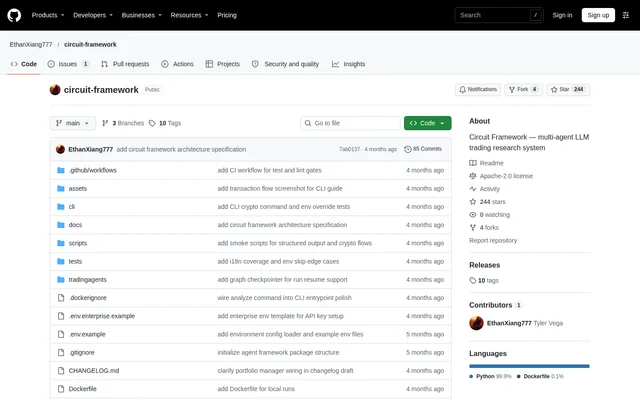
What is circuit-framework?
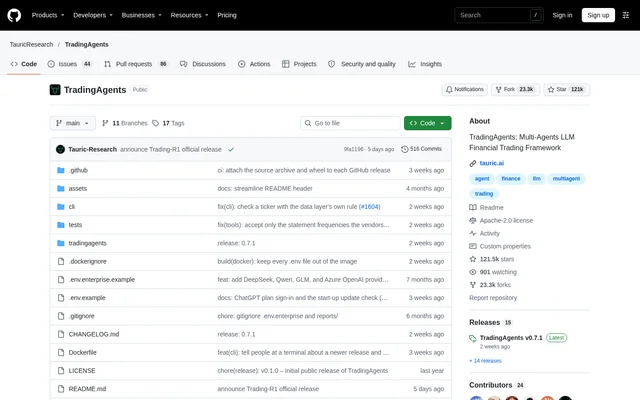
circuit-framework is an open-source framework for cryptocurrency research and simulated trading using specialized LLM agents. The project is a fork of TradingAgents, with crypto-focused workflows and a deterministic risk engine that approves or rejects proposed trades. The internal Python package remains tradingagents for compatibility with the upstream project.
circuit-framework supports research rather than live trading. The software places no real trades, never calls the Hyperliquid Exchange endpoint and never requests wallet credentials. The repository explicitly warns that LLM output can be incorrect and that paper-trading results do not represent live execution.
What circuit-framework can do
circuit-framework combines market analysis, agent debate and rule-based risk evaluation. Crypto analysts share an immutable market snapshot created at the beginning of a run. Strategy profiles change prompts, weights, overlays and risk limits while retaining the same data snapshot, fees, risk engine and paper executor.
- circuit-framework analyzes market structure, derivatives, sentiment, catalysts and market regime.
- circuit-framework produces structured LONG, SHORT or NO_TRADE proposals.
- circuit-framework checks data freshness, stops, spreads, leverage and position limits.
- circuit-framework records approved paper trades in SQLite.
- circuit-framework provides portfolio, positions and leaderboard commands.
- circuit-framework retains the upstream stock research workflow.
How circuit-framework works
circuit-framework starts a crypto analysis run by building a market snapshot from Hyperliquid public Info data. Available inputs include candles, order books, asset contexts and funding history. Analysts and researchers assess the snapshot before a trader agent produces a proposal containing an entry band, stop, take-profits, requested size, leverage, confidence and thesis.
circuit-framework then passes the proposal through risk debate, portfolio management and the deterministic risk gate. The gate sizes, clamps or rejects trades, while preserving NO_TRADE decisions without converting them into fills. Approved proposals reach simulated execution only when paper trading is requested. Decision logs and optional LangGraph checkpoints provide persistence.
Who circuit-framework is for
circuit-framework suits developers and researchers examining agent-based trading decisions rather than seeking an automated live-execution service. CLI commands and programmatic Python access support repeatable research workflows. The included strategy profiles cover approaches such as momentum, mean reversion, derivatives, narrative, macro regime and systematic quantitative research.
- Researchers can compare strategy profiles against shared market inputs.
- Developers can inspect structured proposals and deterministic risk decisions.
- Trading researchers can review simulated positions and portfolio activity.
- Contributors can run offline crypto tests using fixtures and mocks.
circuit-framework licensing and access
circuit-framework is available as an open-source project under the Apache 2.0 license. The repository documents cloning the source, installing the Python project and copying the environment example before configuring LLM API keys for live analysis. Docker execution is also documented through the upstream compose file.
circuit-framework supports providers including OpenAI, Google, Anthropic, xAI, DeepSeek, OpenRouter and Ollama, alongside OpenAI-compatible endpoints. Environment settings select the provider, models, crypto defaults and paper-trading assumptions. Offline unit tests use fixtures and mocks, do not hit the network and require no LLM API key.
circuit-framework strengths and limitations
circuit-framework separates probabilistic LLM analysis from deterministic risk enforcement and keeps strategy comparisons on a shared data path. Public market-data access requires no authentication, while simulated execution avoids requesting wallet credentials. These design choices support inspectable research, but the repository does not present the framework as proof of trading performance.
- LLM analysts can be wrong, and the risk gate cannot create a trading edge.
- On-chain data is excluded until a verified provider is configured.
- Liquidation fields may be unavailable through public Info coverage.
- Paper fills use mid prices, configured slippage and fees rather than exchange matching.
circuit-framework FAQ
What is circuit-framework?
circuit-framework is an open-source multi-agent framework for crypto research and paper trading. Specialized agents analyze market conditions and produce structured trade proposals, which pass through a deterministic risk engine before any simulated execution. The project is a fork of TradingAgents.
Is circuit-framework free?
circuit-framework is available as an open-source project under the Apache 2.0 license. The repository provides installation instructions rather than product subscription plans. Live analysis requires configuring LLM provider access, while the offline unit test suite requires no LLM API key.
Does circuit-framework place real trades?
circuit-framework does not place real trades, call the Hyperliquid Exchange endpoint or request wallet credentials. Approved proposals can be executed only as paper trades. Simulated fills use mid prices with configured slippage and fees, not exchange matching.
Which data sources and LLM providers does circuit-framework support?
circuit-framework uses Hyperliquid public Info data for crypto research and supports LLM providers including OpenAI, Google, Anthropic, xAI, DeepSeek, OpenRouter and Ollama. OpenAI-compatible endpoints are also supported. The retained stock workflow includes Yahoo Finance and Alpha Vantage, with optional FRED and Polymarket.
How do you install and use circuit-framework?
circuit-framework is installed by cloning the repository, installing the Python project and copying the environment example to configure provider keys for live analysis. Research runs are available through CLI commands or Python code. The repository also documents Docker execution.
What are circuit-framework's limitations?
circuit-framework can produce incorrect LLM analysis, and deterministic risk checks do not guarantee a trading edge. On-chain data requires a verified provider configuration, liquidation fields may be unavailable, and paper-trading results do not represent live execution.
From the community
No reviews yet
Be the first to review this tool. What you write helps the next person choose.