What is CM3leon by Meta?
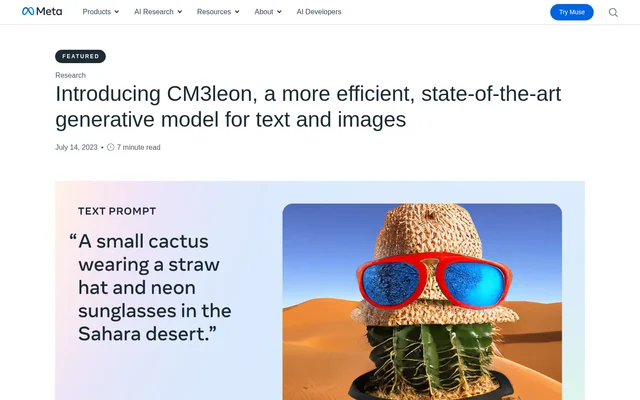
CM3leon by Meta is a multimodal foundation model for generating text and images within a shared architecture. Meta presents the model as research into combining image generation with image understanding, rather than separating those capabilities into task-specific models. The research covers text-to-image generation, image-to-text generation and editing tasks, making the work relevant to researchers studying how language and visual information can be processed together.
CM3leon by Meta uses a causal masked mixed-modal approach that generates text and image sequences conditioned on other text and image content. Meta describes a training recipe adapted from text-only language models, combining retrieval-augmented pre-training with multitask supervised fine-tuning. This approach supports several kinds of visual and language tasks through the same model.
What CM3leon by Meta can do
CM3leon by Meta supports both creating visual content and describing existing images. The examples cover prompts with multiple compositional requirements, edits directed by written instructions and image generation constrained by structural information. Meta also evaluates caption generation and visual question answering, demonstrating that the model’s capabilities extend beyond producing images from text alone.
- CM3leon by Meta generates images from descriptive text prompts.
- CM3leon by Meta edits images according to written instructions.
- CM3leon by Meta produces short captions and detailed image descriptions.
- CM3leon by Meta answers questions about image contents.
- CM3leon by Meta generates images from bounding-box descriptions.
- CM3leon by Meta generates images from segmentation inputs.
How CM3leon by Meta works
CM3leon by Meta uses a decoder-only transformer that accepts and generates both text and images. Retrieval augmentation is part of pre-training, followed by instruction fine-tuning across image and text generation tasks. Meta attributes improvements in instruction following to this multitask training approach, including performance on captioning, visual question answering, text-based editing and conditional image generation.
CM3leon by Meta takes different inputs depending on the task. Image generation starts with a text prompt, while text-guided editing combines an existing image with written instructions. Structure-guided generation uses bounding-box descriptions or segmentation information. Meta also shows generated images processed through a separately trained super-resolution stage, distinguishing that additional stage from the model’s raw image outputs.
Who CM3leon by Meta is for
CM3leon by Meta is relevant to research into multimodal language models, generative imagery and visual understanding. Meta’s article explains the architecture and training approach, presents task examples and links to the research paper. The demonstrated applications span creating images, modifying visual content and extracting descriptions or answers from images, rather than focusing on a single image-generation workflow.
- Image-generation research can examine how CM3leon by Meta handles compositional prompts.
- Image-editing research can explore how CM3leon by Meta follows textual and layout constraints.
- Vision-language research can evaluate CM3leon by Meta on captioning and visual questions.
CM3leon by Meta strengths and limitations
CM3leon by Meta combines image creation, editing and understanding within the same model. Meta documents the use of a licensed training dataset and describes the training recipe, architecture and evaluation tasks. These details support examination of the research, while the article also acknowledges that generative models can reproduce biases found in their training data.
- CM3leon by Meta can reflect biases present in training data.
- CM3leon by Meta uses a separately trained stage for the demonstrated super-resolution results.
- CM3leon by Meta is presented through research examples and a linked paper.
CM3leon by Meta FAQ
What is CM3leon by Meta?
CM3leon by Meta is a multimodal foundation model that generates both text and images. Meta’s research demonstrates text-to-image generation, image editing, captioning and visual question answering using the same model, with a decoder-only transformer architecture.
Can CM3leon by Meta edit images using text?
CM3leon by Meta can edit an existing image according to written instructions. Meta demonstrates text-guided editing alongside other tasks using the same model, and also describes structure-guided generation using layout information, bounding-box descriptions and segmentation inputs.
Can CM3leon by Meta describe images and answer questions?
CM3leon by Meta can generate short captions, provide detailed image descriptions and answer questions about visual content. Meta evaluates these capabilities on image-captioning and visual-question-answering tasks, alongside the model’s image-generation capabilities.
How was CM3leon by Meta trained?
CM3leon by Meta was trained with retrieval-augmented pre-training followed by multitask supervised fine-tuning for image and text generation. Meta states that the model uses a licensed dataset and a decoder-only transformer architecture that supports both text and image inputs and outputs.
Does CM3leon by Meta support higher-resolution images?
CM3leon by Meta can have generated images processed through a separately trained super-resolution stage. Meta distinguishes the raw model outputs from these enhanced examples, so the demonstrated higher-resolution workflow includes an additional stage rather than only the base model.
From the community
No reviews yet
Be the first to review this tool. What you write helps the next person choose.