What is Confident AI?
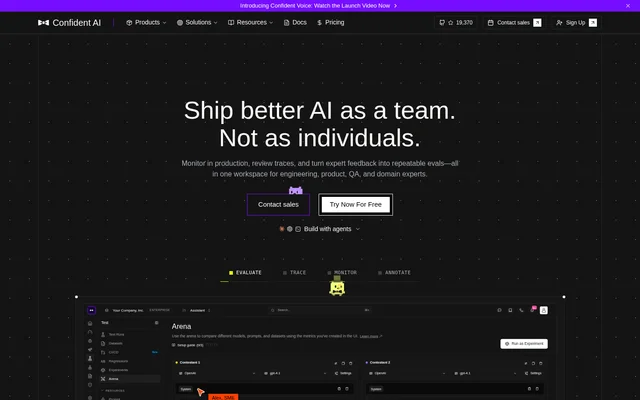
Confident AI is a commercial LLM evaluation and observability platform for teams building and operating AI applications. Confident AI brings engineers, product managers, QA staff, and subject-matter experts into a shared quality workflow, combining production monitoring with trace review, annotation, datasets, and evaluations.
Confident AI was built by the creators of DeepEval but is a separate product from the open-source framework. Confident AI uses DeepEval metrics for LLM-as-a-judge evaluation and also supports fully custom metrics. Evaluation sits alongside observability, red teaming, and governance rather than defining the entire product.
What Confident AI can do
Confident AI connects production failures to repeatable checks for subsequent releases. Confident AI evaluates production traces, groups failures into issues, and alerts teams when problems occur. Human reviewers can flag incorrect responses, provide expected answers, and turn feedback into test cases or evaluations within the same workspace.
- Confident AI monitors trace quality and latency over time.
- Confident AI automatically curates evaluation datasets from observability traces.
- Confident AI lets non-engineers test HTTP and streaming endpoints.
- Confident AI simulates multi-turn chatbot conversations before release.
- Confident AI centralizes red teaming and produces PDF assessment reports.
- Confident AI versions prompts with git-based branching and evaluation-gated merges.
How Confident AI works
Confident AI accepts traces through an OpenTelemetry-native integration approach and SDKs in Python and TypeScript. Listed framework integrations include OpenAI Agents, Claude Agent SDK, LangChain, LangGraph, LlamaIndex, Pydantic AI, CrewAI, and Vercel AI SDK. Gateway integrations include LiteLLM, Portkey, OpenRouter, and Bifrost.
Confident AI exposes APIs for prompt versioning, dataset creation, trace ingestion, project provisioning, annotation collection, and governance policy assignment. Teams can inspect production traces, annotate responses, and use failing examples as evaluation inputs. Prompt workflows can sync with a codebase, enforce merge permissions, and use evaluation results to gate merges.
Who Confident AI is for
Confident AI serves engineering, product, QA, and domain expert teams that need to review AI behavior together. Confident AI also addresses product owners and non-engineers who need to call AI applications directly without waiting for engineering. For regulated industries, Confident AI offers centralized red teaming workflows and assessment reports for stakeholders.
- Engineering teams can investigate production traces and quality regressions.
- Product managers and domain experts can convert incorrect answers into repeatable checks.
- QA teams can test chatbot conversations and review annotation trends.
- Teams in regulated industries can assess risks and share assessment reports.
Confident AI strengths and limitations
Confident AI's stated strengths include keeping tracing, annotation, datasets, and evaluations together instead of moving review data between separate tools. Confident AI also offers deployment and access controls, including multi-region residency, role-based access control, project isolation, and data masking. The supplied page lists plan prices but does not specify detailed usage allowances or feature limits for each plan.
Confident AI FAQ
What is Confident AI?
Confident AI is a commercial LLM evaluation and observability platform built by the creators of DeepEval. Confident AI combines production tracing, expert annotation, evaluation datasets, red teaming, and governance in a shared workspace for engineering, product, QA, and domain expert teams.
Can Confident AI be self-hosted?
Confident AI supports self-hosting as well as use of Confident AI's cloud. Confident AI lists on-premises, AWS, Azure, and GCP deployment options, alongside multi-region data residency, role-based access control, project isolation, and data masking.
Does Confident AI have an API and integrations?
Confident AI exposes APIs for prompt versioning, datasets, traces, projects, annotations, and governance policies. Confident AI also provides Python and TypeScript SDKs, OpenTelemetry-native tracing, and integrations including LangChain, LangGraph, OpenAI Agents, Claude Agent SDK, LiteLLM, and OpenRouter.
How does Confident AI turn feedback into evaluations?
Confident AI lets domain experts, product managers, and engineers annotate traces and provide corrections or expected answers. Confident AI turns failing traces and reviewer feedback into test cases or evaluations that check subsequent releases for the same problems.
Is Confident AI the same as DeepEval?
Confident AI is a separate commercial product from the open-source DeepEval framework. Confident AI natively uses DeepEval metrics for LLM-as-a-judge evaluation and supports custom metrics, while also providing observability, red teaming, governance, and collaborative review workflows.
From the community
No reviews yet
Be the first to review this tool. What you write helps the next person choose.