What is Cradle?
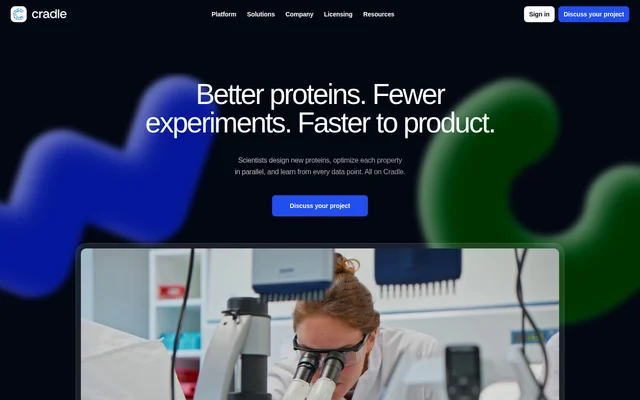
Cradle is an AI protein engineering platform for scientists developing new proteins or improving existing sequences. Cradle brings candidate design, property optimization, and learning from experimental results into a shared workflow. Supported protein types include antibodies, enzymes, vaccines, and peptides, with applications in medicines, crops, and materials.
Cradle serves experimental scientists, computational scientists, and R&D leadership. Cradle also tests models against real data from its own laboratory and shares workflows, benchmarks, and failures. The website presents laboratory validation as part of model development rather than describing protein engineering solely as a computational design task.
What Cradle can do
Cradle supports protein engineering from initial designs through optimized candidates. Cradle uses experimental data and scientists’ domain knowledge to design an optimized plate, then incorporates results into subsequent rounds. The stated optimization scope includes efficacy, developability, and manufacturability in parallel, rather than treating each property as a separate design objective.
- Cradle designs proteins from a target or a scientist’s own sequence.
- Cradle optimizes multiple protein properties in parallel.
- Cradle learns from experimental results across successive rounds.
- Cradle supports antibody, enzyme, vaccine, and peptide engineering.
- Cradle provides point-and-click candidate design and optimization.
- Cradle exposes all web application capabilities through an API.
How Cradle works
Cradle begins with a target or an existing protein sequence. Cradle combines available data with scientific domain knowledge to design candidates for testing. Experimental results then inform the next design round, allowing the workflow to build on earlier findings. The website describes this process as progressing from initial hits to optimized candidates.
Cradle provides a web application for point-and-click work and an API for computational workflows. Computational scientists can script operations and connect Cradle to their existing stack. Cradle runs on Google Cloud infrastructure with technical controls, data isolation, and continuous monitoring; customer data is accessible only to people the customer authorizes.
Who Cradle is for
Cradle is intended for bench scientists who want direct access to machine learning capabilities, computational scientists building scripted workflows, and R&D leaders coordinating teams and programs. Cradle names biopharma and industrial biotechnology among its industry areas, while the published examples also include an academic team developing an antivenom binder.
- Cradle supports therapeutic peptide optimization under potency, specificity, expression, and thermostability constraints.
- Cradle supports antibody engineering for potency and developability.
- Cradle supports enzyme engineering for activity and thermostability.
- Cradle supports vaccine antigen design for stability outside the laboratory.
Cradle pricing and licensing
Cradle uses a purchased-license model with no royalties or milestones. Cradle states that customers own their intellectual property and keep their data. The website provides a project discussion route and a licensing information link, but does not publish license prices or a plan comparison in the supplied page text.
Cradle strengths and limitations
Cradle combines multiple protein modalities, parallel property optimization, and experimental feedback within the same workflow. Cradle offers both a scientist-facing interface and API access, supporting different technical roles. Cradle also states that the platform is ISO27001 and SOC2 Type II certified, alongside Google Cloud hosting and customer-controlled data access.
- Cradle requires a purchased license rather than offering stated free access.
- Cradle relies on experimental data to improve subsequent design rounds.
- Cradle frames engineering targets around properties that scientists can assay.
Cradle FAQ
What is Cradle?
Cradle is an AI protein engineering platform that designs new proteins, optimizes existing sequences, and learns from experimental data. Cradle supports antibodies, enzymes, vaccines, and peptides for applications in medicines, crops, and materials.
Is Cradle free?
Cradle is offered through a purchased license, with no royalties or milestones. Cradle states that customers retain their intellectual property and data, but the supplied page does not list license prices.
Who is Cradle for?
Cradle is for experimental scientists, computational scientists, and R&D leadership. Cradle provides point-and-click candidate design for bench scientists, API-based workflows for computational teams, and a shared design, optimization, and learning workflow across teams and programs.
Does Cradle have an API?
Cradle has an API that includes everything available in the web application. Cradle allows computational scientists to script operations, scale workflows, and connect protein engineering capabilities to their existing technical stack.
What protein properties can Cradle optimize?
Cradle optimizes efficacy, developability, and manufacturability in parallel. Cradle’s published examples address potency, specificity, expression, thermostability, binding, and enzyme activity, with experimental results feeding into subsequent design rounds.
How does Cradle protect customer data?
Cradle runs on Google Cloud infrastructure with technical controls, data isolation, and continuous monitoring. Cradle states that the platform is ISO27001 and SOC2 Type II certified, and customer data is accessible only to people the customer authorizes.
From the community
No reviews yet
Be the first to review this tool. What you write helps the next person choose.