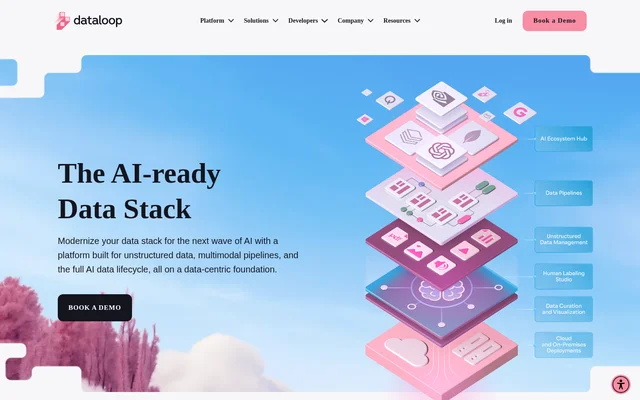
What is Dataloop?
Dataloop is an AI data infrastructure platform for managing unstructured data and building AI applications. Dataloop connects data management, models, pipeline orchestration, application functions, and human feedback across the AI data lifecycle. The website describes a data-centric environment intended for teams that need to develop applications while coordinating datasets, models, and review work.
Dataloop serves technical and operational roles, including data engineers, data scientists, software developers, AI and data leaders, and human reviewers. Dataloop supports unstructured and semi-structured data pipelines, multimodal workflows, and generative AI development, with capabilities for both preparing data and working with models in production.
What Dataloop can do
Dataloop combines data preparation, model development, workflow construction, and human review. Dataloop provides automated preprocessing and embeddings to help teams locate relevant data, alongside tools to curate, version, clean, and route datasets. Model and application components can then be assembled into workflows using reusable elements or custom code.
- Dataloop explores and analyzes unstructured data from diverse sources.
- Dataloop uses preprocessing and embeddings to support similarity-based data discovery.
- Dataloop versions, compares, fine-tunes, evaluates, and deploys models.
- Dataloop builds pipelines through a drag-and-drop interface or Python SDK.
- Dataloop supports multimodal generative AI workflows and retrieval-augmented generation.
- Dataloop incorporates human feedback for annotation, reinforcement learning, and active learning.
- Dataloop runs custom application logic through an in-platform function-as-a-service offering.
How Dataloop works
Dataloop lets teams orchestrate data, models, application elements, and human feedback within a pipeline. Dataloop offers a visual drag-and-drop interface for assembling workflows and a Python SDK for code-based development. Pre-created pipeline templates provide starting points, while the marketplace supplies existing models, elements, and pipelines that teams can combine.
Dataloop supports off-the-shelf models as well as custom model development. Teams can experiment with datasets, compare model versions, fine-tune models, and deploy them to production. Dataloop also provides dedicated application functions that work with data and models without separate authentication or infrastructure setup for those functions.
Who Dataloop is for
Dataloop targets teams whose AI development depends on collaboration across data infrastructure, modeling, software development, and review. Dataloop gives data engineers workflow-building tools, data scientists model experimentation capabilities, and leaders ways to manage and distribute datasets, models, and applications. Human reviewers can contribute feedback through annotation utilities at different points in a pipeline.
- Dataloop helps data engineers combine data sources, models, and human feedback in pipelines.
- Dataloop helps data scientists experiment with models and address pipeline issues.
- Dataloop helps software developers build AI applications with data, models, and an SDK.
- Dataloop helps human reviewers capture annotation and user feedback.
- Dataloop supports teams building generative AI applications with foundation models and retrieval-augmented generation.
Dataloop strengths and security controls
Dataloop brings data, model operations, custom applications, and human review into a connected workflow. Dataloop supports visual and code-based development, while reusable marketplace components and templates offer alternatives to building every workflow element from scratch. These capabilities address different responsibilities across data teams without requiring every contributor to use the same development approach.
Dataloop lists compliance with GDPR, ISO 27001, ISO 27701, and SOC 2 Type II. Dataloop also lists role-based access control, single sign-on, two-factor authentication, AES-256 encryption, and a granular activity audit trail. These controls accompany the website’s description of governance across the platform.
Getting started with Dataloop
Dataloop provides a demo booking option on its website for teams evaluating the product. Dataloop also links to platform information covering data management, models, pipelines, applications, human feedback, marketplace components, and security. The website includes a video and separate information about generative AI capabilities and its NVIDIA NIM embedded offering.
Dataloop FAQ
What is Dataloop?
Dataloop is an AI data infrastructure and application development platform for unstructured data, multimodal pipelines, and the AI data lifecycle. Dataloop combines dataset management, model operations, workflow orchestration, custom application functions, and human feedback.
Who is Dataloop for?
Dataloop is for data engineers, data scientists, AI and data leaders, software developers, and human reviewers. Dataloop supports their work with shared datasets, models, applications, pipelines, and annotation utilities for capturing human feedback.
Can Dataloop build pipelines visually or with code?
Dataloop supports pipeline development through a drag-and-drop interface or its Python SDK. Dataloop also provides pre-created pipeline templates and marketplace components for connecting data, models, application elements, and human feedback in a workflow.
Does Dataloop support generative AI and RAG?
Dataloop supports multimodal generative AI pipelines using off-the-shelf and fine-tuned large language models, foundation models, and retrieval-augmented generation. Dataloop also allows teams to customize models and incorporate human review into application workflows.
How does Dataloop use human feedback?
Dataloop integrates human feedback into pipelines for annotation, reinforcement learning from human feedback, active learning, and other human-centric tasks. Dataloop provides annotation utilities for reviewers and supports real-time human feedback for AI running in production.
What security controls does Dataloop provide?
Dataloop lists role-based access control, single sign-on, two-factor authentication, AES-256 encryption, and granular activity audit trails. Dataloop also states compliance with GDPR, ISO 27001, ISO 27701, and SOC 2 Type II.
From the community
No reviews yet
Be the first to review this tool. What you write helps the next person choose.