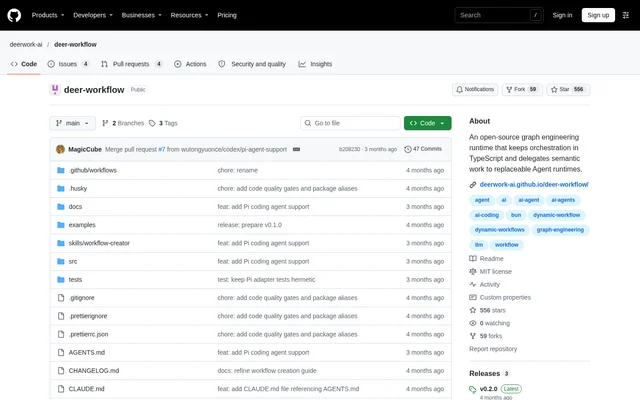
What is deer-workflow?
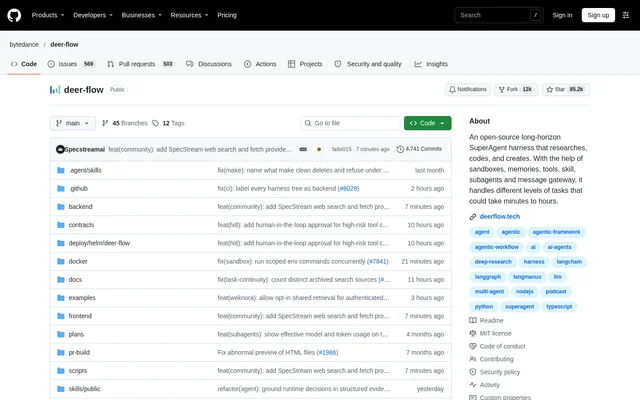
deer-workflow is an open-source Dynamic Workflow runtime for developers building observable, reusable agent graphs. TypeScript defines valid execution paths, while coding agents perform semantic work inside workflow nodes. The project describes this approach as Graph Engineering and identifies deer-workflow as a pilot project for DeerWork.
deer-workflow keeps control flow, phases, inputs, and failure handling in reviewable TypeScript rather than an opaque agent conversation. This separation makes orchestration explicit without tying the architecture to a single coding agent. Codex is the default runtime, but the public Agent interface remains vendor-neutral.
What deer-workflow can do
deer-workflow combines code-defined orchestration with agent-based task execution. The released CLI can generate a runnable workflow module from a description and execute that module with supplied input. Execution output supports both people watching an interactive terminal and automation consuming structured events.
- deer-workflow defines execution paths, phases, inputs, and failure handling in TypeScript.
- deer-workflow generates workflow modules using the bundled workflow-creator Skill.
- deer-workflow supports Codex, Claude Code, and Pi as agent runtimes.
- deer-workflow displays phases and Markdown logs in a live terminal interface.
- deer-workflow streams JSONL events for servers, CI, and process pipelines.
How deer-workflow works
deer-workflow starts with installing Bun and, for the default quick-start path, signing in to Codex CLI. Users then install the released CLI with Bun. A create command passes a workflow description to Codex, which applies the bundled workflow-creator Skill and writes a runnable TypeScript module.
deer-workflow runs the generated module with an input argument. Interactive terminals show a phase-aware interface with Markdown logs. For servers, CI, or process pipelines, the print option streams JSON events to standard output. Generation can use another installed harness by selecting Claude or Pi instead of the default Codex runtime.
Who deer-workflow is for
deer-workflow serves developers who want agent workflows expressed as code and execution output suitable for interactive use or automation. The repository provides research and writing examples that demonstrate parallel investigation and sequential content production. Those examples must be run from a cloned or downloaded copy of the repository.
- deer-workflow can research supplied topics in parallel and synthesize a report.
- deer-workflow includes a Deep Research example that investigates angles, verifies claims, and produces an interactive HTML report.
- deer-workflow includes a Blog Writer example that plans articles, drafts sections, reviews them, and returns structured output.
deer-workflow pricing and access
deer-workflow is distributed as an open-source project under the MIT License. Access is through the released CLI or the source repository, rather than a product subscription described in the README. Developers can clone the repository, install dependencies and Git hooks with Bun, and run the CLI directly from source.
deer-workflow strengths and limitations
deer-workflow combines reviewable orchestration, replaceable agent runtimes, and observable execution. The vendor-neutral Agent interface separates the architecture from Codex, while built-in Claude Code and Pi harnesses offer alternatives. Setup remains developer-oriented: the documented path uses Bun, command-line installation, an installed agent runtime, and TypeScript workflow modules.
- deer-workflow requires Bun for the documented installation and development paths.
- deer-workflow requires Codex CLI sign-in for the default quick-start setup.
- deer-workflow requires a repository clone or download to run the included examples.
deer-workflow FAQ
What is deer-workflow?
deer-workflow is an open-source Dynamic Workflow runtime for building observable, reusable agent graphs. TypeScript defines workflow execution paths, phases, inputs, and failure handling, while replaceable coding agents perform semantic work inside individual nodes.
Is deer-workflow free?
deer-workflow is available as an open-source project under the MIT License. The repository provides a released CLI installation path and source code for development, but does not state pricing for the external agent runtimes used in workflows.
Which coding agents does deer-workflow support?
deer-workflow uses Codex as its default agent runtime and includes built-in Claude Code and Pi harnesses. The public Agent interface is vendor-neutral, and the repository welcomes integrations for other coding agents.
How do you install and run deer-workflow?
deer-workflow is installed through Bun using the released CLI package. The documented quick start requires installing Bun and signing in to Codex CLI, then generating a TypeScript workflow module from a description and running that module with example input.
What can you build with deer-workflow?
deer-workflow supports code-defined agent workflows such as parallel topic research and article-writing pipelines. Repository examples include Deep Research, which verifies claims and produces an interactive HTML report, and Blog Writer, which plans, drafts, reviews, and returns structured output.
Can deer-workflow run in CI or server pipelines?
deer-workflow supports servers, CI, and process pipelines through a print option that streams JSON events to standard output. Interactive terminal runs instead display workflow phases and Markdown logs in a live terminal interface.
From the community
No reviews yet
Be the first to review this tool. What you write helps the next person choose.