What is deja-vu?
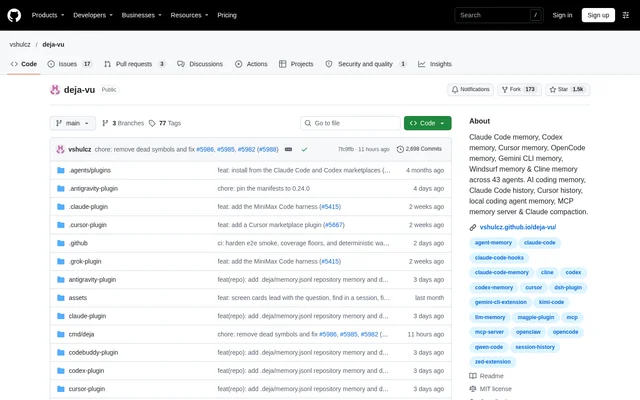
deja-vu is an open-source memory and session-history tool for developers using AI coding agents. The project indexes transcripts already saved on disk and makes relevant previous work available through local search, MCP and hooks. Supported agents include Claude Code, Codex, Cursor, OpenCode, Gemini CLI and Cline.
deja-vu runs as a Go binary and uses no LLM calls in its default workflow. Existing sessions provide the starting history rather than requiring developers to accumulate new memories after installation. The repository describes local indexing across 43 agents, with history available for both direct searches and automatic recall.
What deja-vu can do
deja-vu combines conversation search with records of code changes and decisions. Recall can surface earlier sessions when an agent starts, before a file edit or command, and after a command fails. Search results can also indicate that files touched by an earlier session have since changed.
- deja-vu searches session history by agent, time and project.
- deja-vu reopens sessions in their native agents or hands work to another agent.
- deja-vu tracks opened files, command exit codes and exact edit spans.
- deja-vu marks rejected approaches so later matches explain why they were dropped.
- deja-vu restores deleted chats that remain in its store.
- deja-vu exports sessions, recall audit records and promoted notes to a local HTML file.
- deja-vu adds selected decisions to repository memory for teammates.
How deja-vu works
deja-vu provides an installation script, package-manager options, agent plugins and standalone release binaries. The deja install --auto command connects detected agents to MCP recall and hooks and builds the initial index. A binary-only installation supports searching without agent integration; the separate installation command enables automatic recall.
deja-vu opens a terminal search interface when the deja command runs without arguments. Developers can select sessions, search within conversations, filter history and switch between project views. The deja view command produces a local HTML export, while deja brief provides a plain-text summary for users who do not want the terminal interface.
Who deja-vu is for
deja-vu serves developers working with AI coding agents and teams that want selected lessons to travel with a repository. Cross-agent history supports workflows where a fix discovered in Codex needs to be recalled in Claude Code, Cursor or OpenCode. Repository memory separates deliberately shared decisions from a developer's broader personal session history.
- Developers use deja-vu to find earlier fixes and implementation decisions.
- Developers use deja-vu to recover details omitted during conversation compaction.
- Teams use deja-vu to share selected decisions and dead ends after a repository clone.
- Developers use deja-vu to continue previous work in a different agent.
deja-vu licensing and access
deja-vu is an open-source project distributed under the MIT license, with source code available on GitHub. Access options include Homebrew, npm, Go installation, agent marketplaces and release binaries. Windows users can install through Scoop or winget, or place the released executable on their PATH. The repository also provides an npm command for trying the tool without a persistent installation.
deja-vu strengths and limitations
deja-vu combines local session indexing, automatic credential redaction and cross-agent recall without requiring a cloud account. The standalone binary can search history independently of agent integration. Repository sharing is selective: users choose entries, review the resulting file and commit it like code, rather than automatically publishing their entire session history.
- deja-vu requires alternative Windows installation methods because the shell script reports an unsupported operating system.
- deja-vu needs agent wiring to enable MCP recall and session-start hooks.
- deja-vu sends search queries to a configured endpoint when optional endpoint-based semantic search is enabled.
deja-vu FAQ
What is deja-vu?
deja-vu is an open-source local memory tool for AI coding agents. The project indexes saved sessions and returns relevant history through terminal search, MCP and hooks, helping developers recover earlier fixes, decisions and code-change context across supported agents.
Is deja-vu free and open source?
deja-vu is an open-source project available under the MIT license. The repository provides source code, release binaries, package-manager installation options and agent plugins. Default local indexing and search require no cloud account or LLM calls.
Which AI coding agents does deja-vu support?
deja-vu indexes history across 43 agents, including Claude Code, Codex, Cursor, OpenCode, Gemini CLI and OpenClaw. Agent capabilities differ: the setup guide describes supported integrations, and the automatic installer configures MCP recall and hooks for detected agents.
Does deja-vu keep coding history local?
deja-vu performs default indexing and search locally and strips credentials during indexing. Optional network functions include updates, SSH sync and configured embedding endpoints. When endpoint-based semantic search is enabled, searches send the query to that configured endpoint.
Can deja-vu share memory with a development team?
deja-vu can write selected decisions and rejected approaches to .deja/memory.jsonl in a repository. Users review and commit those entries like code. After a clone, wired agents can recall the shared entries, which are marked as repository content and treated as untrusted.
Does deja-vu work on Windows?
deja-vu supports Windows installation through Scoop, winget or a release ZIP containing the executable. The shell installation script does not support Windows. A binary-only setup supports searching, while agent wiring is optional and enables MCP recall.
From the community
No reviews yet
Be the first to review this tool. What you write helps the next person choose.