What is Floneum?
Floneum is a visual tool for building AI-powered language workflows with large language models. Floneum provides a drag-and-drop interface for assembling workflows and a plugin system for extending their capabilities. The tool serves people working on language tasks as well as developers who need custom workflow components.
Floneum combines language-oriented plugins with general workflow operations. The website lists text generation, structured text generation, embeddings, and search alongside file handling, browser interaction, conditional logic, and arithmetic. This combination gives workflow builders components for handling both language model tasks and the supporting operations around them.
What Floneum can do
Floneum includes 41 built-in plugins spanning language processing, information retrieval, browser actions, and data manipulation. The named plugins include Generate Text, Generate Structured Text, Embedding, Search Engine, Run Python, and Create Browser. Additional components cover logic, lists, numerical operations, and reading or writing files.
- Floneum generates text and structured text through built-in plugins.
- Floneum provides embedding and search components.
- Floneum reads files, writes files, and runs Python.
- Floneum navigates browsers and finds, clicks, or types into nodes.
- Floneum retrieves articles and reads RSS content.
- Floneum supports conditional logic, list manipulation, and arithmetic.
How Floneum works
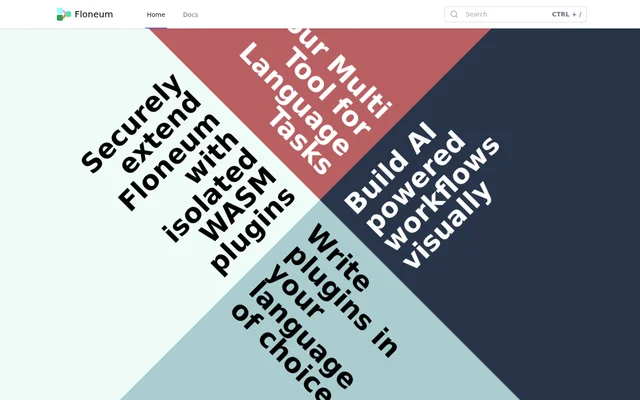
Floneum uses a drag-and-drop interface to build workflows that use large language models. Workflow functionality comes from built-in plugins and custom extensions. Floneum loads plugins through WebAssembly in a sandboxed environment, providing access only to the resources a plugin needs instead of granting full access to the system.
Floneum accepts custom plugins written in any language that can compile to WebAssembly. Floneum provides ergonomic wrappers for Rust, while the website also names C, Java, and Go as options. The website links to a guide and a Build Your First Plugin resource for learning about workflows and plugin development.
Who Floneum is for
Floneum suits people assembling language model workflows visually and developers extending those workflows with custom plugins. The built-in components cover tasks involving generated text, retrieved information, browser content, and local file operations. Developers can add functionality through a WebAssembly-compatible language rather than being limited to the supplied plugin collection.
- Floneum supports text-generation workflows using large language models.
- Floneum supports workflows involving search, embeddings, and retrieved articles.
- Floneum supports browser workflows involving navigation and page-node interaction.
- Floneum supports custom workflow extensions built as WebAssembly plugins.
Floneum strengths and plugin limitations
Floneum brings a visual workflow interface together with built-in language, browser, and data operations. Floneum also separates plugin execution from unrestricted system access through WebAssembly sandboxing. Language flexibility is another practical strength: developers can use Rust wrappers or another language that compiles to WebAssembly, including the C, Java, and Go options named on the website.
- Floneum custom plugins require a language that can compile to WebAssembly.
- Floneum gives plugins access only to the resources they need, not unrestricted system access.
- Floneum specifically provides ergonomic wrappers for Rust.
Floneum FAQ
What is Floneum?
Floneum is a visual workflow builder for language tasks that use large language models. Floneum combines a drag-and-drop interface with built-in plugins for text generation, embeddings, search, browser actions, file operations, and workflow logic.
What can you use Floneum for?
Floneum can build workflows involving generated text, structured text, embeddings, search, browser interaction, file handling, and Python execution. Floneum also includes plugins for article retrieval, RSS reading, conditional logic, list operations, and arithmetic.
How does Floneum isolate plugins?
Floneum loads plugins with WebAssembly in a sandboxed environment. Floneum gives each plugin access only to the resources needed for its work instead of providing full access to the system.
Which languages can you use to write Floneum plugins?
Floneum supports plugins written in any language that can compile to WebAssembly. Floneum provides ergonomic wrappers for Rust, and the website also names C, Java, and Go as languages developers can use.
Does Floneum include browser automation tools?
Floneum includes browser-related plugins for creating a browser, navigating, finding nodes and child nodes, clicking nodes, reading node text, and typing into nodes. Floneum also lists Get Article and Read Rss among its built-in plugins.
From the community
No reviews yet
Be the first to review this tool. What you write helps the next person choose.