What is hiring-agent?
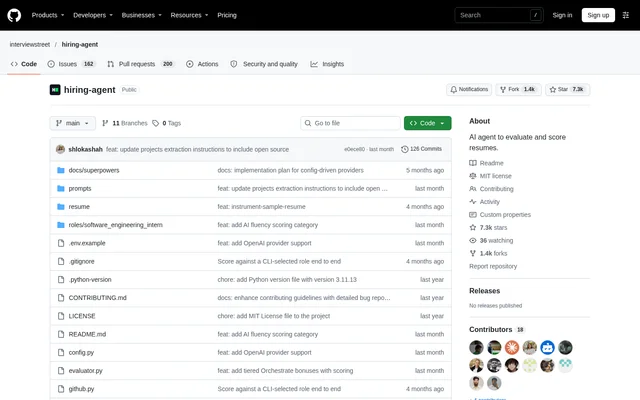
hiring-agent is an open-source resume evaluation project that turns candidate PDFs into structured data and role-specific scores. The project was built to rank intern applications so reviewers could decide which resumes to read first. The repository distinguishes this workflow from an applicant tracking system and states that the project is not a product available to HackerRank customers.
hiring-agent supports a review process in which most applications proceed to human assessment. The documentation describes a deliberately low filtering cutoff, with hiring decisions remaining part of human review. The repository also distinguishes its demonstration configuration from the configuration used for actual intern evaluations, including the choice of language model.
What hiring-agent can do
hiring-agent combines document extraction, GitHub enrichment, and configurable evaluation in a command-line pipeline. The shipped software engineering intern rubric considers open-source work, personal projects, production experience, technical skills, and AI fluency. Other roles can define different categories and weights, while evaluation reports include evidence, bonuses, and deductions.
- hiring-agent converts resume PDF pages into Markdown-like text.
- hiring-agent extracts basics, work, education, skills, projects, and awards into structured JSON.
- hiring-agent fetches GitHub profiles and repositories when a resume includes a GitHub profile.
- hiring-agent evaluates resumes against the selected role's rubric.
- hiring-agent prints readable reports and exports CSV results in development mode.
- hiring-agent scaffolds custom role directories with configuration and prompt templates.
How hiring-agent works
hiring-agent requires Python, installed dependencies, and an LLM backend. Setup involves cloning the GitHub repository, creating a virtual environment, installing the requirements, and copying the environment template. Users configure a model through environment variables and providers.json. Ollama supports local execution, while Gemini requires an API key.
hiring-agent accepts a resume PDF path and a required role argument through score.py. PDF extraction produces text, section-specific prompts assemble structured resume data, and GitHub enrichment adds repository information when available. The evaluator then applies the role's scoring rules. Development mode caches intermediate JSON and appends results to a role-specific CSV file.
Who hiring-agent is for
hiring-agent serves technical resume evaluation workflows, particularly the intern application prioritization described in the repository. The configurable source code also supports developers who want to inspect evaluation logic or adapt a rubric for another role. Customization involves editing role configuration files and prompt templates rather than using a hosted recruiting interface.
- hiring-agent helps reviewers prioritize intern applications for closer reading.
- hiring-agent supports developers creating role-specific evaluation categories.
- hiring-agent provides structured resume data and exported results for evaluation analysis.
hiring-agent pricing and access
hiring-agent is available as an open-source GitHub repository under the MIT license, rather than as a listed subscription service. The repository provides installation instructions and a local Ollama configuration. The default model runs without a cloud API key; hosted model configurations require the relevant provider credentials. No subscription plans or hosted-model pricing figures are stated.
hiring-agent strengths and limitations
hiring-agent makes its scoring logic inspectable and allows users to change evaluation categories, weights, and prompts. Local model support provides an alternative to cloud-backed execution, and reports connect scores with evidence. The documentation also acknowledges research and discussions about scoring reliability and rubric design, so the outputs should not be treated as deterministic measurements.
- hiring-agent scores can vary across repeated evaluations because of LLM non-determinism.
- hiring-agent can be affected by invisible text embedded in resume PDFs.
- hiring-agent's GitHub-centered rubric can disadvantage engineers with private enterprise work.
- hiring-agent requires technical setup and still relies on LLM interpretation of evidence.
hiring-agent FAQ
What is hiring-agent?
hiring-agent is an open-source AI agent that evaluates resume PDFs using role-specific rubrics. hiring-agent extracts structured candidate data, adds GitHub signals, and produces category scores with evidence, bonuses, and deductions to help prioritize resumes for human review.
Is hiring-agent free?
hiring-agent is available as an MIT-licensed open-source project on GitHub. The default Ollama model runs locally without a cloud API key. The repository does not list subscription plans, and hosted model configurations require the appropriate provider credentials.
Can hiring-agent run locally?
hiring-agent can run fully locally with Ollama, and the repository ships with gemma4:latest as the default model. Local setup requires Python, project dependencies, Ollama, and a downloaded model. The default configuration does not require a cloud API key.
Can hiring-agent evaluate resumes for custom roles?
hiring-agent supports custom roles with their own scoring categories, weights, criteria, and system prompts. The command-line role initialization option creates placeholder configuration and template files. Users then edit those files and select the role when scoring a resume.
Is hiring-agent an applicant tracking system?
hiring-agent is not an applicant tracking system, according to the repository. The project was built to prioritize intern resumes for human review. The documentation also states that hiring-agent is not used to screen HackerRank's open roles and is not a product available to HackerRank customers.
From the community
No reviews yet
Be the first to review this tool. What you write helps the next person choose.