What is InsForge?
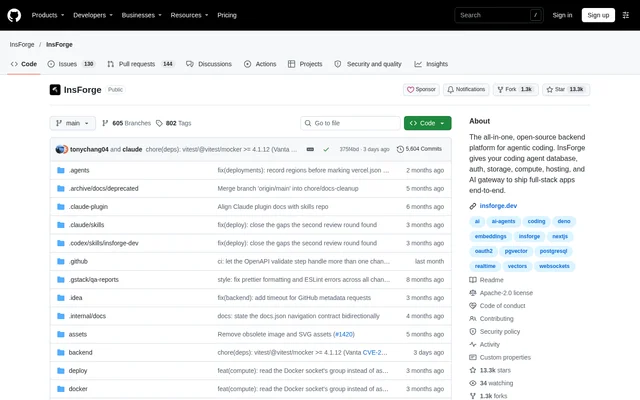
InsForge is an open-source backend platform for developers building full-stack applications with coding agents. InsForge brings database, authentication, storage, compute, hosting, and an AI gateway into a backend that agents can operate. The project is distributed through a public GitHub repository under the Apache-2.0 license.
InsForge provides agent interfaces for reading backend context and configuring resources. Agents can inspect documentation, schemas, deployed functions, storage contents, authentication configuration, and runtime logs. This access supports writing application code, checking backend changes, and investigating problems using information from the running backend.
What InsForge can do
InsForge combines application backend services with operations that coding agents can invoke. The core products cover relational data, user access, file storage, model access, serverless execution, and site deployment. Long-running container services are also listed, but the repository identifies that compute capability as a private preview.
- InsForge provides a Postgres relational database.
- InsForge manages users, authentication, and sessions.
- InsForge provides S3-compatible file storage.
- InsForge exposes an OpenAI-compatible API across multiple LLM providers.
- InsForge runs serverless code through edge functions.
- InsForge supports site builds and deployment.
- InsForge lets agents run migrations and configure backend resources.
How InsForge works
InsForge connects coding agents through an MCP server or a CLI paired with Skills. The MCP server supports both self-hosted and cloud deployments and exposes backend operations as tools for MCP-compatible agents. The CLI and Skills interface is cloud-only and lets agents invoke operations directly from a terminal.
InsForge self-hosting uses Docker Compose. The setup script fetches stack files and generates secrets, after which users edit environment settings and start the services. The quickstart then directs users to connect the MCP server and ask their agent to call the fetch-docs tool to verify the connection.
Who InsForge is for
InsForge is for developers who use coding agents to build and operate full-stack applications. The documented workflows cover creating backend resources, reviewing existing backend state, and debugging application behavior. InsForge also supports separate self-hosted project instances, each with its own containers, volumes, database, and secrets.
- InsForge supports agents building applications that need authentication, data, and file storage.
- InsForge supports backend debugging through schemas, metadata, and runtime logs.
- InsForge supports developers deploying edge functions and application sites.
- InsForge supports separate project instances with distinct configuration and ports.
InsForge pricing and access
InsForge is available as an open-source project licensed under Apache-2.0, with a Docker Compose path for self-hosting. Cloud-hosted access is available through insforge.dev, but the supplied repository text does not state InsForge cloud prices or plan allowances. The repository also lists Railway, Zeabur, Sealos, RepoCloud, and ZopDay as pre-configured deployment options.
InsForge strengths and limitations
InsForge combines backend services with agent access to both operational context and resource configuration. Cloud and self-hosted deployment options provide different access paths, while storage can use the local filesystem or an external S3-compatible provider. Self-hosted setup nevertheless involves configuration work, and some capabilities have explicit availability restrictions.
- InsForge limits CLI and Skills access to cloud deployments.
- InsForge lists long-running container compute as a private preview.
- InsForge requires Docker with Compose for the documented local self-hosting workflow.
- InsForge requires separate project names and ports to avoid shared containers or port collisions.
- InsForge storage overlays require production credentials to replace their shipped defaults.
InsForge FAQ
What is InsForge?
InsForge is an open-source backend platform for agentic coding. InsForge gives coding agents access to database, authentication, storage, compute, hosting, and an AI gateway so developers can build full-stack applications through agent-driven workflows.
Is InsForge free or open source?
InsForge is an open-source project licensed under Apache-2.0 and available for self-hosting through Docker Compose. InsForge also offers cloud-hosted access through insforge.dev, but the supplied repository text does not state cloud pricing or plan allowances.
How do coding agents connect to InsForge?
InsForge supports an MCP server for cloud and self-hosted deployments, plus a cloud-only CLI paired with Skills. InsForge exposes backend operations so compatible coding agents can inspect context, run migrations, deploy functions, create buckets, and configure authentication providers.
Can InsForge be self-hosted?
InsForge can be self-hosted using Docker Compose. InsForge provides a setup script that fetches stack files and generates secrets, followed by environment configuration, service startup, MCP server connection, and a verification prompt using the fetch-docs tool.
What storage providers does InsForge support?
InsForge stores files on the local filesystem by default and supports S3-compatible backing stores. InsForge documents bundled MinIO and RustFS options, plus external providers including AWS S3, Wasabi, R2, Tencent COS, and Aliyun OSS.
Does InsForge have an API for AI models?
InsForge includes a Model Gateway with an OpenAI-compatible API across multiple LLM providers. InsForge lists this gateway alongside database, authentication, storage, edge functions, compute, and site deployment as part of its backend services.
From the community
No reviews yet
Be the first to review this tool. What you write helps the next person choose.