What is Microsoft Cognitive Toolkit?
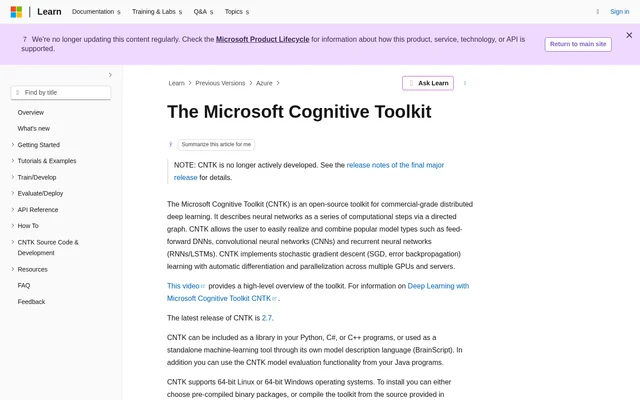
Microsoft Cognitive Toolkit is an open-source framework for building and training neural networks, with support for distributed training across GPUs and servers. Developers can include the toolkit in an application or use it as a standalone machine-learning tool. The toolkit represents each neural network as a directed graph, where the graph describes the computational steps the model performs.
What Microsoft Cognitive Toolkit can do
Microsoft Cognitive Toolkit supports feed-forward, convolutional, and recurrent neural networks, including LSTMs. Developers can use these architectures independently or combine them in a model. The toolkit implements stochastic gradient descent with backpropagation and automatic differentiation, and it can parallelize training across multiple GPUs and servers.
- The toolkit represents neural networks as directed graphs.
- The toolkit combines feed-forward, convolutional, and recurrent networks.
- The toolkit uses automatic differentiation during training.
- The toolkit parallelizes training across GPUs and servers.
- The toolkit supports model exchange through ONNX.
How Microsoft Cognitive Toolkit works
Microsoft Cognitive Toolkit can be added as a library to Python, C#, or C++ programs. For standalone use, developers describe models in BrainScript, the toolkit's model description language. Java programs can use the toolkit's model evaluation functionality. The latest release supports ONNX v1.0, a shared model format that allows developers to move models between frameworks such as CNTK, Caffe2, MXNet, and PyTorch.
Who Microsoft Cognitive Toolkit is for
Microsoft Cognitive Toolkit is for developers who need to define, train, or evaluate neural networks. The library option fits projects that incorporate deep learning into Python, C#, or C++ code, while the standalone option lets developers describe models in BrainScript. Developers working in Java can use the model evaluation functionality from their own programs.
- Build a model that combines convolutional and recurrent networks.
- Distribute training across multiple GPUs or servers.
- Evaluate a model from a Java program.
- Move a model between frameworks using ONNX.
Microsoft Cognitive Toolkit pricing and plans
Microsoft Cognitive Toolkit is distributed as open-source software, with no paid plans described on the documentation page. The toolkit is available through precompiled binary packages or as source code on GitHub for developers who want to compile it. The GitHub license covers 1-bit stochastic gradient descent, so that feature no longer requires a separate license.
Microsoft Cognitive Toolkit strengths and limitations
Microsoft Cognitive Toolkit supports multiple neural network architectures, can distribute training across GPUs and servers, and offers model portability through ONNX. Its integration options differ by language: Python, C#, and C++ can use the toolkit as a library, while the documentation describes Java support for model evaluation. The latest release listed is 2.7, and active development has ended.
- The toolkit is no longer actively developed.
- Operating system support is limited to 64-bit Linux and Windows.
- The documented Java functionality covers model evaluation.
Getting started with Microsoft Cognitive Toolkit
Microsoft Cognitive Toolkit can be installed on 64-bit Linux or Windows using a precompiled binary package or by compiling the source code from GitHub. Developers can choose the library for a Python, C#, or C++ project, or use BrainScript to describe a standalone model. The documentation points to the final major release notes for details about the end of active development.
Microsoft Cognitive Toolkit FAQ
What is Microsoft Cognitive Toolkit?
Microsoft Cognitive Toolkit is an open-source toolkit for distributed deep learning. It describes neural networks as directed graphs and supports feed-forward, convolutional, and recurrent networks, including LSTMs. Training can run in parallel across multiple GPUs and servers.
Is Microsoft Cognitive Toolkit free?
Microsoft Cognitive Toolkit is available as open-source software, with precompiled binaries and source code on GitHub. The documentation does not list paid plans, and the GitHub license covers 1-bit stochastic gradient descent without a separate license.
Which programming languages does Microsoft Cognitive Toolkit support?
Microsoft Cognitive Toolkit can be included as a library in Python, C#, and C++ programs. Java programs can use its model evaluation functionality, and BrainScript is the toolkit's own model description language for standalone use.
Can Microsoft Cognitive Toolkit exchange models with other frameworks?
Microsoft Cognitive Toolkit supports model exchange through ONNX, a shared model representation for interoperability. The latest release supports ONNX v1.0, and the documentation names Caffe2, MXNet, and PyTorch as examples of frameworks that can exchange models through ONNX.
Is Microsoft Cognitive Toolkit still maintained?
Microsoft Cognitive Toolkit is no longer actively developed. The documentation identifies 2.7 as the latest release and points to the release notes for the final major release for details.
From the community
No reviews yet
Be the first to review this tool. What you write helps the next person choose.