What is NeutronField?
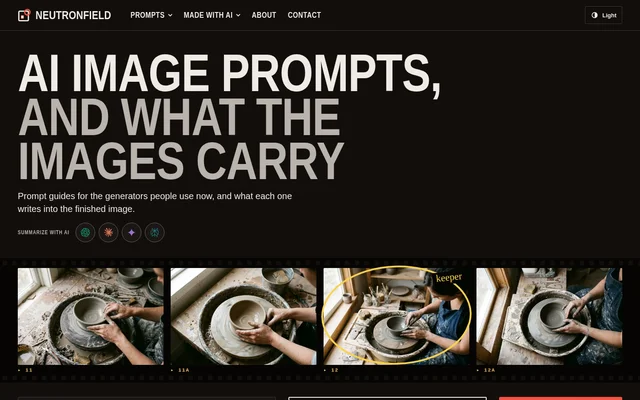
NeutronField is an educational website about writing AI image prompts and understanding the records embedded in generated files. NeutronField combines generator-specific prompting advice with explanations of credentials, watermarks, metadata and saved prompts. The material addresses people making AI images as well as readers evaluating what a generated file can actually establish about its origin.
NeutronField states that the address previously belonged to a prompt marketplace, which closed in 2024. The current page instead presents guides, comparisons and documented examples. NeutronField says its authors run every published prompt and inspect the generated files behind claims about file contents, checking those findings against the relevant vendor documentation.
What NeutronField can do
NeutronField provides reference material rather than presenting the current website as an image generator or prompt marketplace. The guides connect creative choices, such as camera and lighting language, with technical questions about finished files. NeutronField also covers the practical consequences of sharing or selling AI-generated work, including declarations, edits to photographs and the use of real people in prompts.
- NeutronField provides prompt guides for ChatGPT images and Gemini and Nano Banana.
- NeutronField covers Stable Diffusion, Flux, Kling and video models.
- NeutronField explains content credentials, invisible watermarks, metadata fields and saved prompts.
- NeutronField compares file labelling records from the OpenAI image API and Gemini API.
- NeutronField provides guides to photorealistic prompts, art styles and image model behaviour.
- NeutronField explains prompt logs and AI image selling disclosures.
How NeutronField's guides and file checks work
NeutronField organises the website around choosing a generator and reading the relevant prompt guide or file record. Readers can also browse explanations of the records a generated file may contain. The example on the page includes a copyable prompt, the model used, generation settings and a dated inspection of the file returned by the API.
NeutronField separates direct observations from information attributed to vendors. In the Gemini example, the page reports a Google-signed credential recording an imperceptible SynthID watermark, but explicitly says the authors cannot run Google's detector themselves. NeutronField also distinguishes the original API file from the WebP copies displayed on the website, which do not carry those records.
Who NeutronField is for
NeutronField serves readers who want practical prompting guidance alongside a clearer account of image provenance. Image creators can explore style and photographic language, while sellers can read about declarations requested by stock sites and shops. Readers handling AI-edited photographs or prompts involving real people can find related discussions of generative fill, likeness, consent and platform rules.
- Image creators can study generator-specific prompt approaches.
- Image sellers can review guidance on marketplace declarations.
- Readers assessing provenance can compare the meaning and limits of file signals.
- Creators can learn to record jobs in a prompt log for repetition and documentation.
NeutronField strengths and limitations
NeutronField's documented method links prompt examples to named models and dates, and links file claims to files the authors generated and read. NeutronField also explains why missing labels do not establish that an image is human-made. This distinction makes the material relevant to readers who need to separate recorded evidence from assumptions about authorship or generation.
- NeutronField cannot independently verify SynthID with Google's detector.
- NeutronField's displayed WebP copies do not preserve the demonstrated file records.
- NeutronField explains that credentials lose their evidential value when removed from a file.
- NeutronField notes that saved prompts cannot prove that those words alone produced an exact image.
NeutronField FAQ
What is NeutronField?
NeutronField is a website offering AI image prompt guides and explanations of generated-file records. NeutronField covers content credentials, invisible watermarks, metadata and saved prompts, alongside creative prompting techniques and guidance about sharing or selling AI images.
Which image generators does NeutronField cover?
NeutronField lists guidance for ChatGPT images, Gemini and Nano Banana, Stable Diffusion, Flux, Kling and video models. NeutronField also presents a file-record comparison covering the OpenAI image API and the Gemini API.
Does NeutronField test its prompts and file claims?
NeutronField states that its authors run every prompt shown, identify the model and date, and inspect generated files themselves. NeutronField says claims about what generators write into files are also checked against vendor documentation.
Can NeutronField explain whether an image has AI labels?
NeutronField explains the signals a generated file can contain and publishes records from files its authors inspected. NeutronField distinguishes credentials, watermarks, metadata and saved prompts, while warning that a missing label does not mean an image is human-made.
Is NeutronField still a prompt marketplace?
NeutronField states that the prompt marketplace formerly at the address closed in 2024. NeutronField now presents prompt guides, generated-file comparisons and articles about image labelling, selling AI images, consent and prompt logging.
From the community
No reviews yet
Be the first to review this tool. What you write helps the next person choose.