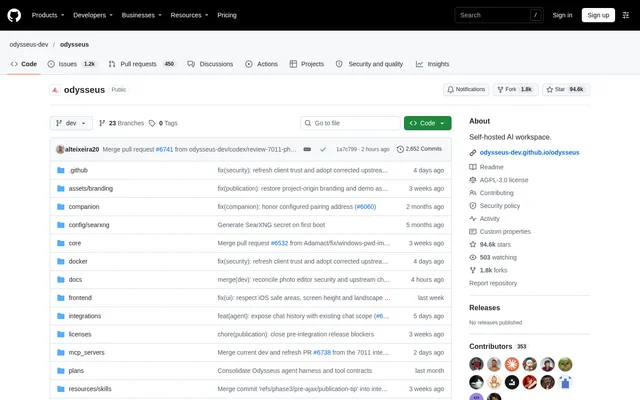
What is Odysseus?
Odysseus is an open-source, self-hosted AI workspace for chat, agents, research, documents, email, notes, calendars, and local model workflows. Odysseus brings these functions into a shared environment for people who want to run AI-assisted work on infrastructure they manage. The public repository provides the code, setup instructions, contribution guidance, and security documentation.
Odysseus supports both local models and API models rather than restricting workflows to one model source. Odysseus also includes a model cookbook for hardware-aware recommendations, downloads, and serving. This makes model selection and operation part of the workspace alongside writing, research, communication, and task management.
What Odysseus can do
Odysseus combines conversational AI with tools for research and everyday work. Odysseus agents can use tools, MCP, files, shell access, skills, and memory, while dedicated workspace features cover documents, email, and scheduling. Additional capabilities include uploads, web search, presets, sessions, themes, and a gallery with an image editor.
- Odysseus conducts multi-step web research with source reading and report generation.
- Odysseus compares models through blind side-by-side testing and synthesis.
- Odysseus edits documents with AI suggestions, Markdown, HTML, CSV, and syntax highlighting.
- Odysseus manages IMAP/SMTP email with triage, tags, summaries, reminders, and reply drafts.
- Odysseus supports notes, todos, reminders, scheduled agent tasks, and CalDAV sync.
- Odysseus recommends models based on hardware and supports downloads and serving.
How Odysseus works
Odysseus provides a Docker Compose quick start: clone the repository, enter the project directory, copy the example environment file, and start the containers. Odysseus becomes accessible at the documented localhost address once the containers are healthy. The initial administrator password appears in the service logs.
Odysseus Compose files pull an official multi-architecture image and build locally only if the pull fails. This supports hosts without a build toolchain, including deployment as a Portainer stack. Odysseus setup documentation also covers native installs, GPU considerations, Windows/macOS instructions, HTTPS, and configuration.
Who Odysseus is for
Odysseus suits people who want a self-hosted environment for AI-assisted research, writing, communication, and scheduling. Odysseus also supports users exploring local models or comparing model outputs. The combination of shell access, model serving, and deployment configuration makes the project relevant to users prepared to manage technical setup.
- Odysseus supports researchers reading web sources and producing reports.
- Odysseus supports writers drafting and revising documents with AI assistance.
- Odysseus supports users organizing email, reminders, tasks, and calendars.
- Odysseus supports model users evaluating responses through blind comparisons.
Odysseus pricing and access
Odysseus is available as an open-source project under the AGPL-3.0-or-later license and is obtained through its public repository. The product documentation describes self-hosted installation rather than subscription plans. Odysseus provides a quick start and a setup guide for deployment; the supplied product text does not specify paid Odysseus tiers.
Odysseus strengths and limitations
Odysseus combines local/API model support with research, document editing, email, and scheduling in one self-hosted workspace. Odysseus offers an official container image and documented alternative installation paths. These capabilities come with deployment responsibilities: the security guidance emphasizes authentication, private-data handling, and restrictions on publicly exposing model or service ports.
- Odysseus requires installation and configuration on user-managed infrastructure.
- Odysseus requires authentication for network-accessible deployments.
- Odysseus advises keeping localhost authentication bypass disabled outside local development.
- Odysseus recommends immutable image tags for production because latest and bare version tags move.
Odysseus FAQ
What is Odysseus?
Odysseus is an open-source, self-hosted AI workspace for chat, agents, research, documents, email, notes, calendars, and local model workflows. Odysseus supports local and API models and includes tools for model comparison, document editing, and scheduled agent tasks.
How is Odysseus licensed and accessed?
Odysseus is distributed as an open-source project under the AGPL-3.0-or-later license through its public repository. Odysseus provides self-hosted installation instructions, including a Docker Compose quick start and setup guidance for native installations.
Does Odysseus support local models and MCP?
Odysseus supports local models, API models, and MCP within its chat and agent features. Odysseus also provides tools, files, shell access, skills, and memory, plus hardware-aware model recommendations, downloads, and serving through its cookbook.
Can Odysseus manage email and calendars?
Odysseus includes an IMAP/SMTP inbox with triage, tags, summaries, reminders, and reply drafts. Odysseus also provides notes, tasks, calendar features, todos, scheduled agent tasks, and CalDAV synchronization for scheduling workflows.
How do you install Odysseus?
Odysseus provides a Docker Compose quick start that involves cloning the repository, copying the example environment file, and starting the containers. Odysseus setup documentation also covers native installations, Windows/macOS instructions, GPU notes, HTTPS, and configuration.
What security precautions does Odysseus require?
Odysseus advises keeping authentication enabled, keeping private data out of Git, and avoiding public exposure of raw model or service ports. Odysseus requires authentication for network-accessible deployments and advises disabling localhost bypass outside local development.
From the community
No reviews yet
Be the first to review this tool. What you write helps the next person choose.