What is PageIndex?
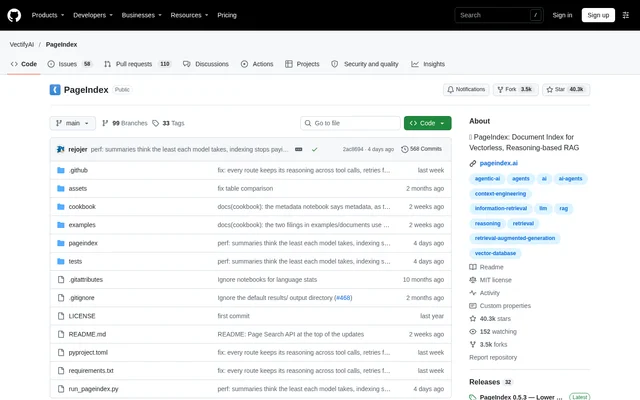
PageIndex is an open-source document retrieval engine that replaces vector indexes with hierarchical tree indexes. PageIndex uses LLM reasoning to navigate document structure and locate relevant information, rather than retrieving passages through semantic similarity. The project is designed for long professional documents where contextual understanding, domain knowledge, and multi-step reasoning matter.
PageIndex describes retrieval as a process of building a document index and then searching that index agentically. PageIndex makes retrieval traceable to explicit references and can incorporate context such as conversation history and domain knowledge. The repository distributes the project under the MIT license.
What PageIndex can do
PageIndex supports document indexing, retrieval, and question answering through a Python SDK. PageIndex separates local text-based PDF workflows from managed cloud capabilities for scanned and image-rich documents. The SDK also exposes streaming, multi-document search, and citations, while agent tools let developers add document retrieval to existing agent frameworks.
- PageIndex generates hierarchical tree indexes without vector databases or chunking.
- PageIndex uses LLM reasoning to search document trees.
- PageIndex supports document chat, streaming, and multi-document search.
- PageIndex provides page-level citations locally and block-level citations in the cloud.
- PageIndex Cloud handles OCR, image understanding, and managed storage.
- PageIndex integrates with the OpenAI Agents SDK and Claude Agent SDK.
How PageIndex works
PageIndex starts with installation of the pageindex Python package and configuration of a PageIndexClient. Developers select models for indexing and chat, submit a document, and ask questions using the returned document identifier. PageIndex extracts the tree structure from document layout without an LLM; the indexing model summarizes and refines that structure.
PageIndex local mode runs indexing on the user's machine and stores results in a local directory. PageIndex Cloud moves indexing and storage to managed infrastructure through a PageIndex API key, while retrieval remains compatible with the application's model provider. Claude subscribers can also connect supported Claude models through Claude Code without an API key.
Who PageIndex is for
PageIndex serves developers building document-aware applications and professionals investigating long, complex source material. PageIndex explicitly identifies financial reports, legal documents, regulatory filings, technical manuals, medical literature, and academic textbooks as suitable inputs. The agent integrations also support applications that need document retrieval within a broader reasoning workflow.
- PageIndex can answer questions about financial reports and regulatory filings.
- PageIndex can retrieve relevant sections from legal documents and technical manuals.
- PageIndex can support research across medical literature and academic textbooks.
- PageIndex can supply document retrieval tools to AI agents.
PageIndex pricing and access
PageIndex is available as an MIT-licensed open-source project, with a Python package for local use. PageIndex local workflows use the user's model access, and the repository discusses model-dependent indexing and query costs. PageIndex Cloud requires a PageIndex API key. Dedicated VPC or on-premises deployment is available through contact with the provider.
PageIndex strengths and limitations
PageIndex combines reasoning-based retrieval with explicit document references and offers a choice between local and managed indexing. PageIndex local mode suits text-heavy PDFs, while the cloud service extends document handling to scanned and image-rich material. Model selection remains relevant: the repository recommends a basic indexing model and a stronger chat model for retrieval.
- PageIndex local mode is limited to text-based PDFs.
- PageIndex Cloud is required for OCR, image understanding, and block-level citations.
- PageIndex File System is available only in the cloud.
- PageIndex requires configured model access for local document workflows.
PageIndex FAQ
What is PageIndex?
PageIndex is an open-source, vectorless RAG engine that builds hierarchical document indexes and uses LLM reasoning to retrieve information. PageIndex is designed for long, complex professional documents and does not require vector databases or chunking.
Is PageIndex free?
PageIndex is available as MIT-licensed open-source software. PageIndex local workflows use configured model access, and model usage can incur indexing and query costs. PageIndex Cloud requires a PageIndex API key; the supplied repository text does not specify cloud subscription prices.
Can PageIndex run locally?
PageIndex supports local indexing, retrieval, and chat through its Python SDK. PageIndex local mode handles text-based PDFs, stores indexes in a local directory, and provides page-level citations. Model access uses an API key or supported Claude models through Claude Code.
What is the difference between PageIndex local mode and PageIndex Cloud?
PageIndex local mode handles text-based PDFs with local indexing and storage. PageIndex Cloud adds managed parsing, OCR, image understanding, cloud storage, block-level citations, metadata, folders, and an MCP server. Cloud-hosted retrieval remains compatible with the application's model provider.
Who is PageIndex for?
PageIndex is for developers and professionals working with long, complex documents. PageIndex identifies financial reports, legal documents, regulatory filings, technical manuals, medical literature, and academic textbooks as suitable material for reasoning-based retrieval and document question answering.
Does PageIndex integrate with AI agent frameworks?
PageIndex provides tools that developers can integrate into the OpenAI Agents SDK, Claude Agent SDK, or other agent frameworks. PageIndex also offers SDK configuration for models, streaming, multi-document search, and citations, while PageIndex Cloud includes an MCP server.
From the community
No reviews yet
Be the first to review this tool. What you write helps the next person choose.