What is pentagi?
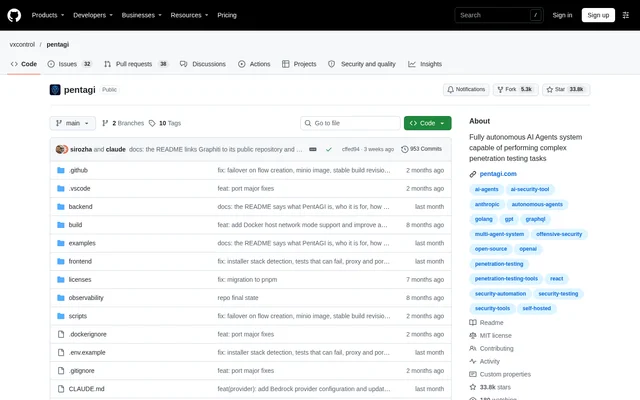
pentagi is an open-source autonomous AI agent system designed to perform complex penetration testing tasks. The public project is hosted in the vxcontrol/pentagi GitHub repository and lists an MIT license. Its stated focus is security testing, with repository topics covering offensive security, security automation and autonomous agents.
pentagi is presented as a multi-agent system rather than a general-purpose writing or coding assistant. The repository also identifies the project as self-hosted. These details position pentagi as a project for security practitioners exploring autonomous testing, while the supplied excerpt does not describe individual testing techniques or demonstrate specific results.
What pentagi can do
pentagi states that its fully autonomous AI agents can perform complex penetration testing tasks. The repository topics add context about the project's multi-agent architecture and security automation focus. The supplied text establishes that broad purpose, but does not enumerate supported scanners, testing targets, reporting formats or individual assessment workflows.
- pentagi performs complex penetration testing tasks using autonomous AI agents.
- pentagi uses a multi-agent system for its security-testing focus.
- pentagi supports self-hosted deployment.
- pentagi makes its source code available under the MIT license.
How pentagi is distributed and structured
pentagi is distributed through a public GitHub repository containing backend and frontend directories, examples and scripts. Deployment-related files include a Dockerfile, an environment example and Docker Compose configurations. These are concrete repository resources; the supplied page does not provide installation commands or a complete deployment procedure.
pentagi also includes configuration files named for Graphiti, Langfuse and observability. The repository topics reference Go, React, GraphQL, OpenAI and Anthropic. Those names appear in the project listing, but the excerpt does not explain their configuration, supported models or how each component participates in a running deployment.
Who pentagi is for
pentagi is relevant to penetration testers and security practitioners evaluating autonomous agents for security work. Its stated purpose centers on complex penetration testing rather than general productivity tasks. The self-hosted designation and public code also make the project relevant to technical teams that want to inspect an agent-based security system.
- Penetration testers can evaluate pentagi for complex testing tasks.
- Security teams can examine pentagi as a security automation project.
- Developers can inspect pentagi's backend, frontend and examples.
pentagi licensing and access
pentagi is an open-source project available from GitHub under the MIT license. The supplied project text does not state subscription plans, product-specific charges or hosted service pricing. The accompanying pricing page describes GitHub products, so those plans and figures do not establish a pricing model for pentagi.
pentagi strengths and documentation limits
pentagi combines a clearly stated penetration-testing purpose with public source access, an MIT license and a self-hosted designation. The repository includes examples and deployment-related files for technical inspection. However, the supplied excerpt is primarily a repository listing: pentagi's detailed workflow, setup requirements and supported testing scope are not documented in the provided text.
pentagi FAQ
What is pentagi?
pentagi is an open-source AI agent system described as fully autonomous and capable of performing complex penetration testing tasks. The public GitHub repository identifies pentagi with multi-agent systems, offensive security and security automation.
Is pentagi free?
pentagi is available as an open-source project under the MIT license through its public GitHub repository. The supplied text does not state pentagi subscription prices or describe the costs of operating a deployment.
Can pentagi be self-hosted?
pentagi is identified as self-hosted in its repository topics. The repository includes a Dockerfile, Docker Compose configuration files and an environment example, although the supplied excerpt does not provide installation commands or detailed deployment requirements.
Who is pentagi for?
pentagi is relevant to penetration testers and security practitioners exploring autonomous security testing. Its stated purpose is performing complex penetration testing tasks, and its repository topics include offensive security, security testing and security automation.
What license does pentagi use?
pentagi uses the MIT license, as listed in the public GitHub repository. The repository also includes LICENSE, NOTICE and EULA.md files, though the supplied excerpt does not reproduce their contents.
From the community
No reviews yet
Be the first to review this tool. What you write helps the next person choose.