What is RAGFlow?
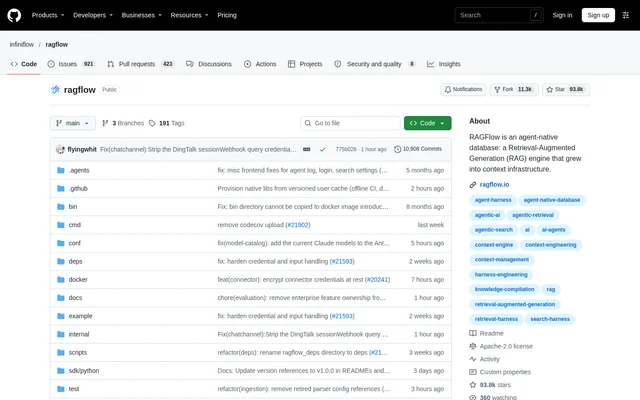
RAGFlow is an open-source Retrieval-Augmented Generation engine that combines RAG workflows with agent capabilities to provide context for LLMs. The repository also describes RAGFlow as an agent-native database. RAGFlow serves developers transforming complex data into AI systems and supports workflows for personal use and businesses.
RAGFlow centers on extracting knowledge from unstructured documents, organizing that knowledge, and retrieving evidence for generated answers. A converged context engine and pre-built agent templates support these workflows. The project is distributed under the Apache-2.0 license and offers both local deployment instructions and access to a cloud service.
What RAGFlow can do
RAGFlow combines document processing, knowledge organization, and retrieval in a configurable workflow. Supported content includes office documents, PDFs, scanned copies, images, structured data, and web pages. RAGFlow also provides APIs for business integration and lets users configure language models and embedding models.
- RAGFlow extracts knowledge from unstructured data with complex document formats.
- RAGFlow provides template-based chunking with visual inspection and human intervention.
- RAGFlow compiles documents and datasets into Wikis, Graphs, Trees, PageIndex, Mind Maps, Timelines, and Skills.
- RAGFlow performs multi-step retrieval that analyzes questions, retrieves knowledge, and verifies evidence.
- RAGFlow offers Low, Medium, High, and Ultra thinking modes for retrieval and reasoning depth.
- RAGFlow displays key references and traceable citations.
- RAGFlow ingests website content through sitemaps and supports Google BigQuery incremental synchronization.
How RAGFlow works
RAGFlow supports Docker deployment for evaluation, integration testing, and production, while launching from source is intended for development and debugging. The documented Docker workflow involves cloning the repository, checking out a release tag, starting services with Docker Compose, and checking readiness through an HTTP health endpoint.
RAGFlow users open the Web UI after the services are ready and sign in through the server address. The model provider page accepts an LLM, embedding model, and reranker, including model names, service addresses, and API keys. Docker configuration files control settings such as ports, passwords, and the document engine.
Who RAGFlow is for
RAGFlow is aimed at developers building AI systems from complex data, with orchestration described for personal users and large businesses. RAGFlow's document processing and evidence-oriented retrieval support workflows that need answers grounded in source material. Knowledge Compilation also supports organizing and reusing content at document and dataset levels.
- Developers can use RAGFlow to build document-grounded AI workflows with configurable models.
- Businesses can use RAGFlow APIs to integrate retrieval workflows into business systems.
- Teams can use RAGFlow to generate structured knowledge artifacts from documents and datasets.
- Users can use RAGFlow to investigate complex questions through repeated retrieval and evidence verification.
RAGFlow pricing and access
RAGFlow is available as an open-source project under the Apache-2.0 license, with source code and deployment instructions in its repository. RAGFlow also links to a cloud service. The supplied page does not list cloud subscription prices or paid plan details, so cloud access should be distinguished from the open-source deployment option.
RAGFlow strengths and limitations
RAGFlow combines broad document-format support with visible text chunks, reference previews, and traceable citations. Configurable models and local deployment give developers control over the retrieval workflow. Operational requirements remain important: local deployment needs infrastructure and model configuration, while source development adds compiler, native-library, and optional frontend tooling requirements.
- RAGFlow recommends a starting configuration of 4 CPU cores, 16 GB RAM, and 50 GB of available disk space.
- RAGFlow resource needs vary with the document engine, data volume, parsing workload, and concurrency.
- RAGFlow local models and optional components may require additional resources.
- RAGFlow source builds require Go, Clang, LLD, CMake, and PCRE2 development files.
- RAGFlow's Docker platform support guidance states that macOS is not currently supported.
RAGFlow FAQ
What is RAGFlow?
RAGFlow is an open-source Retrieval-Augmented Generation engine that combines document understanding, agent capabilities, and context infrastructure for LLMs. RAGFlow helps developers turn complex data into AI systems through knowledge extraction, structured knowledge compilation, multi-step retrieval, and traceable citations.
Is RAGFlow free?
RAGFlow is available as an open-source project under the Apache-2.0 license, with source code and local deployment instructions provided in the repository. RAGFlow also offers a cloud service, but the supplied page does not state cloud pricing or subscription plans.
What file types does RAGFlow support?
RAGFlow supports Word documents, PowerPoint presentations, Excel spreadsheets, TXT files, images, PDFs, scanned copies, structured data, and web pages. RAGFlow also supports website ingestion through sitemaps and Google BigQuery data ingestion with incremental synchronization.
Can RAGFlow be self-hosted?
RAGFlow supports local deployment through Docker or by launching from source. Docker is documented for evaluation, integration testing, and production deployment, while source-based operation is intended for development and debugging. Local setup includes configuring services and adding model-provider details.
How does RAGFlow handle complex questions?
RAGFlow uses agentic retrieval to analyze questions, break them down when needed, retrieve knowledge, and verify evidence. Multiple rounds of retrieval and reasoning gather context for answers. RAGFlow provides Low, Medium, High, and Ultra thinking modes to control retrieval and reasoning depth.
Does RAGFlow have APIs and data integrations?
RAGFlow provides APIs for integration with business systems and supports configurable LLMs and embedding models. RAGFlow also documents Google BigQuery ingestion with incremental synchronization and website content ingestion through sitemaps, alongside support for documents, structured data, and web pages.
From the community
No reviews yet
Be the first to review this tool. What you write helps the next person choose.