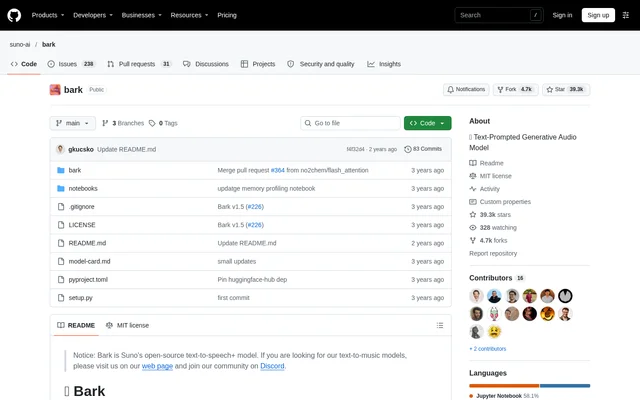
What is Suno AI Bark?
Suno AI Bark is an open-source generative audio model created by Suno for research and demonstration purposes. Suno AI Bark converts text prompts into multilingual speech and other audio, including music, background noise and simple sound effects. The repository provides pretrained model checkpoints that are ready for inference and available for commercial use.
Suno AI Bark differs from conventional text-to-speech systems because text is converted directly into audio without an intermediate phoneme representation. The model uses a GPT-style architecture and a quantized audio representation from EnCodec. This generative approach supports sounds beyond speech but can also produce unexpected departures from a supplied script.
What Suno AI Bark can do
Suno AI Bark accepts text describing speech and other sounds, with prompt conventions for laughter, music, hesitation and emphasis. Suno AI Bark automatically determines language from input text and attempts native accents when languages are mixed. The repository states that English quality is stronger than other supported languages.
- Suno AI Bark generates multilingual speech from text prompts.
- Suno AI Bark produces music, background noise and simple sound effects.
- Suno AI Bark generates nonverbal sounds such as laughter, sighs and crying.
- Suno AI Bark offers 100+ speaker presets across supported languages.
- Suno AI Bark attempts to match a preset's tone, pitch, emotion and prosody.
- Suno AI Bark provides notebooks for long-form generation and voice consistency.
How Suno AI Bark works
Suno AI Bark can be installed directly from the GitHub repository or from a cloned copy of the project. The repository explicitly warns against installing the unrelated package named bark through the standard package command. Python examples show downloading and loading the models, passing text to the generation function, and saving or playing the resulting audio.
Suno AI Bark also supports command-line generation and inference through Hugging Face Transformers. Notebook playback and WAV export are demonstrated in the documentation. Suno AI Bark runs on CPU and GPU hardware, while smaller models and CPU offloading offer alternatives for limited GPU memory. Older hardware can make inference significantly slower.
Who Suno AI Bark is for
Suno AI Bark is intended for the research community and supports developers experimenting with generative audio through code. The repository's Python examples, command-line workflow and notebooks suit technical exploration of speech and non-speech generation. Commercial use is permitted, although the research disclaimer and variable outputs remain important considerations when evaluating a use case.
- Researchers can explore text-prompted speech and non-speech generation.
- Developers can generate multilingual audio using Python or Transformers.
- Audio experimenters can test speaker presets and expressive sound prompts.
Suno AI Bark pricing and access
Suno AI Bark is available as an open-source project under the MIT License, with pretrained checkpoints provided for inference and commercial use. The repository does not list paid model plans or usage charges. Suno AI Bark downloads and caches models through Hugging Face, and the documentation also links to early access for a model playground.
Suno AI Bark strengths and limitations
Suno AI Bark combines multilingual speech, nonverbal expression and other audio generation within a single text-prompted model. Open-source access, commercial-use permission and several code-based workflows make experimentation possible across different hardware setups. Suno AI Bark is nevertheless a generative research model rather than a system designed to reproduce every script exactly or guarantee studio-quality speech.
- Suno AI Bark can generate unexpected content that differs from the prompt.
- Suno AI Bark does not currently support custom voice cloning.
- Suno AI Bark works best with around 13 seconds of spoken text per default generation.
- Suno AI Bark requires notebook-based techniques for longer audio generation.
- Suno AI Bark offers smaller models with slightly lower output quality.
Suno AI Bark FAQ
What is Suno AI Bark?
Suno AI Bark is an open-source, transformer-based text-to-audio model created by Suno. Suno AI Bark generates multilingual speech, music, background noise, simple sound effects and nonverbal sounds, with pretrained checkpoints provided for research and inference.
Is Suno AI Bark free for commercial use?
Suno AI Bark is available under the MIT License, and the repository explicitly permits commercial use of the pretrained model checkpoints. Suno AI Bark is distributed as an open-source project rather than through listed paid model plans.
Does Suno AI Bark support voice cloning?
Suno AI Bark does not currently support custom voice cloning. Suno AI Bark instead offers 100+ speaker presets across supported languages and can generate random voices that fit the input text, while attempting to match preset tone, pitch, emotion and prosody.
Can Suno AI Bark run locally on a CPU or GPU?
Suno AI Bark runs on both CPU and GPU hardware. Suno AI Bark requires around 12GB of VRAM to hold the full model on GPU simultaneously, while smaller models and CPU offloading support lower-memory configurations with performance and quality trade-offs.
How long can Suno AI Bark generate audio?
Suno AI Bark works well with around 13 seconds of spoken text using the default generation function. Suno AI Bark has an architecture and context window optimized for short outputs, and the repository links to notebooks demonstrating long-form generation.
How do you use Suno AI Bark with Hugging Face Transformers?
Suno AI Bark is supported in Hugging Face Transformers from version 4.31.0 onwards. Suno AI Bark documentation demonstrates loading a processor and model, supplying text and a voice preset, generating audio, and playing the result in a notebook or saving a WAV file.
From the community
No reviews yet
Be the first to review this tool. What you write helps the next person choose.