What is Tabirim?
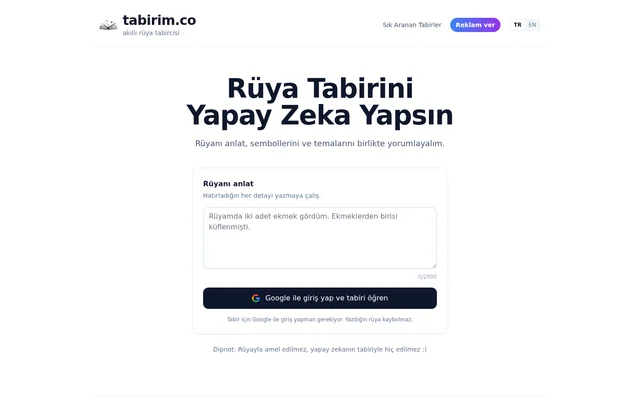
Tabirim is an AI dream interpretation tool that asks users to describe a dream so its symbols and themes can be interpreted. The Turkish-language page presents a direct text-entry experience for people who remember a dream and want an AI-generated interpretation of what they have written.
Tabirim frames the task around the user's own account rather than a preselected list of dream symbols. The page asks users to write every detail they can remember. The stated purpose is to interpret the dream's symbols and themes together, with access to the interpretation placed behind Google sign-in.
What Tabirim can do
Tabirim combines a dream-description field with an AI interpretation workflow. The visible page identifies symbols and themes as the focus of interpretation, displays a limit for the written account, and explains the sign-in requirement before users receive a result. The page also addresses what happens to text already entered.
- Tabirim accepts a written description of a dream.
- Tabirim uses AI to interpret dream symbols and themes.
- Tabirim displays a 2000-character limit for dream entry.
- Tabirim retains the written dream through Google sign-in.
How Tabirim works
Tabirim starts by asking the user to tell their dream and include remembered details. After entering the account, the user follows the Google sign-in prompt to learn the interpretation. The page explicitly says Google sign-in is necessary for interpretation, making authentication part of the stated workflow rather than an optional step.
Tabirim reassures users that the dream they have written will not be lost when they sign in. This matters because the entry field appears before the authentication prompt: users can begin by recording their dream, then complete the required sign-in step without having to discard that written account.
Who Tabirim is for
Tabirim is for people who want an AI interpretation of a remembered dream, particularly those comfortable using the Turkish-language page. The source describes an individual dream-entry experience focused on recalling details and interpreting symbols and themes. The stated use is exploration of dream content, accompanied by an explicit warning against acting on the interpretation.
- Tabirim lets users describe the details they remember from a dream.
- Tabirim supports exploring symbols within a written dream account.
- Tabirim supports exploring themes within a written dream account.
Tabirim strengths and limitations
Tabirim provides a clearly described path from dream entry to interpretation and explicitly preserves entered text during sign-in. Tabirim also places a caution directly on the page: users should not act on dreams, especially an AI interpretation. That warning establishes an important boundary around how the resulting interpretation should be treated.
- Tabirim requires Google sign-in to reveal the interpretation.
- Tabirim restricts the dream entry to 2000 characters.
- Tabirim warns against acting on AI-generated dream interpretations.
Tabirim FAQ
What is Tabirim?
Tabirim is an AI dream interpretation tool that asks users to describe a dream and interprets its symbols and themes. The Turkish-language page encourages users to include every detail they can remember.
Does Tabirim require Google sign-in?
Tabirim requires Google sign-in before users can view a dream interpretation. The page also states that the dream description already entered will not be lost during the sign-in process.
How much can you write in Tabirim?
Tabirim displays a 2000-character limit for the dream description. The page asks users to describe their dream and try to include every detail they can remember within the entry field.
Should you act on a Tabirim dream interpretation?
Tabirim explicitly cautions users not to act on dreams, especially an AI-generated interpretation. The page presents dream interpretation around symbols and themes while warning against using the result as a basis for action.
From the community
No reviews yet
Be the first to review this tool. What you write helps the next person choose.