What is Tarotap?
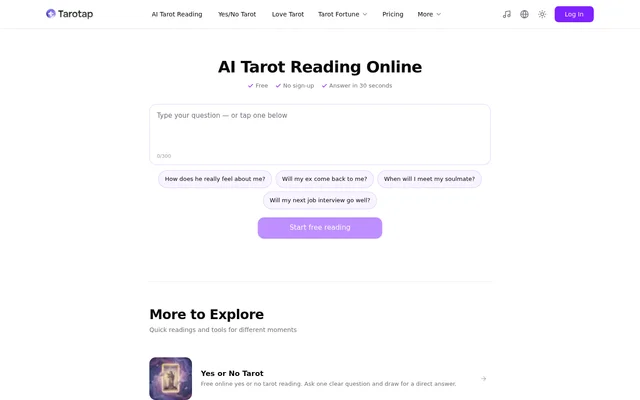
Tarotap is an online AI tarot reading tool that connects card interpretations to questions about relationships, work and personal choices. Tarotap lets users describe their situation before selecting cards, with the AI choosing a spread that fits the question. The service combines card drawing with a conversational interpretation rather than ending with a static reading.
Tarotap also includes tarot learning guides, card meanings and tools for readings across different time frames. Tarotap presents readings as a way to consider current circumstances and possible directions, not as predictions of a fixed future. The website explicitly distinguishes tarot guidance from professional advice.
What Tarotap can do
Tarotap provides general readings alongside dedicated tools for love, career questions and direct yes-or-no answers. Tarotap supports different interpretation depths and reader styles, allowing users to explore the same cards through different approaches. Additional tools cover oracle draws, intention setting and readings focused on particular periods.
- Tarotap selects a spread based on the situation described.
- Tarotap interprets drawn cards using traditional meanings and their positions.
- Tarotap answers follow-up questions about the same reading.
- Tarotap offers Quick Reading and Deep Insight modes.
- Tarotap provides seven reader personalities with different styles.
- Tarotap includes oracle card draws and manifestation goals.
How Tarotap works
Tarotap starts with a question rather than requiring users to choose a spread first. Tarotap can select a timeline, relationship spread or another layout to match the situation. Users then choose cards from a shuffled deck containing all 78 cards, with reversed cards possible, and receive an interpretation tied to the original question.
Tarotap keeps track of the reading session when users ask follow-up questions about card meanings or alternative paths. Quick Reading provides a short interpretation, while Deep Insight takes longer and cross-references card combinations. Paid conversation memory is separate for each reader, so a reader remembers conversations held with that reader.
Who Tarotap is for
Tarotap serves people seeking tarot-based reflection on relationships, career situations and decisions between possible paths. Tarotap also provides resources for people learning how tarot works, including guides to shuffling and reading accuracy. Specific questions are encouraged because the interpretation depends on the situation the user describes.
- Tarotap offers love readings about relationships and moving on after a breakup.
- Tarotap supports questions about interviews and career changes.
- Tarotap includes spreads for comparing different choices.
- Tarotap lets learners draw cards and explore meanings at their own pace.
Tarotap pricing and plans
Tarotap offers one full reading each day without requiring an account or email. The Free plan also lists limited yes-or-no and love readings and a follow-up allowance. Plus and Pro subscriptions provide unlimited AI, yes-or-no and love readings, alongside access to additional spreads, readers and other member features.
Tarotap lists Plus at €14.99 per month billed €179.88 yearly, and Pro at €99.99 per month billed €1,199.88 yearly. Plus includes 8 follow-ups per reading, while Pro includes 20 and voice call readings. Subscriptions can be canceled anytime, with benefits remaining active until the current subscription period ends.
Tarotap strengths and limitations
Tarotap combines a no-sign-up daily reading with question-based spread selection and contextual follow-up conversations. Tarotap offers different reader personalities and interpretation depths rather than a single reading style. Access limits remain important: free usage is restricted, paid plans expand capabilities, and some readings are available only during specific periods.
- Tarotap reserves Deep Insight and additional features for paid plans.
- Tarotap opens Seasonal Spread for four days at each solstice and equinox.
- Tarotap only knows the information users provide.
- Tarotap does not predict a fixed future or replace professional medical, legal or financial advice.
Tarotap FAQ
What is Tarotap?
Tarotap is an online AI tarot reading tool that interprets cards in relation to a user's question. Tarotap selects a suitable spread, lets users draw cards from a shuffled deck and supports follow-up conversations about the reading.
Is Tarotap free?
Tarotap offers one full reading a day for free without an account or email. Tarotap also offers Plus and Pro subscriptions for unlimited readings, more follow-up questions and additional features such as Deep Insight, expanded reader access and customization.
How does Tarotap choose and interpret tarot cards?
Tarotap selects a spread based on the user's question, then lets the user draw from a shuffled deck of 78 cards, including possible reversals. Tarotap interprets traditional card meanings in their spread positions and connects them to the situation described.
What is the difference between Tarotap Quick Reading and Deep Insight?
Tarotap Quick Reading gives a short interpretation in seconds, while Deep Insight takes longer and cross-references card combinations to identify patterns across the spread. Tarotap uses the same cards in both modes, with different levels of interpretation detail.
Can Tarotap predict the future accurately?
Tarotap states that tarot does not predict a fixed future. Tarotap describes readings as exploring current circumstances, possible directions and things to watch for, while the user's actions still affect outcomes. Tarotap is not intended for medical, legal or financial decisions.
Can you cancel a Tarotap subscription?
Tarotap subscriptions can be canceled anytime through Manage Subscription on the pricing page. Tarotap keeps membership benefits active until the end of the current subscription period, and plan changes can also be made through the same subscription controls.
From the community
No reviews yet
Be the first to review this tool. What you write helps the next person choose.