What is Tiledesk?
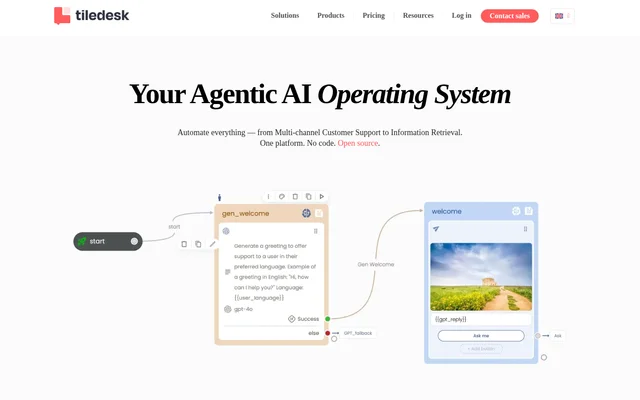
Tiledesk is an open-source, no-code system for building enterprise AI agents for customer support, operations, and information retrieval. Tiledesk combines conversational applications with automated workflows, allowing organizations to connect knowledge, coordinate specialized agents, and involve human staff when needed. The system supports both customer-facing interactions and internal information access.
Tiledesk distinguishes conversational scenarios from automation and batch processing. Conversational applications include customer service, semantic search, and shopping assistance with multi-step response logic. Automation scenarios include data analysis, content generation, email processing, and adding AI workflows to existing services through APIs.
What Tiledesk can do
Tiledesk brings agent design, knowledge retrieval, and business actions into a visual workflow environment. Tiledesk supports specialized agents for roles such as sales, support, onboarding, and internal help. These agents can use different knowledge bases and prompts, while routing directs requests according to intent, language, or topic.
- Tiledesk builds conversation flows with visual prompt chains and MCP tools.
- Tiledesk publishes agents across web, WhatsApp, voice, Messenger, SMS, and email.
- Tiledesk combines full-text and semantic search for knowledge retrieval.
- Tiledesk schedules appointments, checks availability, and sends reminders.
- Tiledesk processes incoming emails and generates knowledge-based replies.
- Tiledesk connects Shopify catalogs to conversational product assistance.
- Tiledesk provides suggestions, articles, and contextual summaries to human agents.
How Tiledesk works
Tiledesk's conversational workflow begins with designing an interaction through visual tools, connecting a knowledge base, documents, or external data, and publishing the agent on a supported channel. Tiledesk's flow builder lets users connect reusable prompt blocks. The Replace Bot action chains agents or switches between them during a conversation.
Tiledesk's automation workflow uses an API endpoint to receive posted data, execute prompt-chain logic, and invoke connected services. Results can be returned, used to trigger another workflow, or saved to an organization's storage services. Knowledge retrieval can use multiple repositories, sequential searches, query routing, guardrails, and search fallbacks.
Who Tiledesk is for
Tiledesk serves organizations that need customer-facing automation or assistance with internal workflows. The source describes applications across manufacturing, education, telecom, finance, retail, healthcare, travel, and professional services. Support teams can automate routine requests while retaining human escalation, and operations teams can connect information retrieval with actions such as scheduling or email processing.
- Tiledesk helps support teams retrieve order information and escalate unresolved issues.
- Tiledesk helps retailers answer product questions and build shopping carts.
- Tiledesk helps service businesses collect information and book appointments.
- Tiledesk helps field technicians access relevant information.
- Tiledesk helps employee-facing teams create workflow copilots.
Tiledesk pricing and access
Tiledesk offers a 14-day free trial with no credit card required and cancellation anytime. Tiledesk also provides paths to request a custom agent or schedule a demo. The supplied page does not list subscription prices or explain plan allowances, so the trial should not be treated as evidence of an ongoing free hosted plan.
Tiledesk strengths and deployment considerations
Tiledesk combines no-code orchestration, multichannel delivery, and human-in-the-loop support rather than limiting agents to standalone conversations. Tiledesk preserves context during human escalation and uses human responses and feedback to improve agents. Separate knowledge repositories and specialized agent roles provide ways to organize support, sales, and internal information without merging every source into a single repository.
Tiledesk supports open-source, on-premises deployment with open models and a stack covering databases, vector storage, embeddings, and language models. Tiledesk can run behind an organization's firewall in its own data center. The supplied page does not specify hardware requirements, an open-source licence, or plan-level deployment restrictions.
Tiledesk FAQ
What is Tiledesk?
Tiledesk is an open-source, no-code AI agent system for customer support, information retrieval, and workflow automation. Tiledesk combines visual conversation design, knowledge bases, specialized agents, APIs, and human handoff for enterprise conversational and operational use cases.
Is Tiledesk free?
Tiledesk offers a 14-day free trial with no credit card required and cancellation anytime. Tiledesk is also described as open source, but the supplied page does not state ongoing hosted subscription prices or identify a permanent free hosted plan.
Which channels does Tiledesk support?
Tiledesk supports web, voice, Facebook Messenger, WhatsApp, SMS, and email. Tiledesk can automate incoming conversations and email replies, while WhatsApp functionality includes inbound assistance and outbound notifications through template-based broadcasts or ad hoc messages.
Does Tiledesk have APIs and integrations?
Tiledesk supports API endpoints, native knowledge-base APIs, and MCP tools. Tiledesk also connects with Shopify stores, WhatsApp Business accounts, and calendars including Google and Outlook. API workflows can receive data, execute prompt chains, invoke services, and return or store results.
Can Tiledesk hand conversations over to human agents?
Tiledesk escalates complex or ambiguous conversations to human agents with full context. Tiledesk also provides an AI copilot with response suggestions, relevant articles, and contextual summaries, and uses human responses and feedback from escalated cases to improve AI agents.
Can Tiledesk run on premises?
Tiledesk supports on-premises deployment behind an organization's firewall and integration in its own data center. Tiledesk describes support for open models and a stack that includes databases, vector storage, embeddings, and language models.
From the community
No reviews yet
Be the first to review this tool. What you write helps the next person choose.