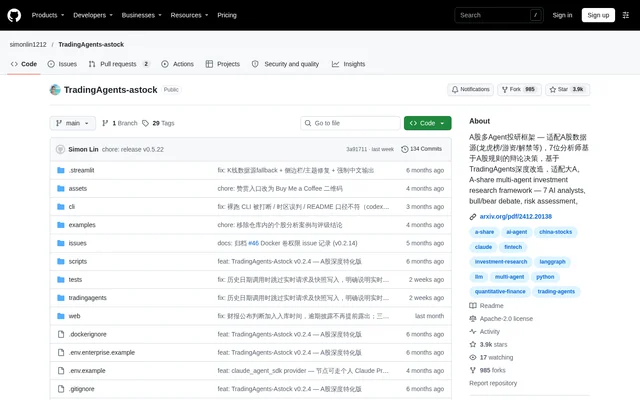
What is TradingAgents-Astock?
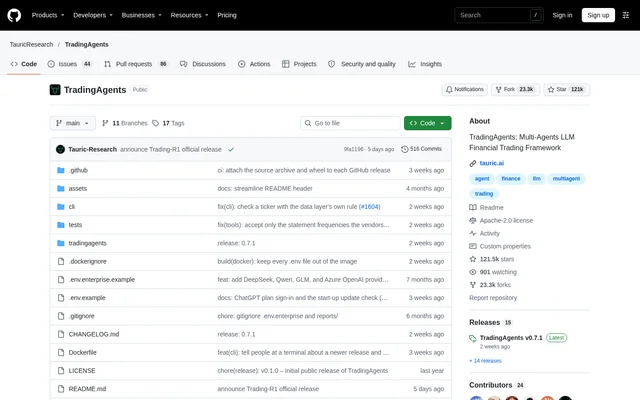
TradingAgents-Astock is an open-source framework for studying AI-assisted investment research in the Chinese A-share market. TradingAgents-Astock is a specialised fork of TauricResearch/TradingAgents, adapting the upstream research architecture through Chinese market-data sources, additional analyst roles and local trading rules. The repository explicitly positions the project as an engineering implementation and research reproduction for research and teaching.
TradingAgents-Astock produces Chinese reports while retaining English for internal debate. The workflow brings analyst findings into research discussion, trading-plan generation and portfolio-level assessment. The project states that these outputs do not constitute investment advice and that TradingAgents-Astock does not provide investment services.
What TradingAgents-Astock can do
TradingAgents-Astock organises research around specialist analysts rather than a single model response. Market, sentiment, news and fundamentals roles work alongside policy, speculative-capital tracking and restricted-share monitoring roles. Their reports feed downstream debates and decisions, keeping A-share-specific evidence within the wider research process.
- TradingAgents-Astock generates reports from 7 specialist analyst roles.
- TradingAgents-Astock runs bull/bear research debates and multi-perspective risk discussions.
- TradingAgents-Astock incorporates T+1 settlement, price limits and minimum lot constraints.
- TradingAgents-Astock exports complete analysis reports as Markdown or PDF.
- TradingAgents-Astock saves analysis history and reports decision-performance statistics.
How TradingAgents-Astock works
TradingAgents-Astock runs through a Streamlit web interface, an interactive CLI or Python code using TradingAgentsGraph. After installation and model configuration, users provide an A-share stock code and analysis date. The web interface also accepts a data start date, displays workflow progress and lets users inspect reports from completed stages.
TradingAgents-Astock separates quick-thinking model roles from deeper synthesis roles for the research and portfolio managers. Configuration can assign different providers or models to individual roles. Supported options include MiniMax, DeepSeek, Qwen, GLM, OpenAI, Anthropic, Google, xAI, OpenRouter, Ollama and custom OpenAI-compatible gateways. Docker is optional rather than required for local use.
Who TradingAgents-Astock is for
TradingAgents-Astock serves research and teaching workflows focused on A-share analysis and multi-agent decision processes. Developers can configure models and role assignments through Python, while users who do not write code can run analyses through the installed web interface. Saved reports and decision logs support inspection of the research process and subsequent outcomes.
- Researchers can examine how specialist reports influence bull/bear debate.
- Educators can demonstrate market-specific constraints in an AI research workflow.
- Developers can assign different model providers to research roles.
- Users can investigate policy changes, capital flows and restricted-share supply.
TradingAgents-Astock pricing and access
TradingAgents-Astock is available from GitHub under the Apache 2.0 licence. The documented market-data sources are free and require no API keys. Model access is separate: the default configuration uses provider API billing, and each analysis requires 30-50 LLM calls. An optional Claude Agent SDK integration can use personal Claude Pro/Max subscription allowances for some or all nodes.
TradingAgents-Astock strengths and limitations
TradingAgents-Astock combines A-share-specific data, specialist analyst roles and configurable model routing within an inspectable open-source workflow. The web interface, CLI and report exports provide different ways to run and review research. Decision-performance reporting adds outcome tracking, but the repository explicitly distinguishes these statistics from backtesting or strategy performance.
- Local use requires Python installation and model configuration.
- Default API-based analysis carries language-model usage charges.
- Performance statistics omit position management, trading costs and market-impact costs.
- Overlapping holding windows and possible selection bias limit interpretation of recorded outcomes.
- Research outputs are not investment advice.
TradingAgents-Astock FAQ
What is TradingAgents-Astock?
TradingAgents-Astock is an open-source multi-agent investment research framework adapted for Chinese A-shares. TradingAgents-Astock combines specialist analyst reports, bull/bear debate and risk assessment with A-share data and trading constraints. The project is intended for research and teaching, not investment advice.
Is TradingAgents-Astock free?
TradingAgents-Astock is available under the Apache 2.0 licence and uses free market-data sources without API keys. Language-model usage is separate and normally billed through provider APIs. An optional Claude Agent SDK integration can instead use personal Claude Pro/Max subscription allowances.
How do you run TradingAgents-Astock?
TradingAgents-Astock runs locally through a Streamlit web interface, an interactive CLI or Python code. Users clone the repository, install the project and configure a language-model provider before entering a stock code and analysis date. Docker is available as an optional deployment method.
Which language models does TradingAgents-Astock support?
TradingAgents-Astock supports providers including MiniMax, DeepSeek, Qwen, GLM, OpenAI, Anthropic, Google, xAI, OpenRouter and Ollama. TradingAgents-Astock also accepts custom OpenAI-compatible gateways and supports assigning different providers or models to individual research roles.
Does TradingAgents-Astock provide backtesting?
TradingAgents-Astock provides decision-performance statistics, but the repository explicitly says these are not backtests or strategy performance. Recorded decisions are assessed against subsequent market data and CSI 300 alpha, without position management, trading costs or market-impact costs.
Can TradingAgents-Astock export research reports?
TradingAgents-Astock exports complete research reports as Markdown or PDF through the web interface. TradingAgents-Astock also displays analyst reports, bull/bear discussions, risk assessments and Buy/Hold/Sell signal cards, while automatically saving historical analyses for later review.
From the community
No reviews yet
Be the first to review this tool. What you write helps the next person choose.