What is Zapier?
Zapier is a web-based AI orchestration platform that connects business apps and runs automated workflows. Zapier brings together Zaps, Tables, Forms, and an AI action layer, serving founders, business teams, developers, and enterprises. The platform supports both visual no-code automation and developer-oriented access through an SDK.
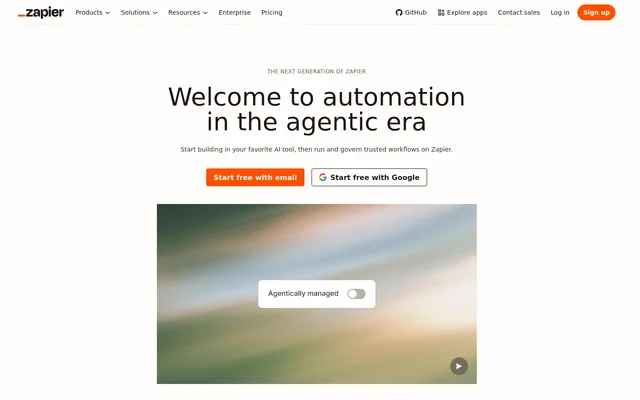
Zapier separates building, running, and governing automation. Teams can begin a workflow in an AI tool, connect business systems through Zapier MCP, and run the resulting automation on Zapier. Enterprise governance tools let administrators control access and inspect agent actions and workflow runs.
What Zapier can do
Zapier combines app connections, structured data, forms, and AI processing to support automated business workflows. Zapier offers fixed-rule steps alongside AI tasks and agents, allowing different parts of a workflow to use different approaches. Next Gen Zaps extend this model with automatic issue detection and recovery, but remain in early access.
- Zapier connects workflows and AI assistants to 9,000+ apps.
- Zapier runs triggered workflows without repeated chat prompts.
- Zapier builds multi-step workflows with logic branches and AI processing.
- Zapier stores structured data in Tables and collects information through Forms.
- Zapier MCP lets AI assistants take actions across connected apps.
- Zapier provides logs and analytics for workflow visibility.
How Zapier works
Zapier workflows, called Zaps, start from a trigger and complete work across connected apps. Users can build with a visual no-code editor or begin in AI tools such as Claude, ChatGPT, and Cursor. Zapier MCP supplies app context and actions, allowing users to test and refine workflows within the conversation.
Zapier describes its approach to mixing fixed rules and AI as Fluid Determinism. Users build with natural language, while Zapier suggests where AI should be used. Repeated work can become deterministic steps that use fewer tokens, with AI added back when unexpected conditions require a different response.
Who Zapier is for
Zapier serves organizations ranging from first-time founders to enterprise teams. Business teams can automate work across apps, developers can connect agents through the SDK, and IT administrators can govern access to systems. The supplied customer stories cover customer service, support operations, credential rotation, and internal automation.
- Zapier can send automatic ticket replies and route tickets to representatives.
- Zapier can support customer service automation while staff handle complex cases.
- Zapier can connect AI agents to approved business tools.
- Zapier can help IT teams inspect workflow activity and control app access.
Zapier pricing and plans
Zapier offers a Free plan with 100 tasks per month, unlimited Zaps, Tables, and Forms, and two-step Zaps. Professional starts at $19.99 per month and adds multi-step Zaps, premium apps, webhooks, AI fields, and conditional form logic. Team starts at $69 per month and includes 25 users and shared app connections.
Zapier Enterprise requires contacting sales and includes unlimited users, advanced administration, deployment options, and observability. Zapier uses a shared task pool across workflows, AI steps, code, MCP, and SDK usage. Task consumption varies with AI model tier, code runtime, and connector type rather than every action necessarily consuming the same amount.
Zapier strengths and limitations
Zapier combines broad app connectivity with no-code building, developer tools, and enterprise controls. Zapier also brings workflows, forms, and data storage into a shared environment. Governance capabilities include permissions at the app, action, and connection level, plus visibility into workflow owners, agent actions, and the systems involved.
- Zapier limits the Free plan to 100 monthly tasks and two-step Zaps.
- Zapier offers Next Gen Zaps through early access.
- Zapier includes live chat starting at the Professional 2,000 task tier.
- Zapier task usage increases with more powerful AI models or longer-running code.
Zapier FAQ
What is Zapier?
Zapier is a web-based AI orchestration and workflow automation platform that connects 9,000+ apps. Zapier combines automated workflows called Zaps with Tables, Forms, AI assistant connections, and governance tools for business teams and enterprises.
Is Zapier free?
Zapier offers a free plan with 100 tasks per month, unlimited Zaps, Tables, and Forms, and two-step Zaps. Zapier also offers paid Professional and Team plans, while Enterprise pricing is available by contacting sales.
Does Zapier work with ChatGPT, Claude, and Cursor?
Zapier connects Claude, ChatGPT, Cursor, and other AI tools to business apps through Zapier MCP. Zapier MCP lets users provide app context, take actions, and test or refine workflows without leaving the AI conversation.
How does Zapier task-based pricing work?
Zapier uses a shared account-level task allocation for workflows, AI steps, code, MCP, and SDK usage. Every Zap step and external connector call uses tasks, with consumption affected by AI model tier, code runtime, and connector type.
What are Zapier Next Gen Zaps?
Zapier Next Gen Zaps are early-access workflows that turn work built in AI tools into automated processes with advanced logic and automatic recovery. Zapier describes an AI manager agent that detects workflow issues and fixes them automatically.
Does Zapier offer enterprise governance?
Zapier provides enterprise governance capabilities including app, action, and connection controls, along with visibility into agent actions and workflow runs. Zapier Enterprise includes advanced administration and observability, and Zapier lists SAML SSO, SCIM, and compliance capabilities among its security features.
From the community
No reviews yet
Be the first to review this tool. What you write helps the next person choose.