What is Zelma?
Zelma is an AI tool for exploring public assessment results for students in Grades 3–8. Researchers, journalists, parents, and others interested in schools can use Zelma to ask how students are doing in a state or district and see the data behind the answer. Zelma uses the State Assessment Data Repository, which was assembled from public records from state education agencies and reconciled with federal NCES identifiers.
What Zelma can do
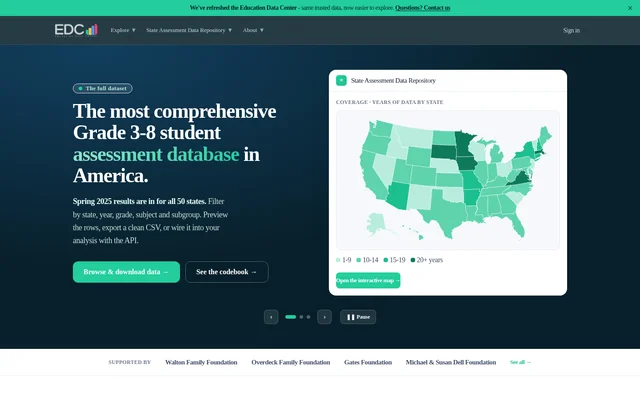
Zelma returns a chart, a table, and a written answer when users ask questions in plain English. The interactive map offers another way to explore proficiency, moving from a state view to district results and to school results where available. Users who want to work with the underlying records can browse and download the dataset or query the API.
- Zelma charts how math and ELA scores have changed over time.
- Zelma displays assessment results by subgroup.
- Zelma maps proficiency across all 50 states.
- Zelma lets users preview filtered rows and export them as a CSV.
- Zelma gives each graph a shareable link that opens without a login.
How Zelma works
Zelma lets users select a state and ask a question scoped to its assessment data, such as how math scores have changed since 2019. The resulting answer includes a link to the exact underlying data. In the download interface, users can filter records by state, year, grade, subject, and subgroup, then preview the matching rows before exporting them.
Zelma also points users to API documentation and provides a ready-made API call from any download screen. The endpoint can be used from R, Stata, or Python. A codebook documents the dataset, and numbered releases and a public changelog help researchers identify which version they used for an analysis or citation.
Who Zelma is for
Zelma gives parents a way to look up assessment results without working in a spreadsheet. Journalists and policymakers can share a graph as a link that readers can open without logging in. Researchers can use the dataset filters to select the records they need, then download the rows or query the API for further analysis.
- Track how math and ELA scores have changed in a state.
- Compare district math results within a state.
- Examine assessment results by race and ethnicity.
- Download a filtered dataset for research.
Zelma pricing and plans
Zelma is free to explore, and users do not need an account to get started. The State Assessment Data Repository is free for research and other non-commercial use with attribution. Commercial use requires permission under the terms of service, a distinction between exploring the data and reusing the dataset for commercial purposes.
Zelma strengths and limitations
Zelma offers spring 2025 assessment results for all 50 states. The repository also covers DC, Puerto Rico, and the U.S. Virgin Islands. A codebook explains where the data comes from, and the versioned releases help users cite a specific dataset. The earliest records date to 1998, but the number of years available depends on the state.
- Assessment data covers Grades 3–8.
- The number of historical years varies by state.
- School-level results are available only where the data exists.
Zelma FAQ
What is Zelma?
Zelma is an AI tool for exploring U.S. student assessment results in Grades 3–8. Users can ask questions in plain English about state or district results and receive a chart, a table, and a written answer linked to the underlying data.
Is Zelma free to use?
Zelma is free to explore, with no account needed to start. The State Assessment Data Repository is free for research and other non-commercial use with attribution. Commercial use of the dataset requires permission.
What assessment data does Zelma cover?
Zelma uses assessment data for Grades 3–8, including spring 2025 results from all 50 states. The repository also covers DC, Puerto Rico, and the U.S. Virgin Islands. Subjects include ELA, math, science, and social studies, and school-level results are available where the data exists.
Can you download data from Zelma or access it through an API?
Zelma offers CSV downloads and a documented API for assessment data. Users can filter by state, year, grade, subject, and subgroup, then preview the matching rows. The download screen also provides a ready-made API call for use in R, Stata, or Python.
Can you share charts from Zelma without a login?
Zelma gives each graph a shareable link that anyone can open without logging in. Journalists, policymakers, and other users can send the link directly rather than sharing a screenshot.
From the community
No reviews yet
Be the first to review this tool. What you write helps the next person choose.