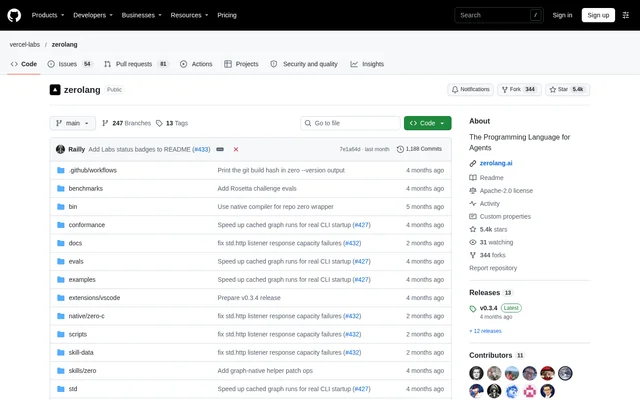
What is Zerolang?
Zerolang is an experimental, open-source programming language designed for agents. Published in the vercel-labs repository, Zerolang makes a semantic graph the program database. Humans request outcomes, while agents query compiler facts, submit checked edits, and validate the result. The repository distributes Zerolang under the Apache-2.0 license.
Zerolang differs from a text-first coding workflow because the checked compiler input is zero.graph. Human-readable .0 files are projections of that graph rather than the normal agent authoring surface. This distinction lets humans review program text while agents work directly with semantic structure instead of line ranges.
What Zerolang can do
Zerolang exposes program structure through compiler commands and checked graph operations. Agents can inspect symbols, node IDs, graph hashes, types, effects, ownership facts, capabilities, imports, call edges, and target facts. The compiler rejects stale hashes, unexpected field values, invalid shapes, and type errors before writing changes to the graph store.
- Zerolang applies checked semantic edits through zero patch.
- Zerolang exposes compiler facts through zero query and zero inspect.
- Zerolang checks, tests, and runs programs through dedicated commands.
- Zerolang exports readable projections for human review.
- Zerolang imports intentional human edits back into the graph.
- Zerolang bundles version-matched skills for agents.
How Zerolang works
Zerolang starts from a conversational request, such as building a hello-world program. The documented example initializes a package, applies operations with zero patch, and runs the result. The expected agent loop queries the graph, submits a checked patch, handles compiler rejection when necessary, and then runs task validation.
Zerolang supports a daily workflow using zero query, zero patch, zero check, zero test, and zero run. The current directory is the default input. For human review, zero export and zero verify-projection expose and verify projection text. After intentional text edits, zero import and zero check bring those changes back through the compiler.
Who Zerolang is for
Zerolang is for developers exploring programming workflows in which agents operate on compiler-known structure. Human participation remains part of the design: people describe outcomes and review projections when useful. Repository contributors can also build the local compiler and run documentation, conformance, native, and command-contract checks during development.
- Zerolang supports experiments with agent-authored graph-first packages.
- Zerolang supports human review of readable program projections.
- Zerolang supports compiler development with local builds and repository checks.
Zerolang licensing and access
Zerolang is available as an open-source repository under the Apache-2.0 license. The README provides a shell-based compiler installer, a PATH configuration step, and a version check. Developers can also build the compiler locally using pnpm install and make. These are documented access methods rather than hosted subscription plans.
Zerolang provides an agent bootstrap skill through npx skills add vercel-labs/zerolang. The compiler also bundles version-matched skills, accessible through zero skills and commands for agent, graph, language, and standard-library guidance. The README directs readers to zerolang.ai for documentation.
Zerolang strengths and limitations
Zerolang combines compiler-checked semantic edits with readable projections for human review. Explicit import and export commands make the text-to-graph boundary visible, while patch validation rejects invalid or stale changes before storage. However, the repository labels Zerolang experimental and explicitly warns about breaking changes, rough edges, and security issues.
- Zerolang should run in isolated workspaces.
- Zerolang should not run against production systems or sensitive data.
- Zerolang requires compiler installation or a local source build.
Zerolang FAQ
What is Zerolang?
Zerolang is an experimental, graph-native programming language for agents. Zerolang uses a semantic graph as the program database, allowing agents to query compiler facts, submit checked edits, and validate results while humans review readable text projections when useful.
Is Zerolang open source?
Zerolang is an open-source project published under the Apache-2.0 license in the vercel-labs repository. Zerolang provides instructions for installing the compiler and building the compiler locally, along with documentation and agent skills.
How do agents edit programs in Zerolang?
Zerolang expects agents to use zero query and zero patch rather than normally authoring projection text. Zerolang checks graph edits and rejects stale graph hashes, unexpected field values, invalid shapes, and type errors before writing the store.
Can humans read and edit Zerolang programs?
Zerolang provides human-readable .0 projections of zero.graph for reading, review, and occasional editing. Zerolang uses explicit export, projection verification, and import commands so intentional text edits pass back through the graph workflow rather than silently diverging.
Is Zerolang ready for production?
Zerolang is explicitly experimental, and the repository warns users to expect breaking changes, rough edges, and security issues. Zerolang should run in isolated workspaces rather than against production systems or sensitive data.
How do you install Zerolang?
Zerolang provides a shell installer at zerolang.ai/install.sh, followed by PATH configuration and a compiler version check. Zerolang also documents a local compiler build and an agent bootstrap skill installed through npx skills add vercel-labs/zerolang.
From the community
No reviews yet
Be the first to review this tool. What you write helps the next person choose.