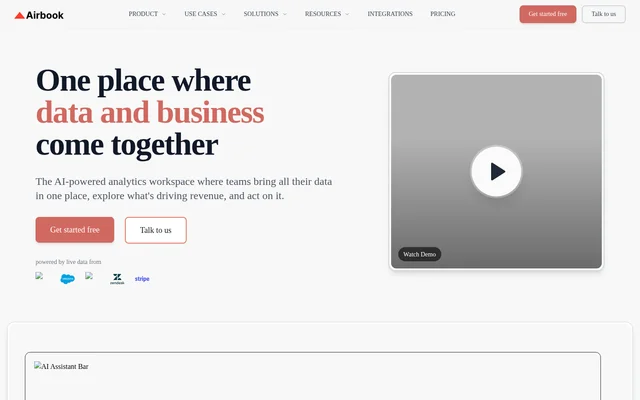
What is Airbook?
Airbook is an AI-powered analytics workspace that brings business data, analysis, dashboards, and actions together. Airbook is designed for analysts and teams working across revenue operations, go-to-market activities, and data management. The workspace connects information from business applications, databases, and warehouses so teams can investigate revenue performance using shared data.
Airbook combines business intelligence capabilities with a collaborative workspace. Teams can explore data with SQL or AI, create charts and dashboards, and share findings through comments, notes, and team editing. Airbook also supports activation, allowing teams to move from analysis into workflows in downstream tools.
What Airbook can do
Airbook covers a connected analytics workflow, from bringing sources together to presenting findings and sending results into other tools. Available capabilities vary by plan: database analysis is available through the free offering, while Growth adds cross-source analysis and Scale extends the workflow into broader business connections and activation.
- Airbook answers analytical questions written in plain English using connected data.
- Airbook supports SQL queries and a visual no-code query builder.
- Airbook creates charts, interactive dashboards, and AI-generated dashboards.
- Airbook joins data across sources and supports reusable metrics.
- Airbook captures data snapshots and schedules report delivery.
- Airbook builds workflows for segments, campaigns, alerts, and downstream actions.
How Airbook works
Airbook starts with connections to business tools, databases, or data warehouses. Named sources include PostgreSQL, MySQL, Snowflake, BigQuery, HubSpot, Salesforce, Stripe, and product analytics tools such as Amplitude and Mixpanel. Users then explore connected information through SQL or natural-language questions, with no-code query building included in Growth.
Airbook organizes analysis into projects and presents results through dashboards and reports. Teams can collaborate on findings and reuse governed metrics across reports and segments. Growth includes MCP access, while Scale includes downstream workflows and custom destinations for moving insights into business actions.
Who Airbook is for
Airbook serves individual analysts working with databases as well as RevOps, GTM, and data teams combining information across functions. Airbook addresses pipeline review preparation, campaign attribution to revenue, funnel analysis, and self-service reporting. Data teams can centralize connected data and reuse governed logic instead of maintaining separate calculations across reports.
- Airbook helps RevOps teams review pipelines using CRM, product, and billing data.
- Airbook helps GTM teams measure campaign impact on pipeline and revenue.
- Airbook helps growth teams identify audiences for conversion, expansion, or retention.
- Airbook helps data teams provide self-service analysis with reusable metrics.
Airbook pricing and plans
Airbook offers Freemium at $0, Starter at $99/month, Growth at $599/month, and Scale at $1,499/month. Enterprise uses custom pricing. Freemium includes 10 AI requests per month, 1 analyst seat, 1 database connection, unlimited viewers, and 2 projects with unlimited dashboards. Starter expands this to 50 AI requests, 2 analyst seats, and unlimited projects.
Airbook Growth includes 100 monthly AI requests, 5 analyst seats, a CRM connection, and a database or warehouse connection. Scale includes 500 monthly AI requests, 5 analyst seats, and any 5 connectors. Additional analyst seats cost $19/month on Growth and Scale. Paid self-service plans offer free trials, while Enterprise directs buyers to sales.
Airbook strengths and limitations
Airbook brings data connections, analysis, collaboration, and activation into a shared workspace rather than treating reporting as a separate endpoint. Support for SQL, plain-English questions, and no-code querying accommodates different analytical skills. Airbook also lists granular permissions, encrypted storage, and SOC2 Type 2 certification, alongside unlimited viewers across the listed plans.
- Airbook caps AI requests on non-Enterprise plans.
- Airbook limits free usage to a database connection and an analyst seat.
- Airbook requires Growth or higher for cross-source joins and MCP access.
- Airbook places broader connectors, workflow activation, and custom destinations in Scale.
Airbook FAQ
What is Airbook?
Airbook is an AI-powered analytics workspace that connects business data for analysis, dashboards, collaboration, and downstream actions. Airbook supports plain-English questions and SQL, helping analysts, RevOps, GTM, and data teams explore revenue performance from connected sources.
Is Airbook free?
Airbook offers a Freemium plan at $0 with 10 AI requests per month, 1 analyst seat, 1 database connection, unlimited viewers, and 2 projects with unlimited dashboards. Airbook also offers paid Starter, Growth, and Scale plans, plus custom Enterprise pricing.
Which data sources does Airbook connect to?
Airbook lists connections for databases, warehouses, CRMs, marketing tools, product analytics, and support and billing systems. Named sources include PostgreSQL, MySQL, Snowflake, BigQuery, Salesforce, HubSpot, Stripe, Amplitude, and Mixpanel. Airbook connection allowances vary by plan.
Can Airbook analyze data without SQL?
Airbook supports analytical questions in plain English and AI-powered natural-language-to-SQL querying. Airbook also offers a visual no-code query builder in Growth, alongside chart and dashboard creation, so analysis is not limited to users who write SQL.
Does Airbook support workflows and MCP access?
Airbook includes MCP access in Growth and downstream workflow capabilities in Scale. Airbook Scale can trigger workflows for segments, campaigns, and alerts in downstream tools, and supports custom destinations for sending insights into other business systems.
Who is Airbook for?
Airbook serves individual database analysts, small analytics teams, RevOps, GTM, and data teams. Airbook use cases include pipeline reviews, measuring campaign impact on revenue, finding funnel bottlenecks, identifying expansion or retention opportunities, and enabling self-service exploration of governed data.
From the community
No reviews yet
Be the first to review this tool. What you write helps the next person choose.