What is Airship?
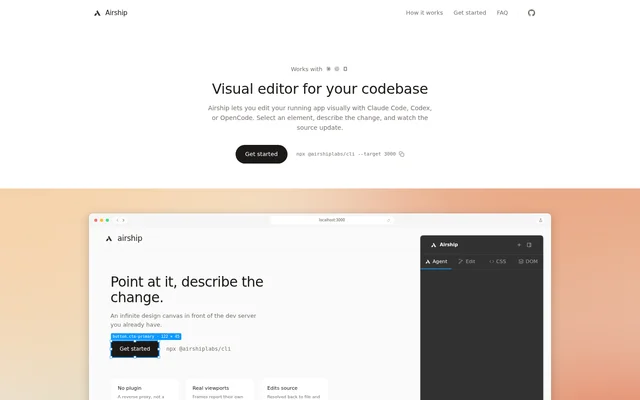
Airship is a local visual editor for developers who want to change a running application's interface through a coding agent. Airship places an infinite design canvas in front of an existing development server, rather than requiring the interface to be recreated in a separate design tool. Users work with the real application, select an element, and describe the change they want made to its source.
What Airship can do
Airship connects visual interface work to source editing by resolving selected elements back to their files and lines. Airship supplies that context to Claude Code, Codex, or OpenCode alongside inspector changes and viewport information. The workspace shows the resulting code changes and supports testing the same application across device sizes.
- Airship maps selected interface elements to source locations.
- Airship displays streaming status and inline code diffs.
- Airship shows real desktop, tablet, and mobile viewports side by side.
- Airship works with Tailwind, CSS Modules, and styled-components.
- Airship lets users undo individual edits without Git.
How Airship works
Airship runs as a reverse proxy in front of a development server that is already running. Users start their application normally, then launch Airship with npx @airshiplabs/cli --target 3000 when the application uses that port. Airship opens the visual editor without adding dependencies, configuration, or a build plugin. Supported applications include Vite, Next, Remix, Rails, and anything serving HTML over HTTP.
Airship uses the authentication already configured for the selected coding agent. After a user selects an element and describes a change, Airship passes the selection, source location, changed values, and active frames to that agent. The agent can reread selection context while working. Airship then presents the source changes in the workspace, keeping interface inspection and code editing together.
Who Airship is for
Airship is for developers working on application interfaces who already use, or want to use, Claude Code, Codex, or OpenCode. Airship supports visual iteration on real application code rather than a separate mockup. The workflow is relevant when a developer needs to communicate an element-specific change, inspect responsive behavior, or preserve a project's existing styling conventions while adjusting its appearance.
- Airship helps developers scope agent requests to selected interface elements.
- Airship supports checking layout changes across device viewports.
- Airship supports visual adjustments using existing design-system values.
Airship strengths and limitations
Airship combines local operation, source-aware selection, real viewports, and reversible edits without changing the application's build setup. Airship binds to localhost by default, has no telemetry or hosted service, and does not receive the user's code. However, the chosen coding agent still handles requests through its own provider and retains its normal filesystem and network access unless safe mode is enabled.
- Airship requires a running application served over HTTP.
- Airship requires a supported coding agent and the stated Node.js version.
- Airship safe mode can restrict edits to the project and block potentially destructive commands.
Airship FAQ
What is Airship?
Airship is a local visual editor that connects a running application to Claude Code, Codex, or OpenCode. Airship lets developers select interface elements, describe changes, and review source updates within a visual canvas connected to their existing development server.
Does Airship require a plugin or build changes?
Airship does not require a plugin or changes to the application's build. Airship runs as a reverse proxy in front of an existing development server and adds nothing to the project's dependencies, configuration, or bundle.
Which coding agents and styling systems does Airship support?
Airship supports Claude Code, Codex, and OpenCode, using existing agent authentication. Airship also works with Tailwind, CSS Modules, and styled-components, using the styling conventions and design tokens already present in the project.
Does Airship send code off the machine?
Airship does not send code to Airship and runs entirely on localhost by default, with no account, telemetry, or hosted service. Airship's selected coding agent handles requests using the same credentials and provider that the agent uses from the terminal.
Can Airship undo changes without Git?
Airship can undo every edit directly in the visual editor without requiring Git. Airship keeps the previous version of the file for reverting changes, although some supported agents may use Git internally for their own diffs and change tracking.
From the community
No reviews yet
Be the first to review this tool. What you write helps the next person choose.