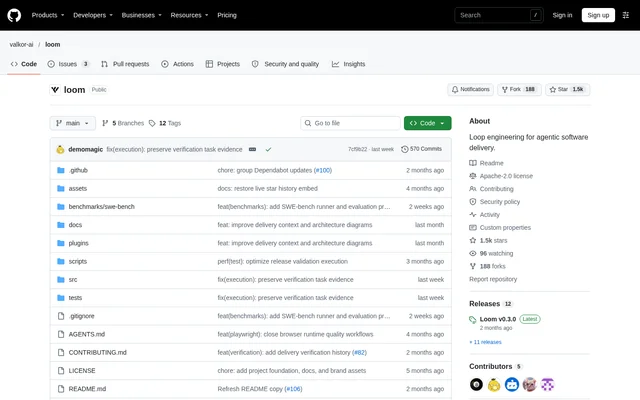
What is Loom?
Loom is an open-source software delivery harness that runs beside a coding agent and coordinates larger changes through a structured workflow. Loom supports developers using Codex, Claude Code, and OpenCode for features, reviews, repairs, deployments, and work that another person or session must be able to inspect and continue.
Loom records requirements, decisions, task progress, results, runtime facts, and repair history in a project-local .loom/ directory. This persistent delivery state lets a new session pick up recorded work rather than reconstructing the workflow from chat history. Loom describes its delivery loop as scope clarification, planning, building, checking, repair, preview, and handoff.
What Loom can do
Loom connects execution with verification and repair rather than treating generated code as the final result. Test and review findings guide subsequent repairs, and the updated result is checked again. Loom also selects technical references for the current task, drawing from shared material covering architecture, APIs, language and framework work, review, and browser verification.
- Loom clarifies requirements and records task boundaries.
- Loom turns delivery contracts into bounded task plans.
- Loom records task results with supporting evidence.
- Loom routes review findings into repair workflows.
- Loom resumes delivery from saved project state.
- Loom retrieves matching knowledge-source excerpts during clarification.
How Loom works
Loom runs as a local MCP delivery state machine accessed through an agent plugin. Developers use @loom in Codex and /loom in Claude Code or OpenCode. The coding agent requests the next action, reads declared fields, writes the expected artifact, and submits the result. Loom then validates, persists, and routes the next step.
Loom uses an installer that detects the operating system and CPU, verifies the release package, installs the Rust MCP server, creates an isolated Python runtime, registers MCP access, refreshes the plugin, and runs installation checks. After installation or an update, a new agent session loads the refreshed registration and plugin files.
Who Loom is for
Loom is for developers whose software changes require more than an initial generated implementation. Loom supports work where requirements need confirmation, execution needs boundaries, checks may trigger repairs, or delivery must survive a session interruption. Optional knowledge sources also support projects that depend on product rules, design standards, operating procedures, or other local reference material.
- Loom supports building a feature or application.
- Loom supports resuming interrupted delivery.
- Loom supports reviewing and repairing changes.
- Loom supports validating a local preview.
Loom licensing and access
Loom is distributed through a public GitHub repository under the Apache-2.0 license. The source page provides release installation commands, Windows PowerShell instructions, and a local-build installation path for repository checkouts. Loom can be installed for a single supported coding agent or for all supported agents on the same machine.
Loom strengths and limitations
Loom combines persistent delivery records, targeted context retrieval, and structured repair routing in a workflow that runs alongside supported coding agents. Loom preserves artifacts for inspection and continuation while keeping task-specific reads explicit. These capabilities come with local prerequisites and maintenance steps, including agent installation, Docker for deployment, and rebuilding knowledge indexes after source documents change.
- Loom requires Codex, Claude Code, or OpenCode installed locally.
- Loom requires Docker for loom deploy.
- Loom requires a new agent session after plugin installation or updates.
- Loom requires knowledge indexes to be rebuilt when registered files change.
Loom FAQ
What is Loom?
Loom is an open-source delivery harness for coding agents that coordinates scope clarification, planning, implementation, verification, repair, previews, and handoff. Loom stores delivery state in a project-local .loom/ directory so work can continue across agent sessions.
Which coding agents does Loom support?
Loom supports Codex, Claude Code, and OpenCode through local plugins and an MCP server. Loom uses @loom commands in Codex and /loom commands in Claude Code or OpenCode, with installation options for an individual agent or all supported agents.
Can Loom resume interrupted coding work?
Loom can resume interrupted delivery through the continue command inside a supported coding agent. Loom preserves requirements, task progress, results, runtime facts, and repair history locally, allowing a reopened session to advance from the recorded delivery state.
What does Loom require to run?
Loom requires a supported coding agent installed locally: Codex, Claude Code, or OpenCode. Loom also requires Docker for the deploy workflow. The installer sets up the Rust MCP server, an isolated Python runtime, agent MCP registration, and plugin files.
Can Loom use local documents as knowledge sources?
Loom supports optional knowledge sources containing Markdown, text, JSON, YAML, PDF, and DOCX files. Loom searches enabled, successfully built indexes during requirement clarification and reads matching chunks to form user-visible questions or confirmation points, rather than treating documents as requirements automatically.
Is Loom open source?
Loom is an open-source project available on GitHub under the Apache-2.0 license. Loom provides release installers and a local-build installation path that builds the Rust MCP server and setup binary before installing and checking the agent integration.
From the community
No reviews yet
Be the first to review this tool. What you write helps the next person choose.