What is Background Agents?
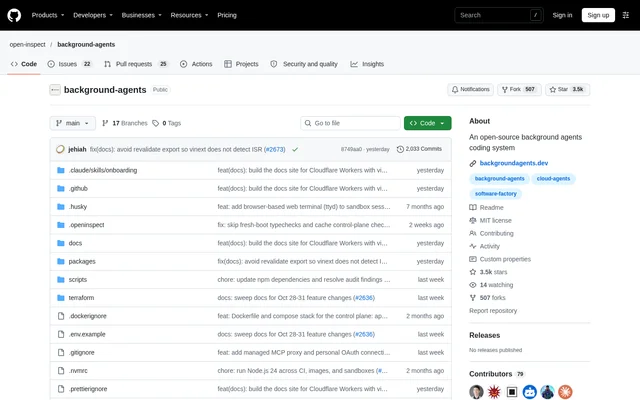
Background Agents is an open-source coding system that runs development tasks in the background for software teams. Background Agents provides development sandboxes, collaborative sessions, and connections to the tools teams use to manage code and issues. The repository describes a system inspired by Ramp's Inspect and makes the source available under the MIT license.
Background Agents is designed for deployment within a single organization whose users are trusted. Teams own sessions, environments, and automations, while session visibility controls determine who can read or participate. These internal access controls do not create tenant isolation, so the project is not designed as a shared service for unrelated organizations.
What Background Agents can do
Background Agents combines coding environments with collaboration and automation features. Sessions can span multiple repositories, retain filesystem state, and receive reusable instructions. The web interface includes streaming output, model and reasoning selectors, a terminal panel, and multiplayer presence. Separate sandbox subtasks allow agents to work on parallel parts of a task.
- Background Agents runs tasks with Node.js, Python, git, browser automation, and VS Code.
- Background Agents coordinates changes across repositories and opens a pull request per repository.
- Background Agents streams shared sessions to connected collaborators.
- Background Agents attributes git commits to the user who supplied the prompt.
- Background Agents runs scheduled jobs and responds to external events.
- Background Agents assigns reusable skills globally or to selected repositories and environments.
How Background Agents works
Background Agents accepts sessions through the web interface, Slack messages, GitHub pull requests, Linear issues, and authenticated webhook requests. Users select repositories or a saved environment, choose a model, and submit a task. Environments group repositories with their own secrets scope and optional prebuilt images, while snapshots preserve sandbox state for follow-up work.
Background Agents uses a Cloudflare control plane with Workers and Durable Objects, connected to a sandbox backend. The repository includes infrastructure packages for Modal, Daytona, E2B, and Boat. A local MCP server lets Claude Code or another MCP client read sessions and automation runs, with optional permissions for running automations or importing skills.
Who Background Agents is for
Background Agents serves software development teams that want background coding work connected to their existing collaboration tools. The documented workflows cover repository changes, pull request review, issue-driven development, and recurring automation. Shared sessions support colleagues working together, while personal skill profiles let users reuse frequently needed instructions.
- Background Agents turns Linear issue mentions or assignments into coding sessions.
- Background Agents reviews pull requests automatically or responds to GitHub mentions.
- Background Agents starts Slack-based tasks and returns results in message threads.
- Background Agents performs coordinated work across several repositories.
- Background Agents responds to GitHub events, Sentry alerts, and webhooks.
Background Agents licensing and model access
Background Agents is distributed as an MIT-licensed open-source project, with documentation for local setup, contribution, and deployment. Background Agents supports Anthropic models through API credentials or a connected Claude subscription on the Claude Agent harness. OpenAI models support an existing ChatGPT subscription through OAuth, and eligible SuperGrok subscriptions provide another model access option.
Background Agents strengths and deployment limitations
Background Agents brings shared coding sessions, repository coordination, reusable instructions, and workflow integrations into the same system. Filesystem snapshots, prebuilt images, and proactive sandbox warming support session startup and continuation. Deployment guidance recommends organizational SSO or VPN protection, restricted sign-in, and a GitHub App installation limited to intended repositories.
- Background Agents requires a single-tenant deployment with trusted users.
- Background Agents does not compare personal GitHub repository permissions before session creation.
- Background Agents may retain cached credentials in snapshots.
Background Agents FAQ
What is Background Agents?
Background Agents is an open-source background coding system for software teams. Background Agents runs tasks in development sandboxes, supports collaborative sessions, creates pull requests, and connects with web, Slack, GitHub, Linear, and webhook workflows.
Is Background Agents open source?
Background Agents is available as an open-source project under the MIT license. Background Agents includes documentation for local setup, contribution, and deployment, while model access uses supported API credentials or provider subscriptions.
Which integrations does Background Agents support?
Background Agents supports Slack, GitHub, Linear, authenticated webhooks, and a local MCP server. Background Agents can start sessions from Slack messages or Linear issues, review GitHub pull requests, and let Claude Code or another MCP client read sessions and automation runs.
Can Background Agents work across multiple repositories?
Background Agents can work across several repositories within a single sandbox and open a pull request for each repository. Background Agents also supports named environments that save repository sets with their own secrets scope and optional prebuilt images.
Can Background Agents be deployed for multiple tenants?
Background Agents is designed only for single-tenant deployments where users are trusted members of the same organization. Background Agents provides team access controls rather than tenant isolation; multi-tenant deployment would require additional GitHub App separation, access validation, and data-model isolation.
Which AI models can Background Agents use?
Background Agents supports Anthropic and OpenAI models by default, with additional providers available through opt-in configuration. Background Agents supports connected Claude subscriptions on the Claude Agent harness, ChatGPT subscriptions through OAuth, and eligible SuperGrok subscriptions, alongside other documented provider options.
From the community
No reviews yet
Be the first to review this tool. What you write helps the next person choose.