What is Chain of Thought Prompting?
Chain of Thought Prompting is an article by Sander Schulhoff in Learn Prompting’s intermediate documentation. Written for people learning to prompt language models, the article explains a technique that uses worked examples to encourage a model to explain its answer. Learn Prompting rates the article easy even though it appears in the intermediate section.
What Chain of Thought Prompting can do
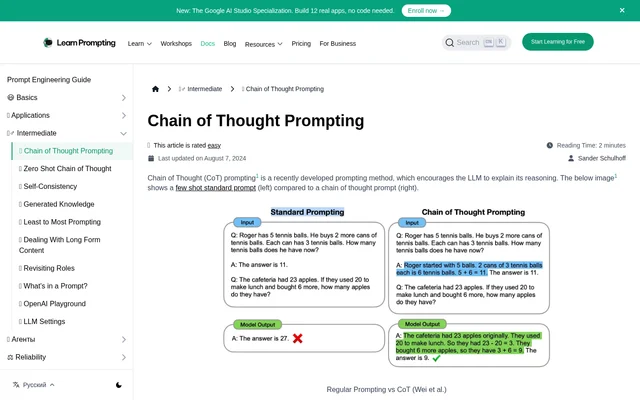
Chain of Thought Prompting shows how adding worked steps to examples changes what a prompt demonstrates to a model. Instead of showing only a question and its answer, the examples also show how the answer was reached. The article illustrates the difference with a word problem and places the demonstration alongside published benchmark results.
- The guide compares standard few-shot prompts with prompts that include worked reasoning.
- The guide shows GPT-3 answering the same word problem incorrectly and correctly under different prompts.
- The guide reports results from arithmetic, commonsense, and symbolic reasoning tasks.
- The guide identifies a limitation observed in smaller models.
How Chain of Thought Prompting works
Chain of Thought Prompting describes a few-shot workflow: the prompt includes examples in which the steps leading to each answer are written out, followed by the question the model should answer. The examples demonstrate both how to work through the problem and what the response should contain. The technique changes the prompt rather than fine-tuning the model.
Who Chain of Thought Prompting is for
Chain of Thought Prompting is for readers learning how to construct prompts for reasoning tasks. The word problem provides a concrete example of what to change in a few-shot prompt, while the research discussion gives readers context for applying the technique beyond arithmetic. The guide distinguishes demonstrated results from cases where the approach may not help.
- Compare a standard prompt with a prompt that includes worked steps.
- Use worked arithmetic examples to demonstrate how to solve a word problem.
- Study reported results for commonsense and symbolic reasoning tasks.
Chain of Thought Prompting pricing and plans
Chain of Thought Prompting is available as a Learn Prompting documentation article. The separate course pricing page lists a free individual plan with access to free courses and certificates of completion. Plus costs $21 per month billed annually, and Teams costs $25 per seat per month billed annually. Learn Prompting directs enterprise customers to contact sales for pricing.
Chain of Thought Prompting is a guide rather than the course subscription described on the pricing page. Learn Prompting lists the full course library, an in-course AI Playground with an AI Tutor, and hand-graded projects under Plus and Teams. The Enterprise plan lists personalized learning paths, an admin dashboard, and LMS and LXP integrations.
Chain of Thought Prompting strengths and limitations
Chain of Thought Prompting pairs a direct prompt comparison with evidence from published research. The example uses the same word problem and GPT-3 model to illustrate how the prompt changes the result. The article also reports that prompted PaLM 540B achieved a 57% solve rate on GSM8K, while noting that gains in the cited research depended on model size.
- The cited study observed performance gains only with models of roughly 100 billion parameters.
- Smaller models in the cited research sometimes produced illogical explanations.
- Those explanations sometimes led to lower accuracy than standard prompting.
Chain of Thought Prompting FAQ
What is Chain of Thought Prompting?
Chain of Thought Prompting is a Learn Prompting article about encouraging large language models to explain how they reach an answer. The guide compares standard few-shot prompts with prompts that include worked steps in their examples.
Is Chain of Thought Prompting free?
Chain of Thought Prompting is available in Learn Prompting’s documentation. The separate course pricing page lists a free individual plan with access to free courses, plus paid subscriptions for individuals and teams and contact-sales pricing for enterprises.
How does Chain of Thought Prompting work?
Chain of Thought Prompting uses few-shot examples that show the steps leading to each answer. These examples encourage the language model to include similar explanatory steps when answering the next question. The article demonstrates the method without fine-tuning a model.
What tasks can Chain of Thought Prompting help with?
Chain of Thought Prompting describes research reporting improvements on arithmetic, commonsense, and symbolic reasoning tasks. The guide demonstrates the technique on a word problem that GPT-3 answered incorrectly under standard prompting and correctly with a chain-of-thought prompt.
Does Chain of Thought Prompting work with smaller language models?
Chain of Thought Prompting notes that smaller models in the cited research sometimes performed worse with the technique than with standard prompting. Those models produced illogical explanations, and the study reported gains only with models of roughly 100 billion parameters.
From the community
No reviews yet
Be the first to review this tool. What you write helps the next person choose.