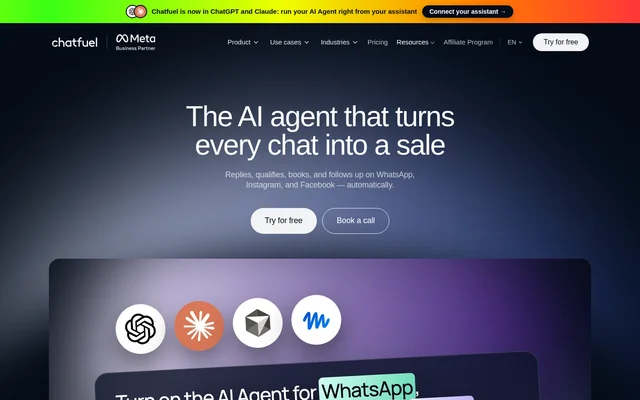
What is Chatfuel?
Chatfuel is an AI agent and customer messaging tool for businesses that sell and support customers through conversations. Chatfuel brings messaging, booking, follow-ups, and automation into one workspace, with particular emphasis on WhatsApp and Instagram-first businesses. Chatfuel also supports agencies managing client businesses, creators selling through direct messages, and developers building AI-powered experiences.
What Chatfuel can do
Chatfuel automates tasks across the sales conversation, from responding to an initial comment to qualifying a prospect, arranging an appointment, or sharing a payment link. Chatfuel also creates lead cards from chats and provides advertising reporting within the automation dashboard. These capabilities connect customer communication with sales tracking rather than treating replies as an isolated task.
- Chatfuel replies to post and Reel comments publicly and through direct messages.
- Chatfuel asks qualification questions and identifies leads ready to buy or book.
- Chatfuel sends payment links and confirms orders after payment.
- Chatfuel books appointments, sends reminders, and syncs bookings to a calendar.
- Chatfuel creates lead cards automatically from conversations.
- Chatfuel reports which advertising creatives generated sales.
How Chatfuel works
Chatfuel lets businesses connect messaging channels and launch automation using ready-made templates or visually built flows without coding. Chatfuel documentation covers connecting clients, building qualification bots, and running ads. Teams can manage live conversations in the inbox and follow up when automation needs a human, while developers can use the Chatfuel SDK and API for custom experiences.
Chatfuel lists integrations with Google Sheets, Zapier, Stripe, HubSpot, Shopify, and Calendly. Chatfuel uses the official WhatsApp Business API for WhatsApp messaging. For setup, Chatfuel also offers conversational configuration through Coworker; the pricing page states that setup conversations consume credits, so configuration can contribute to initial usage costs.
Who Chatfuel is for
Chatfuel serves businesses handling sales and service through messaging, agencies deploying automation for clients, and creators converting social engagement into conversations. Chatfuel lists industry templates and applications for beauty, real estate, coaching, professional services, fitness, local services, e-commerce, education, and clinics. Developers can also build white-label agent experiences using the SDK.
- Chatfuel helps agencies deploy and manage automation for client businesses.
- Chatfuel helps creators respond to comments and qualify buying intent in direct messages.
- Chatfuel helps service businesses qualify enquiries and schedule appointments.
- Chatfuel helps online sellers answer product questions and collect payments through chat.
Chatfuel pricing and plans
Chatfuel offers a free trial with a starting balance, followed by paid Business and Agency plans. Business S is US$18 per month billed yearly at US$216/year and includes US$20 in monthly AI credits. Agency S is US$90 per month billed yearly at US$1,080/year and includes US$100 in monthly AI credits plus support for 3 companies.
Chatfuel meters AI replies, WhatsApp templates, and lead events reported to Meta. Chatfuel includes inbox, contacts, bookings, flows, and every channel in every plan. Meta WhatsApp messaging charges are separate from the subscription but come from the same wallet. Annual billing is paid for the year, and paid plans can be cancelled through billing settings.
Chatfuel strengths and limitations
Chatfuel combines customer messaging and sales tasks with no-code configuration, shared inbox access, and developer tools. Chatfuel supports a workflow that can move from a social comment to qualification, booking, or payment. However, Chatfuel uses metered credits, so the subscription price alone does not describe every potential charge associated with automation and WhatsApp messaging.
- Chatfuel does not carry unused credits over to the next renewal.
- Chatfuel pauses AI replies when credits are exhausted unless credits are added or the plan is upgraded.
- Chatfuel charges credits for setup conversations through Coworker.
- Chatfuel requires a paid plan to continue after the trial.
Chatfuel FAQ
What is Chatfuel?
Chatfuel is an AI messaging and sales automation tool for businesses using channels such as WhatsApp, Instagram, and Facebook. Chatfuel combines customer replies, lead qualification, booking, follow-ups, and contact management, with templates and visual flows for no-code setup.
Is Chatfuel free?
Chatfuel offers a free trial with a starting balance, followed by paid plans. Business S costs US$18 per month when billed yearly at US$216/year and includes US$20 in monthly AI credits. Meta WhatsApp messaging fees are separate from the subscription.
Do you need coding skills to use Chatfuel?
Chatfuel does not require coding skills for standard setup because businesses can launch with templates and build flows visually. Chatfuel also provides an SDK and API for developers who want to integrate AI experiences into products or build white-label agent platforms.
What integrations does Chatfuel support?
Chatfuel lists integrations with Google Sheets, Zapier, Stripe, HubSpot, Shopify, and Calendly. Chatfuel also offers API access and an SDK for custom development, alongside the official WhatsApp Business API for WhatsApp messaging.
What happens when Chatfuel credits run out?
Chatfuel pauses AI replies when available credits run out until additional credits are added or the account moves to a higher plan. Chatfuel offers credit packs and auto-reload, while unused credits do not roll over between renewals.
Can a team manage customer chats in Chatfuel?
Chatfuel lets teams handle live conversations and follow up when automation needs a human. Chatfuel includes the inbox, contacts, bookings, flows, and every channel in every plan, allowing customer communication and related tasks to be managed in one workspace.
From the community
No reviews yet
Be the first to review this tool. What you write helps the next person choose.