What is CodeThreat?
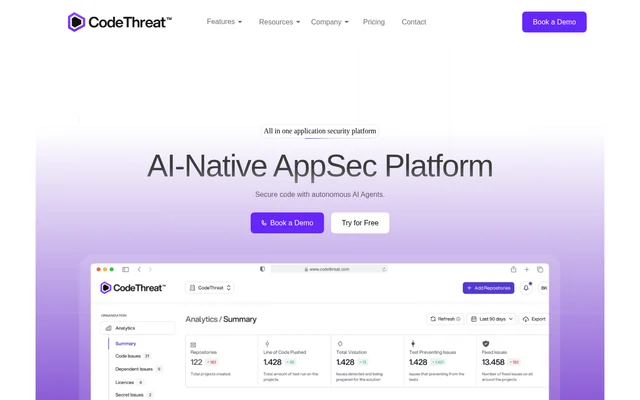
CodeThreat is an AI-native application security platform that uses autonomous agents to analyze code and security findings. CodeThreat serves developers and security teams working on pull requests, repository understanding, and vulnerability assessment. The product combines security scanning with AI-powered code intelligence so reviews, results, and project context can be examined together.
CodeThreat covers static application security testing, software composition analysis, infrastructure as code, container security, and secret scanning. The AI analysis uses project context to examine logic flaws, data flows, and authentication paths. Repository analysis adds information about architecture, documentation, endpoints, and dependencies alongside the security review.
What CodeThreat can do
CodeThreat combines pull request analysis with broader codebase inspection and finding validation. CodeThreat examines changes before merge, reviews projects for issues and risks, and maps repository structure. The false-positive agent rechecks findings, flags those considered non-exploitable, and explains why they are likely false positives.
- CodeThreat analyzes pull request changes for security risks before merge.
- CodeThreat performs AI-driven reviews across an entire codebase.
- CodeThreat rechecks security findings and explains likely false positives.
- CodeThreat maps repository components, flows, and relationships.
- CodeThreat generates insights about architecture, documentation, endpoints, and dependencies.
- CodeThreat combines SAST, SCA, IaC, container security, and secret scanning.
How CodeThreat works
CodeThreat integrates with GitHub, GitLab, Bitbucket, CI/CD pipelines, and cloud providers to bring analysis into existing development workflows. CodeThreat supports 27+ programming languages and frameworks. Pull request analysis highlights risks before code merges, while project-wide analysis supplies context about the broader codebase and its relationships.
CodeThreat presents reviews, results, and context in one place rather than separating repository understanding from security findings. Repository mapping visualizes structure and flows, while AI SAST evaluates the codebase with project context. Enterprise customers also have on-prem deployment and private LLM model hosting options listed in their plan.
Who CodeThreat is for
CodeThreat addresses small teams exploring application security, teams shipping code at scale, and companies needing deeper security coverage and governance. CodeThreat supports developers reviewing changes and application security teams assessing vulnerabilities. The plan descriptions distinguish lightweight evaluation from paid team capabilities and enterprise deployment, support, and compliance needs.
- Developers can use CodeThreat to assess security risks during pull request review.
- Security teams can use CodeThreat to recheck findings and investigate likely false positives.
- Engineering teams can use CodeThreat to understand repository architecture and data flows.
- Enterprises can use CodeThreat for on-prem deployment and advanced compliance reporting.
CodeThreat pricing and plans
CodeThreat offers a Free plan at $0 per month with 3 private repositories, limited Agentic PR Review, limited False Positive Elimination, and SAST plus SCA scanning. The Free plan does not include credit top-ups. The website provides a free access option alongside demo booking and sales contact.
CodeThreat lists the Pro plan at $39 per contributor per month, with role-based access control, secret scanning, infrastructure security, Jira integration, and vulnerability reports and exports. The Enterprise plan lists on-prem deployment, an SLA with dedicated support, advanced compliance reporting, private LLM model hosting options, and manual invoicing.
CodeThreat strengths and limitations
CodeThreat brings several security disciplines into a shared product and connects security analysis to pull request workflows. Repository mapping and contextual finding explanations support investigation beyond a list of scanner alerts. Access is tiered, however: the free offering limits repository coverage and agent capabilities, while enterprise deployment options are listed separately.
- CodeThreat limits the Free plan to 3 private repositories.
- CodeThreat provides only limited Agentic PR Review and False Positive Elimination on the Free plan.
- CodeThreat excludes credit top-ups from the Free plan.
- CodeThreat lists on-prem deployment and private LLM hosting options under Enterprise.
CodeThreat FAQ
What is CodeThreat?
CodeThreat is an AI-native application security platform that uses autonomous agents to review code, analyze repositories, and recheck security findings. CodeThreat combines SAST, SCA, infrastructure as code, container security, and secret scanning for development and security teams.
Is CodeThreat free?
CodeThreat offers a Free plan at $0 per month with 3 private repositories, limited Agentic PR Review, limited False Positive Elimination, and SAST plus SCA scanning. CodeThreat also offers a Pro plan at $39 per contributor per month and an Enterprise plan.
Which integrations does CodeThreat support?
CodeThreat integrates with GitHub, GitLab, Bitbucket, CI/CD pipelines, and cloud providers. CodeThreat also lists Jira integration in the Pro plan and supports 27+ programming languages and frameworks.
How does CodeThreat handle false positives?
CodeThreat uses a False Positive Agent to recheck findings, flag non-exploitable issues, and explain why findings are likely false positives. CodeThreat also describes continuous learning to filter weak or non-relevant findings, with limited False Positive Elimination included in the Free plan.
Can CodeThreat be deployed on premises?
CodeThreat lists on-prem deployment under the Enterprise plan, alongside private LLM model hosting options. CodeThreat Enterprise also includes an SLA with dedicated support, advanced compliance reporting, and manual invoicing.
What can CodeThreat repository analysis do?
CodeThreat maps an entire project and generates AI-powered insights about architecture, documentation, endpoints, dependencies, and data flow. CodeThreat repository mapping visualizes components, flows, and relationships to help teams understand codebase structure.
From the community
No reviews yet
Be the first to review this tool. What you write helps the next person choose.