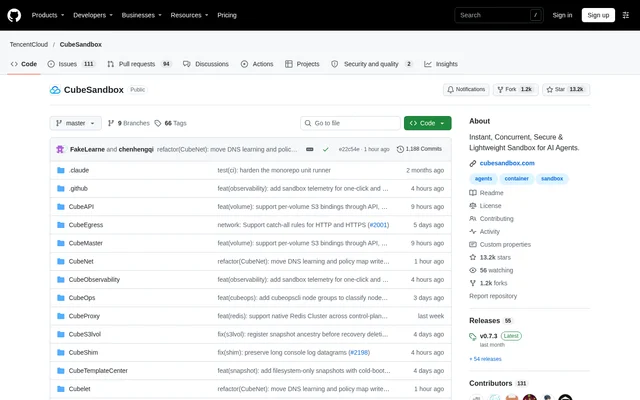
What is CubeSandbox?
CubeSandbox is an open-source sandbox service for AI agents, built on RustVMM and KVM. CubeSandbox gives agent code a hardware-isolated execution environment, with each sandbox running a dedicated operating-system kernel inside a MicroVM. The project supports both single-node deployment and scaling to multi-node clusters.
CubeSandbox targets workflows that need isolated execution alongside manageable sandbox state and infrastructure. The repository provides documentation, deployment guides, and example projects covering code execution, browser automation, OpenClaw integration, and reinforcement learning training. A browser console provides visual access to sandbox management after installation.
What CubeSandbox can do
CubeSandbox combines execution isolation, state management, storage, and network controls in a sandbox service. CubeSandbox also exposes an E2B-compatible interface for existing client workflows. The documented capabilities cover both individual sandbox operations and infrastructure concerns such as shared storage, credential handling, and automatic suspension of idle environments.
- CubeSandbox runs each sandbox in a dedicated MicroVM with its own kernel.
- CubeSandbox creates snapshots, clones saved states, and rolls back running sandboxes.
- CubeSandbox automatically pauses idle sandboxes and resumes them on the next request.
- CubeSandbox filters outbound traffic and injects credentials without exposing keys to sandbox code.
- CubeSandbox supports custom storage backends and volumes shared across sandboxes.
- CubeSandbox provides sandbox creation and streaming logs through a browser console.
How CubeSandbox works
CubeSandbox installation follows a documented workflow: provision a server, install the service, create a sandbox template, and run agent code. The quick-start guide requires an x86_64 Linux environment with KVM support and says no source build is needed. Separate documentation covers native ARM64 compilation, build, and deployment workflows.
CubeSandbox uses an API gateway, cluster orchestrator, reverse proxy, and compute-node lifecycle component to route requests and manage sandboxes. CubeSandbox supports E2B SDK workflows through its compatible interface. Observability components expose CPU, memory, sandbox-count metrics, and execution logs, with support for Prometheus, Loki/Elasticsearch, and Grafana.
Who CubeSandbox is for
CubeSandbox serves developers building AI agents and teams operating agent execution infrastructure. CubeSandbox examples connect the sandbox service to practical workloads rather than only demonstrating deployment. Snapshot, rollback, and fork operations also support workflows that need saved execution states or parallel exploration from a common checkpoint.
- CubeSandbox supports isolated code execution for AI agents.
- CubeSandbox includes examples for browser automation and OpenClaw integration.
- CubeSandbox includes reinforcement learning training examples.
- CubeSandbox can fork a saved state to explore execution paths in parallel.
CubeSandbox pricing and access
CubeSandbox is available as an open-source project through a public GitHub repository. The supplied page does not list subscription plans or hosted-service prices. CubeSandbox documentation describes deployment on cloud virtual machines and bare metal, Terraform deployment on Tencent Cloud, and deployment on standard Kubernetes clusters marked as preview.
CubeSandbox strengths and limitations
CubeSandbox brings hardware isolation, network policy enforcement, credential protection, and state management into the same service. CubeSandbox supports both smaller deployments and clustered infrastructure, with browser-based management and documented observability integrations. Compatibility and deployment claims still need qualification: the roadmap identifies remaining E2B specification gaps, and some deployment or state-transfer features are explicitly marked as preview.
- CubeSandbox requires infrastructure provisioning and installation before use.
- CubeSandbox marks Kubernetes deployment as preview.
- CubeSandbox lists closing remaining E2B API compatibility gaps on its roadmap.
- CubeSandbox labels its development environment as not recommended because of poor performance.
CubeSandbox FAQ
What is CubeSandbox?
CubeSandbox is an open-source sandbox service for AI agents built on RustVMM and KVM. CubeSandbox runs agent workloads in hardware-isolated MicroVMs and supports single-node deployments, multi-node clusters, snapshots, cloning, rollback, and network security controls.
How is CubeSandbox available?
CubeSandbox is available as an open-source project through its public GitHub repository. CubeSandbox provides installation guides and deployment documentation, but the supplied page does not list subscription plans or hosted-service pricing.
Is CubeSandbox compatible with the E2B SDK?
CubeSandbox supports the E2B SDK interface, and the repository describes switching from E2B Cloud by changing an environment variable without client-code changes. CubeSandbox also lists closing remaining E2B API specification gaps on its roadmap, so complete API coverage should not be assumed.
How does CubeSandbox protect sandbox credentials and network traffic?
CubeSandbox uses kernel-level network isolation, egress filtering, and an application-layer security proxy. CubeSandbox supports domain, path, and method policies, while its credential vault injects credentials for external API calls without exposing the keys to sandbox code.
What deployment options does CubeSandbox support?
CubeSandbox supports single-node and multi-node deployment, with guides for cloud virtual machines and bare metal. CubeSandbox also documents Terraform deployment on Tencent Cloud and deployment on standard Kubernetes clusters in preview, alongside native ARM64 support.
Can CubeSandbox save and restore sandbox state?
CubeSandbox supports snapshots, cloning, and rollback to saved sandbox states through its Copy-on-Write snapshot engine. CubeSandbox also supports automatic pause and resume, plus cross-node pause and resume using an S3 backend; creating sandboxes from snapshots is marked as preview.
From the community
No reviews yet
Be the first to review this tool. What you write helps the next person choose.