What is Dify?
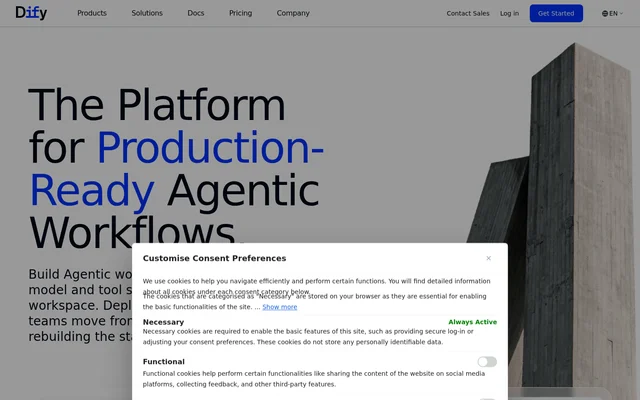
Dify is an AI application development platform for building agents, agentic workflows, and retrieval-augmented generation applications. Dify brings workflows, knowledge bases, model providers, and tools into a collaborative workspace for developers and teams. Deployment choices include managed cloud hosting, private infrastructure, and a source-available Community Edition.
Dify uses visual building blocks and AI prompts to make application logic visible. Teams can define how an application retrieves information, makes decisions, invokes tools, requests human input, and completes tasks. Dify also provides publishing and monitoring capabilities so teams can test, deploy, and improve applications within the same workspace.
What Dify can do
Dify connects application design with knowledge preparation, integrations, and delivery. Agents can be created through conversation or manual configuration, then used independently or placed inside workflows. Knowledge pipelines prepare source content before connecting knowledge bases to agents or workflows, while publishing options expose the resulting applications in several formats.
- Dify builds visual workflows with prompts, decisions, tools, and human input.
- Dify creates agents with skills, tools, and knowledge.
- Dify extracts, cleans, chunks, indexes, and tests retrieval from source content.
- Dify installs model providers, tools, data sources, and MCP integrations.
- Dify publishes applications as hosted experiences, APIs, embeds, or MCP-compatible tools.
- Dify tracks logs, feedback, annotations, latency, and usage.
How Dify works
Dify lets teams define application behavior in Workflow Studio and prepare supporting information through Knowledge Pipeline. Source material can come from files, websites, online documents, and drives. Teams can install integrations from the Marketplace or define their own, then reuse approved plugins across applications rather than configure each project separately.
Dify Cloud provides a managed workspace without infrastructure setup. Dify Community Edition supports a single-command Docker deployment, while Dify Enterprise can run on private infrastructure or in a VPC and offers a Helm chart for Kubernetes deployments. Applications can be published and reviewed using the available monitoring data.
Who Dify is for
Dify serves independent developers and small teams building production AI applications, medium-sized teams needing collaboration and higher throughput, and enterprises with procurement, security, and audit requirements. Dify also supports no-code agent development, and the page describes its interface as accessible to beginners working on AI applications.
- Dify helps developers build agents that combine tools and knowledge.
- Dify supports teams creating document-backed RAG applications.
- Dify supports natural language processing pipelines.
- Dify lets teams embed agents into websites or reuse agents inside workflows.
Dify pricing and plans
Dify Cloud offers a free Sandbox plan for trying core features, plus paid Professional and Team plans. The structured pricing data lists Professional at $59 per workspace per month and Team at $159 per workspace per month. The pricing page also lists annual workspace prices of $590 and $1590, respectively.
Dify Sandbox includes 200 message credits, 5 apps, 50 knowledge documents, and 50MB of knowledge storage. Paid plans increase workspace capacity and other quotas. Dify Enterprise is available through sales, while the Community Edition is source-available under an Apache-2.0-derivative license with community Discord and forum support.
Dify strengths and limitations
Dify combines visual development, knowledge preparation, plugin reuse, publishing, and monitoring rather than treating these as separate application-building steps. Dify also offers deployment choices for teams that want managed hosting or control over private infrastructure. Enterprise capabilities include SSO, SAML, RBAC, audit logs, and dedicated support.
- Dify Sandbox has limits on members, applications, storage, and triggers.
- Dify stops new document uploads when knowledge storage reaches its limit.
- Dify self-hosting requires infrastructure management.
- Dify Community Edition uses an Apache-2.0-derivative license.
Dify FAQ
What is Dify?
Dify is an AI application development platform for building agents, visual workflows, and RAG applications. Dify combines knowledge pipelines, model and tool integrations, publishing, and monitoring in a collaborative workspace.
Is Dify free?
Dify offers a free cloud Sandbox plan for trying core features, with limits on credits, applications, documents, and storage. Dify also offers paid cloud plans, Enterprise deployment, and a source-available Community Edition for Docker-based self-hosting.
How much does Dify cost?
Dify Cloud includes a free Sandbox plan, Professional at $59 per workspace per month, and Team at $159 per workspace per month. Dify also lists annual prices of $590 for Professional and $1590 for Team, excluding applicable taxes.
Can Dify be self-hosted?
Dify supports self-hosting through its source-available Community Edition with a single-command Docker deployment. Dify Enterprise can run on private infrastructure or in a VPC and includes a Helm chart for Kubernetes deployments.
Does Dify support APIs and MCP integrations?
Dify supports publishing applications as API endpoints and MCP-compatible tools, alongside hosted experiences and embeds. Dify also provides Marketplace integrations for model providers, tools, data sources, and MCP, with support for defining custom integrations.
Who is Dify for?
Dify serves independent developers, small teams building production AI applications, medium-sized teams needing collaboration and higher throughput, and enterprises with security and audit requirements. Dify also supports no-code agent development for beginners.
From the community
No reviews yet
Be the first to review this tool. What you write helps the next person choose.