What is Elicit?
Elicit is an AI tool for scientific research that helps researchers find evidence, analyze studies, and produce cited research outputs. Elicit supports work ranging from answering a research question to conducting a comprehensive literature review. The stated audiences include researchers in academia, pharmaceuticals, medical technology, government, consumer goods, industrials, and software.
Elicit combines paper search, research reports, systematic review workflows, a source library, and a research agent. Elicit supports AI-generated claims with sentence-level citations from underlying sources. Interactive tables and multi-step workflows provide ways to examine evidence beyond a conversational response, while saved sources can be reused in future projects.
What Elicit can do
Elicit covers several stages of evidence-based research, from locating relevant studies to preparing reports and maintaining an existing body of work. Elicit searches over 138 million academic papers and 545,000 clinical trials. The research agent can also gather evidence from scientific databases, academic journals, public data sources, and internally uploaded documents.
- Elicit uses semantic search to find relevant research without requiring every matching keyword.
- Elicit generates research reports with customizable papers and information coverage.
- Elicit automates screening and data extraction for systematic reviews.
- Elicit creates cited reports, tables, figures, bioinformatics analyses, calculations, and slides.
- Elicit stores and organizes sources for reuse in future projects.
- Elicit Routines find new evidence, update work, and report back for review.
How Elicit works
Elicit demonstrates a report workflow that starts with a researcher typing a research question. Elicit then searches academic papers and generates a structured report with citations. Researchers can change which papers are included and what information the report covers, allowing the output to reflect a particular research scope.
Elicit also offers a shared library where researchers and AI agents can work from the same evidence. Elicit Routines let researchers tell the research agent what to keep current. For programmatic use, the Elicit API and MCP server bring research capabilities into agents and workflows; the supplied page does not describe implementation steps.
Who Elicit is for
Elicit serves researchers across scientific domains and industries rather than a single discipline. Elicit names pharmaceuticals, academia, medical devices and technology, policy and government, consumer goods, industrials, and software and technology. These audiences use scientific evidence to inform research, product development, policy decisions, materials engineering, and software performance questions.
- Elicit supports academic researchers reviewing existing scientific knowledge.
- Elicit supports pharmaceutical researchers examining clinical trials and previous literature.
- Elicit supports policy researchers gathering evidence for government decisions.
- Elicit supports industrial researchers investigating materials and engineering questions.
- Elicit supports software researchers examining user experience and algorithmic performance.
Elicit strengths and limitations
Elicit combines source-linked outputs, customizable reports, and reusable evidence organization. Elicit states that every AI-generated claim has sentence-level citations, giving researchers a route back to the underlying material. The stated scale reaches up to 1,000 relevant papers and 20,000 data points analyzed at once, although systematic review support is not described as fully automated from beginning to end.
- Elicit only partially supports search and report generation within systematic reviews.
- Elicit states upper limits for papers found and data points analyzed at once.
- Elicit describes a monthly usage pool without specifying the allowance on this page.
Getting started with Elicit
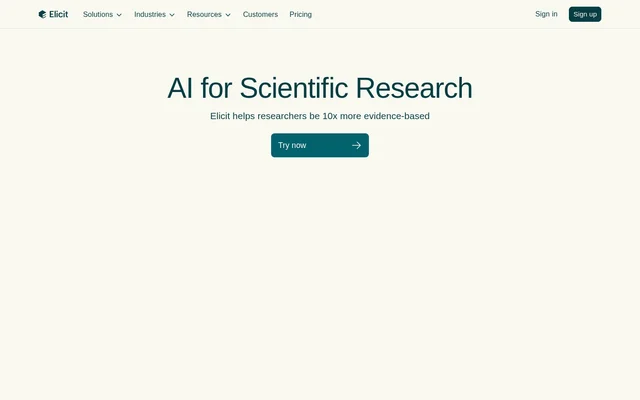
Elicit provides a website entry point labeled Try now and demonstrates beginning with a research question. Elicit users can generate a report, adjust its paper selection and information coverage, and organize useful sources in the library. Researchers maintaining ongoing work can describe what the research agent should keep current through Routines. Subscription prices and plan details are not stated in the supplied page.
Elicit FAQ
What is Elicit?
Elicit is an AI scientific research tool that helps researchers search academic literature, generate cited reports, and extract information from studies. Elicit also supports systematic review screening, source organization, and ongoing research updates through Routines.
What sources does Elicit search?
Elicit searches over 138 million academic papers and 545,000 clinical trials. Elicit's research agent also gathers evidence from scientific databases, academic journals, public data sources, and internally uploaded documents.
Can Elicit automate systematic literature reviews?
Elicit can automate screening and data extraction for systematic literature reviews, while only partially supporting search and report generation. Elicit also provides customizable research briefs based on a process inspired by systematic reviews.
Does Elicit provide citations?
Elicit supports AI-generated claims with sentence-level citations from underlying sources. Elicit generates structured research reports with citations and allows researchers to change which papers and information are covered in those reports.
Does Elicit have an API or MCP server?
Elicit offers an API and MCP server that bring its research capabilities into agents and workflows. Elicit also describes a shared research library where researchers and AI agents can work from the same evidence.
How does Elicit keep research up to date?
Elicit uses Routines to find new evidence, update existing work, and report back for review. Elicit lets researchers tell the research agent what to keep current so ongoing research can incorporate new findings.
From the community
No reviews yet
Be the first to review this tool. What you write helps the next person choose.