What is Epsilon?
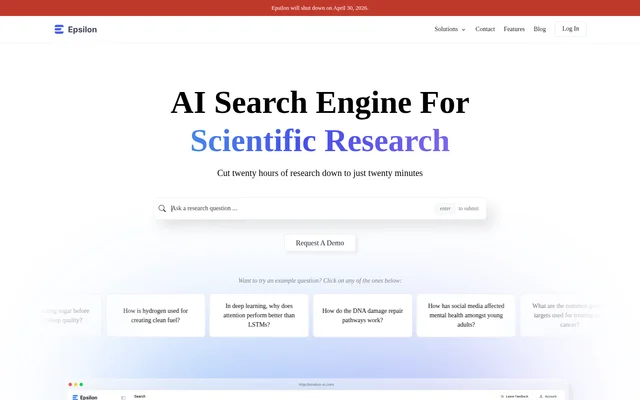
Epsilon is an AI search engine for scientific research that helps researchers investigate questions using academic literature. Epsilon combines cited answers, publication and patent discovery, information extraction, and paper libraries. The website announces that Epsilon will shut down on April 30, 2026, an important constraint for anyone considering ongoing research use.
Epsilon uses a dataset supplied by Semantic Scholar containing over 200 million academic papers, including papers from PubMed, arXiv, and Papers With Code. The website describes research activities ranging from finding citations and evaluating research questions to writing grants, drafting proposals, and learning unfamiliar topics.
What Epsilon can do
Epsilon supports research tasks from initial evidence searches through synthesis across saved papers. Answers summarize relevant passages and include inline references to the underlying source content. Publication searches also organize results into latest research, key texts, and relevant articles, helping researchers approach a topic through different groups of results.
- Epsilon answers research questions with inline source references.
- Epsilon searches for publications and patents.
- Epsilon extracts relevant information from multiple papers for a question or claim.
- Epsilon summarizes the introduction, results, and conclusion of uploaded papers.
- Epsilon organizes saved papers into research libraries.
- Epsilon searches across an entire library to synthesize findings.
How Epsilon works
Epsilon takes a research question, finds the top 100 related papers, and passes those papers with the query to GPT-4 to generate a scientific summary. Researchers can open papers directly from search results or save a PDF to a library when that PDF is publicly available.
Epsilon also accepts uploaded papers for summarization and supports searches across saved libraries. Epsilon states that queries pass to third-party infrastructure providers such as OpenAI and that the same applies to library papers. The website says this data cannot be traced back to individual users.
Who Epsilon is for
Epsilon serves researchers who need to find, evaluate, and combine academic evidence. The website names literature reviews, meta-analyses, grant writing, project execution, and paper writing as uses. Example questions span sleep, clean fuel, deep learning, DNA repair, mental health, cancer treatment, and inequality, illustrating the range of research topics presented.
- Researchers can use Epsilon to find evidence supporting or challenging a claim.
- Researchers can use Epsilon to locate citations for papers and proposals.
- Researchers can use Epsilon to extract information for literature reviews and meta-analyses.
- Research teams can use Epsilon for onboarding and learning new topics.
Epsilon strengths and limitations
Epsilon brings source-linked answers, document extraction, and library synthesis into the same research workflow. Inline references connect generated summaries to academic source content, while library searches focus synthesis on papers a researcher has selected. These capabilities support evidence gathering and comparison without relying solely on a general answer disconnected from source papers.
- Epsilon announces that the service will shut down on April 30, 2026.
- Epsilon can save search-result PDFs to a library when those PDFs are publicly available.
- Epsilon sends queries and library papers to third-party infrastructure providers.
Getting started with Epsilon
Epsilon provides example research questions on its website and a demo request option. The described workflow starts with a question, continues through cited answers and publication searches, and extends to saving or uploading papers. Researchers can then organize papers into libraries and search across those collections to synthesize results.
Epsilon FAQ
What is Epsilon?
Epsilon is an AI search engine for scientific research that generates cited answers, finds publications and patents, and helps researchers extract and synthesize information across papers. Epsilon uses a Semantic Scholar dataset containing over 200 million academic papers.
How does Epsilon generate research answers?
Epsilon finds the top 100 papers related to a search query and passes them, along with the query, to GPT-4. Epsilon summarizes scientific information and includes inline references to the underlying source content.
Can Epsilon summarize uploaded papers?
Epsilon summarizes uploaded papers, covering their introduction, results, and conclusion. Epsilon also lets researchers create libraries, save papers, and search across an entire library to synthesize findings from papers they trust.
When will Epsilon shut down?
Epsilon announces that the service will shut down on April 30, 2026. The shutdown notice appears on the same page that describes Epsilon's scientific search, cited answers, paper extraction, and library synthesis capabilities.
Does Epsilon share research queries with third parties?
Epsilon passes search queries to third-party infrastructure providers such as OpenAI, and the website says the same applies to papers added to a library. Epsilon states that none of this data can be traced back to an individual user.
From the community
No reviews yet
Be the first to review this tool. What you write helps the next person choose.