What is Fabric?
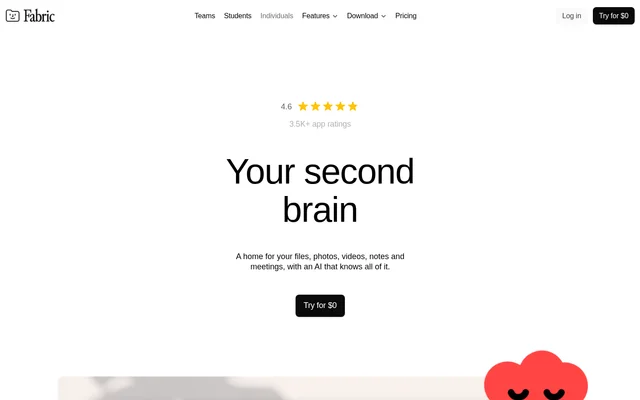
Fabric is an AI workspace for storing, searching, and working with files, photos, videos, notes, and meetings. Fabric brings cloud storage, writing, visual planning, and task management into a shared environment. The website identifies founders, students, designers, researchers, and marketers among its intended audiences, alongside freelancers, educators, consultants, and other professionals.
Fabric connects saved material with an AI that can search information and perform work across supported apps. The workspace includes a visual canvas for arranging content, an editor for writing and linking ideas, and spaces for gathering project material. Fabric also supports sharing content externally through published portals.
What Fabric can do
Fabric combines content search with tools for creating, organizing, and sharing work. Supported material includes PDFs, EPUBs, images, documents, audio files, video files, emails, and meeting notes. Fabric also describes agents that search, summarize, connect information, and take actions, with examples ranging from drafting client replies to updating project roadmaps.
- Fabric searches visual libraries by description, colour, or mood.
- Fabric records meetings, transcribes conversations, and retains key points.
- Fabric creates tasks with priorities, due dates, and reminders linked to relevant files.
- Fabric arranges files, assets, and notes on a visual canvas.
- Fabric schedules agents to research the web or summarize sales calls.
- Fabric publishes spaces as portals with password protection and link analytics.
- Fabric sends emails, creates tasks, updates CRM records, and retrieves invoices through connected apps.
How Fabric works
Fabric is available on web, mobile, and desktop, and can mount as a drive on a computer. Fabric streams the portions of files needed for access, including video editing without downloading entire files. The page also describes working offline and accessing a library while using little local storage space.
Fabric connects to apps including Gmail, Google Drive, Notion, Slack, Linear, Salesforce, Dropbox, and GitHub. Users can create agents with their own names, personalities, and schedules. Each AI receives an email inbox, allowing users to request work by email or forward messages and attachments that the AI can offer to save.
Who Fabric is for
Fabric addresses people who collect information and coordinate work across documents, media, and apps. The website describes an AI thought companion for founders, tutoring support for students, a searchable visual library for designers, research discussion for researchers, and a workspace for marketers' campaign assets, briefs, and references.
- Fabric helps designers find saved images by description, colour, or mood.
- Fabric helps researchers annotate papers and discuss ideas.
- Fabric helps marketers gather campaign assets, briefs, and references.
- Fabric helps students work through lectures and texts with AI guidance.
- Fabric helps client-facing professionals share deliverables through published portals.
Fabric pricing and access
Fabric advertises a $0 starting option and also refers to Fabric subscriptions. The supplied page does not list subscription prices, plan names, or the limits of the starting offer. Fabric access is described across web, mobile, and desktop, with an additional option to mount Fabric as a computer drive.
Fabric strengths and sharing considerations
Fabric combines several related workflows: storing source material, finding information, developing ideas, assigning tasks, and sharing results. Fabric also extends AI work into connected apps rather than limiting agents to answering questions. For external collaboration, Fabric publishes spaces through links that do not require a recipient login, with password protection available for shared spaces, folders, or files.
Fabric provides link analytics showing who viewed shared links, when they viewed them, and how long they spent. This supports checking engagement with proposals and other client material. The supplied page does not describe plan-specific feature restrictions, so the availability of individual capabilities within the $0 starting option is not established.
Fabric FAQ
What is Fabric?
Fabric is an AI workspace for files, photos, videos, notes, and meetings. Fabric combines searchable cloud storage with a writing editor, visual canvas, task management, meeting transcription, and agents that can perform work across connected apps.
Is Fabric free?
Fabric advertises a $0 starting option and references subscriptions. Fabric's supplied page does not state subscription prices, plan names, or free-access limits, so the scope of the starting offer is not specified.
Which apps does Fabric integrate with?
Fabric lists integrations including Gmail, Google Drive, Notion, Slack, Linear, Salesforce, Dropbox, GitHub, Outlook, and Zapier. Fabric says connected-app actions include sending emails, creating tasks, updating CRM records, and retrieving invoices.
Can Fabric run scheduled AI agents?
Fabric lets users create AI agents with individual names, personalities, and schedules. Fabric agents can run scheduled research and summarization jobs, and each AI receives an email inbox for requests, forwarded messages, and attachments.
Can Fabric share files with clients without a login?
Fabric can publish spaces as portals for clients, stakeholders, or new hires through links that require no recipient login. Fabric also offers password protection for shared spaces, folders, and files, plus analytics showing viewing activity.
Does Fabric work on desktop and mobile?
Fabric is available on web, mobile, and desktop, and can mount as a drive on a computer. Fabric describes offline working and file streaming that accesses only the needed content rather than downloading entire files.
From the community
No reviews yet
Be the first to review this tool. What you write helps the next person choose.