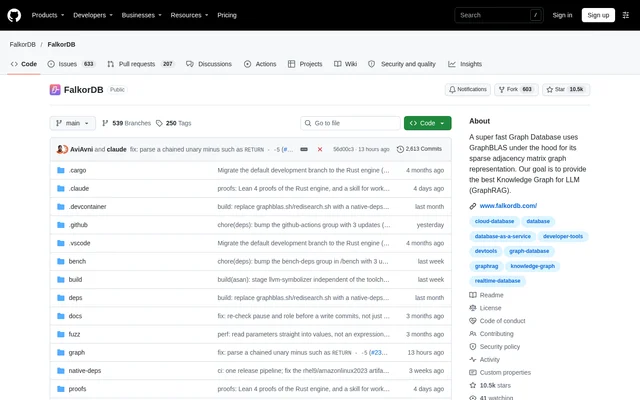
What is FalkorDB?
FalkorDB is an open-source graph database project for building and querying property graphs, with a stated focus on knowledge graphs for large language models. FalkorDB identifies generative AI, agent memory, cloud security, and fraud detection as application areas. The repository contains a Rust implementation that builds a Redis module using GraphBLAS for graph storage and traversal.
FalkorDB represents graph adjacency through sparse matrices and uses linear algebra for querying. FalkorDB supports nodes and relationships with attributes under the Property Graph Model. OpenCypher compatibility, including proprietary extensions, provides a query language for creating graph data and retrieving information about relationships.
What FalkorDB can do
FalkorDB combines property-graph data modeling with matrix-based storage and query execution. FalkorDB provides database access through a browser interface, supported client libraries, and Redis commands. The repository demonstrates creating a graph of motorcycle riders and teams, then querying team membership and counting matching riders.
- FalkorDB stores graph adjacency using sparse matrices.
- FalkorDB executes graph queries using linear algebra.
- FalkorDB supports attributes on nodes and relationships.
- FalkorDB accepts OpenCypher queries with proprietary extensions.
- FalkorDB exposes commands through Redis clients.
- FalkorDB provides official clients for Java, Python, Node.JS, Rust, Go, and C#.
How FalkorDB works
FalkorDB can be started with the Docker command supplied in the repository. The command maps database and browser ports and mounts a local data directory. After starting the container, users can open http://localhost:3000 to access the browser interface or connect through a supported client library.
FalkorDB's Python example connects to a local database, selects a named graph, and sends queries through the graph object. FalkorDB also accepts GRAPH.QUERY commands through redis-cli. Other Redis clients can interact with the database when they support sending raw commands, although the exact method depends on the client.
Who FalkorDB is for
FalkorDB is aimed at developers working with connected data and knowledge graphs, particularly applications involving large language models. FalkorDB's examples show how entities and their relationships can be created and queried programmatically. The repository also names agent memory, cloud security, and fraud detection as uses for the database.
- FalkorDB supports knowledge-graph work for large language models and GraphRAG.
- FalkorDB serves graph-based agent memory applications.
- FalkorDB targets cloud security and fraud detection applications.
- FalkorDB can model and query relationships such as riders belonging to teams.
FalkorDB licensing and access
FalkorDB is available from a public GitHub repository, and the source states that the project is licensed under the Server Side Public License v1. The supplied page does not describe subscription plans or commercial pricing. FalkorDB provides Docker startup instructions, source code, official documentation links, and client-library references.
FalkorDB strengths and setup limitations
FalkorDB offers several documented access paths: a browser interface, official language clients, and raw Redis commands. FalkorDB also provides a development container with dependencies pre-installed. For contributors building manually, the repository documents native dependencies, compiler requirements, and test commands rather than presenting source compilation as a dependency-free process.
- FalkorDB source builds require GraphBLAS, LAGraph, and RediSearch dependencies.
- FalkorDB local development requires a suitable compiler and OpenMP setup.
- FalkorDB's development-container workflow requires Docker, VS Code, and the Dev Containers extension.
- FalkorDB raw Redis command methods depend on the selected client.
FalkorDB FAQ
What is FalkorDB?
FalkorDB is a property graph database that uses GraphBLAS sparse matrices for graph storage and traversal and linear algebra for querying. FalkorDB focuses on knowledge graphs for large language models and supports OpenCypher queries with proprietary extensions.
How can you run FalkorDB locally?
FalkorDB can run locally using the Docker command in its repository. FalkorDB provides a browser interface at http://localhost:3000 after startup, and developers can also connect using supported client libraries or Redis clients.
Which programming languages does FalkorDB support?
FalkorDB lists official client libraries for Java, Python, Node.JS, Rust, Go, and C#. FalkorDB also lists additional community clients and supports access from Redis clients that can send raw commands.
What can you use FalkorDB for?
FalkorDB targets knowledge graphs for large language models, GraphRAG, generative AI, agent memory, cloud security, and fraud detection. FalkorDB's repository also demonstrates creating and querying relationships between motorcycle riders and teams.
What license does FalkorDB use?
FalkorDB is licensed under the Server Side Public License v1, according to its repository. FalkorDB makes its source available on GitHub and provides Docker and source-build instructions; the supplied page does not state commercial pricing.
What does building FalkorDB from source require?
FalkorDB source builds require GraphBLAS, LAGraph, and RediSearch native dependencies, along with compiler and OpenMP setup. FalkorDB recommends a development container with dependencies pre-installed and also documents a manual build workflow using Cargo.
From the community
No reviews yet
Be the first to review this tool. What you write helps the next person choose.