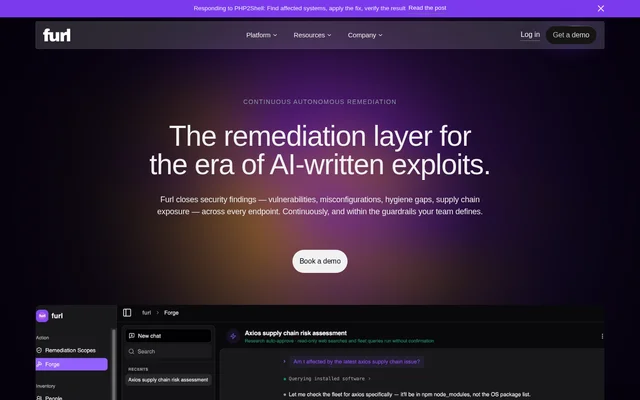
What is Furl?
Furl is an autonomous security remediation tool for security and IT teams that need to close endpoint findings rather than only identify them. Furl addresses vulnerabilities, misconfigurations, hygiene gaps and supply chain exposure. The website describes continuous remediation within guardrails defined by the team, with investigation, fix generation and confirmation that a finding has been closed.
Furl focuses on remediation work that extends beyond patch management. The website highlights misconfigurations, hardening gaps, legacy software and end-of-life systems as endpoint risks that can remain in a backlog without a patch. Furl investigates these findings and builds fixes for the affected environment, including findings that have no vendor fix.
What Furl can do
Furl combines environment discovery, fix generation and controlled execution in a remediation workflow. Furl uses information about the affected stack rather than treating every finding as a generic patching task. The capabilities described on the website cover both the changes needed to resolve a finding and the checks needed to confirm that remediation succeeded.
- Furl maps running software, ownership and business-critical context before making changes.
- Furl generates fixes for the specific software, dependencies and environment.
- Furl deploys fixes and validates whether the finding has closed.
- Furl rolls back changes if anything fails.
- Furl follows team-defined confidence thresholds and approval gates.
- Furl addresses findings that have no vendor fix.
How Furl works with existing security tools
Furl connects to existing scanners and patch tools, with Qualys, Tenable and Rapid7 explicitly named as scanner integrations. Furl picks up findings from those scanners and pulls context from the environment before generating fixes. The website presents this approach as a way to retain existing security tools while adding remediation for findings those tools surface.
Furl maps what is running, who owns it and what is business-critical before execution. Furl then builds and deploys a fix for the specific stack, validates the result and rolls back if anything fails. Teams set confidence thresholds and approval gates, while retaining responsibility for exceptions.
Who Furl is for
Furl serves security and IT teams responsible for finding and fixing endpoint risk. Furl is aimed at teams with unresolved remediation backlogs, including findings that cannot be closed through a vendor patch alone. The website also emphasizes evidence that issues are actually being fixed, rather than simply flagged by scanning tools.
- Furl helps security teams act on findings from existing vulnerability scanners.
- Furl helps IT teams address endpoint misconfigurations and hardening gaps.
- Furl supports remediation of risks involving legacy software and end-of-life systems.
- Furl helps teams confirm that deployed fixes have closed findings.
Furl access and demo booking
Furl provides a demo booking option on its website as the stated route for prospective users. Furl presents the demo alongside its remediation workflow, endpoint coverage and scanner integrations. The page directs security and IT teams toward that demonstration rather than describing a self-service installation or account setup process.
Furl strengths and operational guardrails
Furl combines compatibility with existing security tools, environment-specific fixes and post-deployment validation. Furl also includes rollback when execution fails and allows teams to control confidence thresholds and approval gates. These controls define the boundary of autonomous execution: the website states that teams handle exceptions while Furl handles the volume of remediation work.
Furl FAQ
What is Furl?
Furl is an autonomous security remediation tool for security and IT teams. Furl investigates endpoint findings, generates fixes for the affected environment, and deploys and validates changes within team-defined guardrails.
Which security scanners does Furl integrate with?
Furl connects to Qualys, Tenable and Rapid7 scanners, alongside existing patch tools. Furl picks up scanner findings and uses environment context to generate fixes without requiring teams to replace their existing tools.
Can Furl fix security findings without a vendor patch?
Furl addresses findings that have no vendor fix, including endpoint misconfigurations and hardening gaps. Furl also identifies legacy software and end-of-life systems as remediation targets beyond conventional patch management.
How does Furl control autonomous remediation?
Furl follows confidence thresholds and approval gates defined by the team. Furl maps running software, ownership and business-critical context before execution, validates deployed fixes, and rolls back if anything fails. Teams handle exceptions.
How can teams get access to Furl?
Furl offers demo booking through its website. Furl presents this access route for security and IT teams interested in its autonomous remediation workflow, endpoint coverage and connections to existing scanners and patch tools.
From the community
No reviews yet
Be the first to review this tool. What you write helps the next person choose.