What is Gemini by Google?
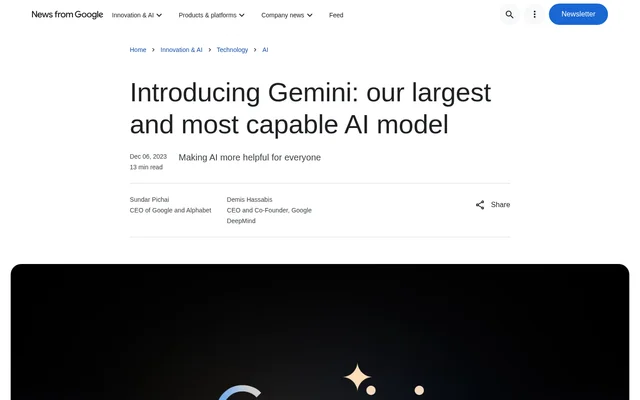
Gemini by Google is a family of general-purpose AI models built to work with different types of information in the same model. Teams across Google, including Google DeepMind and Google Research, contributed to its development. The announcement describes Gemini as a foundation model for developers and enterprise teams building AI applications, rather than as a tool for a single task. The Gemini 1.0 family includes Ultra for highly complex work, Pro for a broad range of tasks, and Nano for on-device use.
What Gemini by Google can do
Gemini by Google can combine information from text, code, images, audio, and video when answering questions. The difference between recognizing an input and reasoning about it matters here: the announcement describes a model that can use written and visual material together, not just describe an image on its own. Google also highlights document analysis and programming as distinct applications. For document collections, the stated capabilities include reading and filtering information; for programming, they include explaining existing code and generating new code.
- Gemini by Google reasons across written and visual information.
- Gemini by Google reads and filters documents to extract insights.
- Gemini by Google interprets audio and video inputs.
- Gemini by Google explains and generates code in Python, Java, C++, and Go.
- Gemini by Google explains reasoning in subjects such as math and physics.
How Gemini by Google works
Gemini by Google was pretrained on multiple types of data from the start, then fine-tuned with additional multimodal data. Google contrasts that approach with training separate components and joining them later. The announcement also distinguishes model design from deployment: Google trained Gemini 1.0 on its TPU infrastructure, but designed the family to run in environments ranging from data centers to mobile devices. Nano is the variant Google identifies for on-device tasks, while Pro is intended for a wide range of tasks.
Who Gemini by Google is for
Gemini by Google is aimed at developers and enterprise teams that want to build AI applications, including applications that work with more than one kind of input. Google also describes a collaborative role for the models in programming: programmers can use them to reason through a problem, consider a code design, or assist with implementation. For research and analysis, the announcement highlights extracting information from large document collections and points to science and finance as fields where that capability could be useful.
- Developers can build applications that combine text with visual inputs.
- Programmers can get help designing and implementing code.
- Research teams can filter documents and extract relevant insights.
Gemini by Google model options and benchmark results
Gemini by Google offers model sizes for different workloads, but the announcement does not present Ultra, Pro, and Nano as pricing tiers or state what they cost. The benchmark results also have a specific scope. Google reports that Ultra scored 59.4% on MMMU, a benchmark for multimodal reasoning, and outperformed prior models on the image benchmarks it tested without relying on a separate system to extract text from images. Those results describe Ultra on specific evaluations, not performance across every model size or application.
Pros and cons
What works
- Combines information from different input types in the same model
- Supports common programming languages including Python, Java, C++, and Go
- Includes a model size optimized for on-device tasks
Gemini by Google FAQ
What is Gemini by Google?
Gemini by Google is a family of AI models designed to understand and combine text, code, audio, images, and video. Google introduced Gemini 1.0 in Ultra, Pro, and Nano sizes for complex tasks, general workloads, and on-device use, respectively.
What can Gemini by Google do with documents?
Gemini by Google can read, filter, and interpret documents to extract insights from large collections. Google also describes the models as able to reason across complex written and visual information, which can help answer questions that draw on more than one type of input.
Can Gemini by Google write and explain code?
Gemini by Google can understand, explain, and generate code in programming languages such as Python, Java, C++, and Go. Google describes the models as tools that can help programmers reason through problems, propose code designs, and assist with implementation.
Which Gemini by Google model is designed for on-device use?
Gemini by Google includes Gemini Nano, the model size optimized for on-device tasks. Google describes the model family as designed to run in environments ranging from data centers to mobile devices, with Ultra intended for highly complex tasks and Pro for a wide range of tasks.
Who is Gemini by Google for?
Gemini by Google is intended for developers and enterprise teams building and scaling AI applications. Google also describes uses for programmers who need help with code and for teams that want to extract insights from large collections of documents.
From the community
No reviews yet
Be the first to review this tool. What you write helps the next person choose.