What is Google T5?
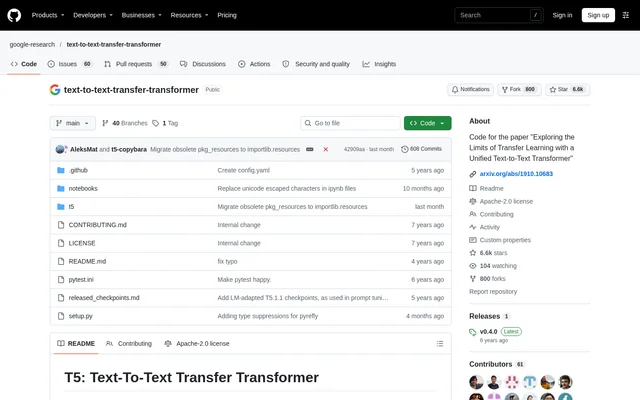
Google T5 is an open-source text-to-text transformer project for researchers and developers working on natural language processing. The repository primarily contains code for reproducing the experiments in Exploring the Limits of Transfer Learning with a Unified Text-to-Text Transformer. Google T5 also provides modules for developing and fine-tuning models on mixtures of text-to-text tasks.
Google T5 expresses task examples as input and target text, with preprocessing functions converting source datasets into that format. The repository includes released pretrained models and instructions for adapting those models to other data. Much of the implementation focuses on loading, preprocessing, mixing, and evaluating datasets rather than providing a consumer-facing writing application.
What Google T5 can do
Google T5 combines dataset utilities with model interfaces for training, evaluation, and inference. Researchers can use predefined preprocessors and metrics or define their own functions. Task datasets can also be combined into mixtures, allowing a training workflow to draw from multiple text-to-text tasks with configurable mixture rates.
- Google T5 loads datasets through TensorFlow Datasets, text files, or custom functions.
- Google T5 converts source examples into input and target text.
- Google T5 tokenizes text and decodes output tokens with SentencePiece.
- Google T5 combines task datasets for multi-task training.
- Google T5 fine-tunes released pretrained checkpoints.
- Google T5 evaluates predictions with predefined or custom metrics.
How Google T5 works
Google T5 can be installed with pip install t5[gcp], and the repository provides command-line examples for pretraining, fine-tuning, evaluation, and decoding. Users prepare a task or a preprocessed TSV dataset, select a model configuration, and specify the task mixture. Fine-tuning uses the pretrained model's operative configuration, which includes the checkpoint path.
Google T5 connects tasks and mixtures to Mesh TensorFlow or an experimental Hugging Face Transformers interface. The Mesh TensorFlow workflow supports the repository's experiment-reproduction instructions and large-model TPU use. The Hugging Face interface supports loading, fine-tuning, and evaluating pretrained models using PyTorch on a single GPU.
Who Google T5 is for
Google T5 is intended primarily for researchers reproducing the paper's experiments and developers building text-to-text models. The documented workflows involve Python packages, dataset preparation, model configuration, and command-line execution. Google T5 is therefore relevant to technical users who need control over training data, task mixtures, preprocessing, or evaluation.
- Google T5 supports reproducing the published transfer-learning experiments.
- Google T5 supports adapting pretrained checkpoints to custom datasets.
- Google T5 supports pretraining models from scratch.
- Google T5 supports defining custom text-to-text tasks and evaluation functions.
Google T5 pricing and access
Google T5 is an open-source project distributed under the Apache-2.0 license rather than a listed subscription service. The repository identifies a Colab tutorial with a free TPU as the easiest way to try the project. Google T5 also documents package installation and Google Cloud TPU setup for users running the command-line workflows.
Google T5 strengths and limitations
Google T5 provides reusable dataset components, released checkpoints, and detailed experiment workflows. Those resources support controlled research and custom training pipelines. However, the repository states that the TensorFlow implementation with MeshTF is no longer actively developed and recommends T5X, implemented in JAX and Flax, for users new to the project.
- Google T5's Hugging Face interface is experimental and subject to change.
- Google T5's direct TSV workflow cannot define preprocessing hooks or evaluation metric functions.
- Google T5's TPU workflows require accessible cloud storage and environment configuration.
- Google T5's C4 preparation requires substantial downloading and computation.
Google T5 FAQ
What is Google T5?
Google T5 is an open-source text-to-text transformer project that provides code for reproducing published transfer-learning experiments. Google T5 includes dataset utilities, model interfaces, and workflows for training, fine-tuning, and evaluating NLP models.
Is Google T5 free?
Google T5 is available as an open-source project under the Apache-2.0 license. Google T5 also links to a Colab tutorial with a free TPU, while the repository separately documents Google Cloud infrastructure setup for TPU workflows.
Can Google T5 fine-tune pretrained models?
Google T5 supports fine-tuning the pretrained models released alongside the paper. Google T5's documented workflow uses the pretrained model's operative configuration, a selected task mixture, and either task-based datasets or preprocessed TSV files.
Does Google T5 support PyTorch and GPUs?
Google T5 includes an experimental Hugging Face Transformers interface for loading, fine-tuning, and evaluating pretrained models using PyTorch on a single GPU. Google T5's documentation warns that this interface is subject to change.
Is Google T5 still actively developed?
Google T5's TensorFlow implementation with MeshTF is no longer actively developed, according to the repository. Google T5's documentation recommends that new users start with T5X, an implementation using JAX and Flax.
What datasets can Google T5 use?
Google T5 supports TensorFlow Datasets, text files with an example per line, custom functions returning TensorFlow datasets, and preprocessed TSV files. Google T5 requires a task definition when users need preprocessing hooks, postprocessing, or evaluation metric functions unavailable through direct TSV input.
From the community
No reviews yet
Be the first to review this tool. What you write helps the next person choose.