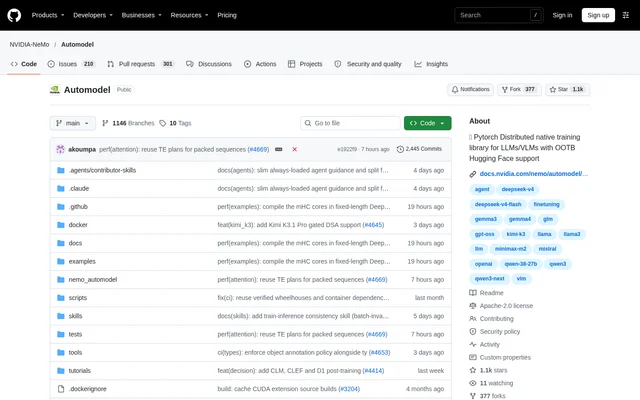
What is Automodel?
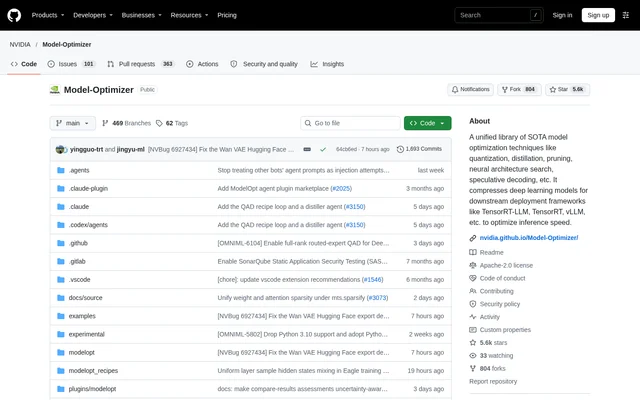
Automodel is an open-source distributed training library for large language models and vision-language models. Automodel uses native PyTorch distributed training and offers out-of-the-box Hugging Face support. The project is hosted in the NVIDIA-NeMo GitHub repository and provides resources for developers and researchers adapting supported models.
Automodel documentation includes ready-to-use recipes, examples, model coverage information, and performance resources. The repository also contains tutorials, scripts, tests, and contribution guidance. Model announcements describe language, vision-language, image-generation, and other multimodal training workflows, with specific recipes and coverage pages explaining the supported configurations.
What Automodel can do
Automodel supports several training and adaptation methods across its documented model coverage. Capabilities include full-parameter fine-tuning, supervised fine-tuning, and parameter-efficient adaptation with LoRA. Distributed execution options appear in model-specific recipes, while separate workflows cover image generation and drafter training for speculative decoding.
- Automodel supports full-parameter and LoRA fine-tuning for supported models.
- Automodel provides expert, pipeline, and context parallelism in documented configurations.
- Automodel includes packed-sequence and long-context training recipes.
- Automodel supports text-to-image full fine-tuning and LoRA for selected image models.
- Automodel includes image-editing LoRA fine-tuning for a supported image model.
- Automodel supports training target-aligned speculative decoding drafters.
How Automodel works
Automodel organizes training guidance around model-specific recipes, documentation, examples, and coverage pages. Developers can identify a supported model and consult its associated fine-tuning guide or recipe. The repository links configurations for tasks such as supervised fine-tuning, LoRA adaptation, packed training, and distributed execution.
Automodel combines Hugging Face support with PyTorch-native distributed training. Documented configurations use FSDP2 and combinations of expert, pipeline, and context parallelism. Some model guides also address checkpoint setup or data preparation, training, and evaluation, so the practical workflow depends on the selected model and task.
Who Automodel is for
Automodel is relevant to developers and researchers who work directly with model training code and distributed training configurations. The documented workflows cover language model adaptation, multimodal supervised fine-tuning, image-model adaptation, and speculative decoding research. The available recipes provide concrete starting points for these technical use cases.
- Automodel supports developers adapting language models with supervised fine-tuning or LoRA.
- Automodel supports researchers fine-tuning vision-language models on image-text tasks.
- Automodel provides recipes for teams training supported mixture-of-experts models.
- Automodel supports developers training drafters for speculative decoding.
Automodel pricing and source access
Automodel is available as an open-source project through its public GitHub repository under the Apache-2.0 license. The supplied page presents source code, documentation, recipes, and contribution resources rather than a commercial plan comparison. The page does not state subscription prices or hosted-service charges.
Automodel strengths and limitations
Automodel combines native PyTorch distributed training, Hugging Face support, and model-specific training recipes in an open-source library. The repository covers both language and multimodal workflows and provides links to supporting guides. These resources are intended for technical model development rather than a documented consumer-facing training interface.
- Automodel requires technical setup to use its training code and configurations.
- Automodel capabilities depend on the selected model and documented recipe.
- Automodel includes large-model recipes that require multi-node or multi-GPU hardware.
Automodel FAQ
What is Automodel?
Automodel is an open-source PyTorch-native distributed training library for large language models and vision-language models. Automodel provides out-of-the-box Hugging Face support, model-specific fine-tuning recipes, documentation, and examples through the NVIDIA-NeMo GitHub repository.
Is Automodel free?
Automodel is available as an open-source project under the Apache-2.0 license. The repository provides source code, documentation, and training recipes; the supplied page does not list subscription plans or hosted-service prices.
Does Automodel support Hugging Face?
Automodel provides out-of-the-box Hugging Face support alongside PyTorch-native distributed training. The repository links model coverage pages and recipes for supported models, including full-parameter fine-tuning, supervised fine-tuning, and LoRA workflows.
What can you fine-tune with Automodel?
Automodel supports fine-tuning supported language models, vision-language models, and selected image-generation models. Documented workflows include full-parameter training, LoRA, text-to-image adaptation, and image-editing LoRA, with available methods depending on the model and recipe.
Does Automodel support distributed training?
Automodel supports PyTorch-native distributed training, with documented configurations using FSDP2, expert parallelism, pipeline parallelism, and context parallelism. Specific combinations depend on the model, and some recipes describe multi-node or multi-GPU training.
Can Automodel train speculative decoding models?
Automodel supports training target-aligned drafters for speculative decoding. The repository names EAGLE, P-EAGLE, DFlash, and DSpark workflows and links a speculative decoding overview alongside model-specific drafter training recipes.
From the community
No reviews yet
Be the first to review this tool. What you write helps the next person choose.