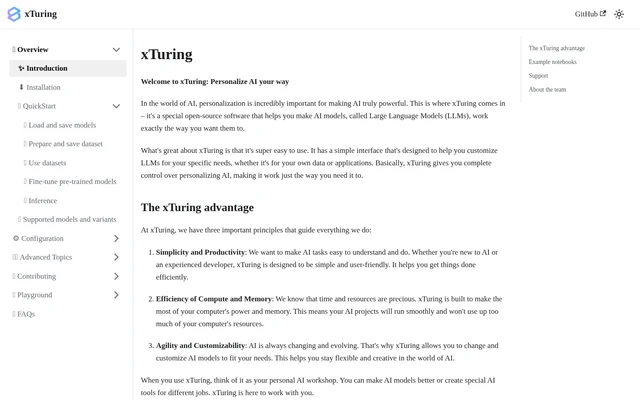
What is xTuring?
xTuring is open-source software for customizing large language models to suit particular data and applications. xTuring is intended for both people new to AI and experienced developers who want to personalize model behavior. The project comes from Stochastic, whose team includes researchers and engineers working on machine learning, computing, and practical AI applications.
xTuring describes simplicity, compute and memory efficiency, and customizability as guiding principles. The stated aim is to make model personalization accessible through a simple interface while allowing users to adapt models to their needs. These principles describe the project's design priorities rather than providing measured performance results.
What xTuring can do
xTuring supports language model personalization and supplies examples organized around tasks rather than model families. The page names fine-tuning and evaluation notebooks as starting points, with a separate documentation reference for supported models and naming variants. The concrete examples cover LoRA, LoRA with INT8, and perplexity evaluation.
- xTuring helps customize LLMs for specific data and applications.
- xTuring provides a notebook for fine-tuning with LoRA.
- xTuring provides a notebook for fine-tuning with LoRA plus INT8.
- xTuring provides a notebook for evaluating perplexity.
How xTuring works
xTuring directs users to the Quickstart guide or a task-specific example notebook to begin. The listed notebook paths are examples/notebooks/finetune_lora.ipynb, examples/notebooks/finetune_lora_int8.ipynb, and examples/notebooks/evaluate_perplexity.ipynb. Users exploring model choices are referred to the Supported models and variants documentation. The page does not provide installation commands or a detailed execution workflow.
Who xTuring is for
xTuring is designed for users ranging from AI beginners to experienced developers. The central use case is adapting language models to a person's own data or application requirements. The task-based examples also give users concrete entry points for exploring model fine-tuning and evaluation without organizing their starting point around a particular model family.
- AI beginners can explore personalization through the Quickstart guide and examples.
- Developers can adapt LLMs for application-specific needs.
- Users can follow notebooks for LoRA fine-tuning or perplexity evaluation.
xTuring pricing and access
xTuring is available as open-source software licensed under Apache 2.0. The page presents documentation and example notebooks as the route into the project rather than describing subscription plans. No paid tiers or pricing figures are listed. The available access information centers on the open-source license, the Quickstart guide, and the task-based notebook examples.
xTuring strengths and documented limits
xTuring combines an open-source license with task-oriented examples and a stated focus on simplicity and resource efficiency. The documentation offers specific starting points for fine-tuning and evaluation, while the Discord community offers a place to discuss ideas. The overview does not name supported models or quantify compute and memory savings; model details are referred to separate documentation.
xTuring FAQ
What is xTuring?
xTuring is open-source software for personalizing large language models for specific data and applications. xTuring comes from Stochastic and emphasizes a simple interface, compute and memory efficiency, and flexibility for users ranging from AI beginners to experienced developers.
What license does xTuring use?
xTuring is licensed under Apache 2.0 and is described as open-source software. The page points users to a Quickstart guide and example notebooks, but does not list subscription plans or pricing figures.
Does xTuring support LoRA fine-tuning?
xTuring provides example notebooks for fine-tuning with LoRA and for fine-tuning with LoRA plus INT8. The examples are organized by task rather than model family, with model options covered in separate Supported models and variants documentation.
Can xTuring evaluate model perplexity?
xTuring provides a perplexity evaluation example notebook at examples/notebooks/evaluate_perplexity.ipynb. The notebook appears alongside LoRA and LoRA plus INT8 fine-tuning examples in the task-based examples listed on the page.
How do you get started with xTuring?
xTuring directs new users to the Quickstart guide or the example notebooks. Users can choose a fine-tuning or perplexity evaluation task, consult the Supported models and variants documentation, and discuss ideas with other members of the Discord community.
From the community
No reviews yet
Be the first to review this tool. What you write helps the next person choose.