What is Instatic?
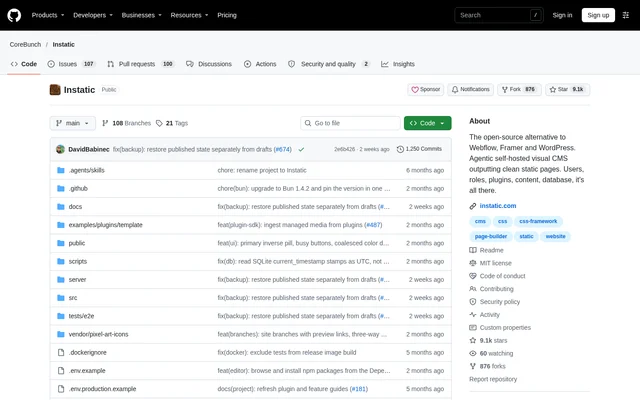
Instatic is an open-source visual content management system for creating, managing, and publishing websites. Instatic brings the canvas editor, content engine, media, authentication, forms, plugins, and publisher together in a single Bun server. The repository describes the project as a self-hosted alternative to Webflow, Framer, and WordPress, with SQLite or Postgres backing the site.
Instatic separates the editing environment from the published website. Published pages contain semantic HTML and compact CSS rather than the editor's machinery, builder attributes, or a framework runtime. This makes static page delivery central to the project, while the server provides the administrative tools needed to maintain content and design.
What Instatic can do
Instatic supports visual design, reusable site structures, structured content, and AI-assisted editing within the same CMS. The canvas can show breakpoint frames side by side, while live mode supports editing a full-size page in place. Core Framework supplies design tokens for colors, fluid typography, spacing, and generated utility classes.
- Instatic creates reusable visual components with typed parameters and named slots.
- Instatic applies shared templates and renders collections through content loops.
- Instatic uses an AI agent to build real, editable canvas nodes.
- Instatic imports raw HTML or complete static sites with conflict previews.
- Instatic stores form submissions in the site's own data tables.
- Instatic manages custom post types with drafts, scheduling, and published version history.
How Instatic works
Instatic can be deployed through Railway templates, Render, or Docker on a VPS or personal hardware. Railway deployment generates secret keys, attaches a storage volume, and configures health checks. The source recommends SQLite for most sites and Postgres for teams of authors or those wanting managed database backups.
Instatic users build pages with modules such as text, images, buttons, video, forms, and containers. AI requests pass through the same import pipeline used for pasted markup, producing editable structure and styles. Users supply Claude, OpenAI, OpenRouter, or local Ollama models. Updates use a redeployed image, while databases and uploads remain on attached storage.
Who Instatic is for
Instatic addresses website owners who want visual editing alongside control over hosting and content storage. The deployment guidance explicitly covers blogs, portfolios, small businesses, and teams with multiple authors. Custom tables also support structured information beyond posts, including product catalogs, testimonials, team directories, form submissions, and lightweight CRM records.
- Instatic supports publishing blogs and portfolio websites.
- Instatic supports managing shared content workflows for author teams.
- Instatic supports rendering product catalogs and galleries with loops.
- Instatic supports collecting and exporting form submissions without a third-party form service.
Instatic licensing and deployment access
Instatic is distributed as an open-source project under the MIT license and is available through the public repository. The source provides deployment paths rather than subscription plans or hosting prices. Users can choose Railway, Render, or their own server, and AI use follows the user's selected model, key, and bill. Deployment guides cover databases, HTTPS with Caddy, and backups.
Instatic strengths and limitations
Instatic combines site design, structured content, publishing, and operational administration without requiring separate tools for each function. Static output avoids a framework boot process, hydration, and a database round-trip on the common delivery path. Backend plugins run in per-plugin QuickJS-WASM sandboxes, while media storage adapters and plugin-defined content sources extend the built-in capabilities.
- Instatic requires deployment to a hosting provider or user-controlled server.
- Instatic leaves AI model selection, keys, and billing to the user.
- Instatic provides operational analytics rather than third-party visitor tracking.
- Instatic requires explicit editor.code permission for editor extensions and app-kind admin pages.
Instatic FAQ
What is Instatic?
Instatic is an open-source, self-hosted visual CMS that combines website design, structured content management, and publishing in a single Bun server. Instatic publishes semantic HTML and compact CSS, with SQLite or Postgres providing database storage.
Is Instatic free?
Instatic is available as an open-source project under the MIT license. The repository does not state hosting prices or subscription plans. Instatic supports self-hosted deployment, and AI features use the user's own model key and billing.
Which AI models does Instatic support?
Instatic supports Claude, OpenAI, OpenRouter, and local Ollama models through a bring-your-own-model approach. Instatic's AI agent builds editable canvas nodes and edits content entries, with model keys and usage billing supplied by the user.
Where can Instatic be deployed?
Instatic can be deployed on Railway, Render, or a user-controlled server using Docker. Instatic supports SQLite and Postgres, and the repository includes deployment guidance for VPS hosting, HTTPS with Caddy, database configuration, and backups.
Can Instatic import an existing website?
Instatic can import pasted HTML as editable nodes or import a complete static site containing HTML, CSS, images, and fonts. Instatic's Super Import converts these assets into pages, style rules, design tokens, and media, previews conflicts before writing, and treats the import as a single undo.
Does Instatic support plugins?
Instatic supports plugins packaged as zip files with manifests. Instatic's plugin SDK can add HTTP routes, admin pages, scheduled jobs, content-loop sources, canvas modules, storage adapters, and frontend assets. Backend plugin code runs in a QuickJS-WASM sandbox with permissions controlled by the site owner.
From the community
No reviews yet
Be the first to review this tool. What you write helps the next person choose.