What is Lyro?
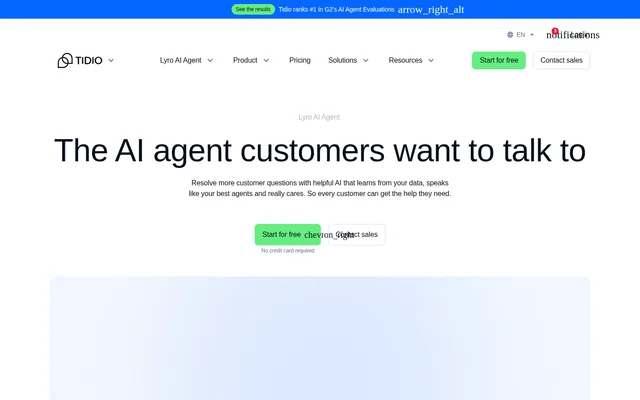
Lyro is an AI customer service agent from Tidio that uses a business’s support content to answer customer questions and handle recurring tasks. Lyro serves support teams that want automated responses alongside human assistance. Businesses can use Lyro within Tidio or connect Lyro to an existing customer service system.
Lyro uses Claude from Anthropic and Tidio’s in-house models rather than ChatGPT. Lyro interprets customer intent and generates natural-language responses from supplied content instead of relying exclusively on predefined questions and scripts. Businesses provide the knowledge and guidance that determine what Lyro can answer and how those answers should sound.
What Lyro can do
Lyro combines question answering with support actions, product recommendations, and conversation oversight. Support teams can define brand guidance, review performance, and decide when a human should take over. Lyro also provides resolution rates, satisfaction scores, and conversation patterns that teams can use to identify missing knowledge and refine responses.
- Lyro answers customer questions using supplied support content.
- Lyro automates order updates, lead qualification, and ticket routing.
- Lyro recommends products directly from a store.
- Lyro applies guidance for tone, style, and escalation rules.
- Lyro lets teams monitor conversations and join chats in real time.
- Lyro reports resolution rates, satisfaction scores, and conversation patterns.
How Lyro works
Lyro can be added to a website without technical knowledge. Businesses supply support content, which Lyro automatically collects and uses as a knowledge base. Lyro generates answers from that material, while support teams review conversations and add missing information. Questions beyond the available knowledge are forwarded to a human agent.
Lyro Connect extends Lyro to existing customer service software, including Zendesk, Intercom, and Salesforce. The stated workflow is to integrate the support system, share support content, and activate Lyro. When a question falls outside Lyro’s knowledge, Lyro creates a ticket in the connected support solution for a human agent to answer.
Who Lyro is for
Lyro is intended for customer service teams handling repetitive questions while keeping human agents available for complex or sensitive cases. Online stores can use Lyro for product recommendations and questions about orders, shipping policies, and product availability. Businesses can also use Lyro to qualify leads and direct requests to the appropriate department.
- Lyro answers recurring support questions from a business knowledge base.
- Lyro helps shoppers find products and obtain order information.
- Lyro qualifies leads and routes support tickets.
- Lyro escalates sensitive conversations or unanswered questions to human agents.
Lyro pricing and plans
Lyro starts with 50 free conversations for every Tidio account, with no credit card required. Continued use requires a paid Lyro plan, and the page advertises conversation pricing starting from $0.5. Multiple replies within the same customer interaction count as a single conversation, including when a customer leaves and later returns.
Lyro paid-plan conversation limits refresh 30 days after payment. Lyro Connect is available only with Plus and Premium subscriptions according to the page’s FAQ, while the integration promotion names Tidio Premium. Sales representatives explain the Connect pricing structure during a demo. Custom solutions can include model training, custom integrations, reporting, and implementation assistance.
Lyro strengths and limitations
Lyro supports automation without requiring businesses to replace their current help desk. Human handoffs, live monitoring, and configurable guidance give support teams ways to oversee automated conversations. Lyro’s knowledge-based approach also makes support content maintenance important: the page explicitly links accurate content and filling knowledge gaps with the ability to answer more questions.
- Lyro requires a paid plan after the initial free conversations.
- Lyro needs relevant support content to answer a customer’s question.
- Lyro Connect requires a Plus or Premium subscription.
Lyro FAQ
What is Lyro?
Lyro is an AI customer service agent from Tidio that answers questions using a business’s support content. Lyro understands customer intent, generates natural-language responses, handles recurring tasks, and transfers questions outside the available knowledge to human support agents.
Is Lyro free?
Lyro is free to try with 50 conversations included in every Tidio account, without a credit card. Continued use requires a paid Lyro plan. The page advertises conversation pricing starting from $0.5, with paid-plan conversation limits refreshing 30 days after payment.
Does Lyro integrate with Zendesk, Intercom, and Salesforce?
Lyro connects with Zendesk, Intercom, and Salesforce through Lyro Connect, allowing businesses to retain existing customer service software. The page’s FAQ limits Lyro Connect to Plus and Premium subscriptions, and the integration promotion specifically names Tidio Premium.
Does Lyro use ChatGPT?
Lyro uses Claude from Anthropic and Tidio’s in-house models, not ChatGPT. Lyro uses supplied support content as its knowledge base and applies business guidance to customer responses, including tone, style, and escalation rules.
What counts as a Lyro conversation?
Lyro counts a customer interaction through a channel integrated with Tidio as a conversation when the AI agent provides a reply. Multiple replies within that interaction still count as a single conversation, even when the customer leaves the chat and returns later.
What happens when Lyro cannot answer a question?
Lyro forwards questions outside its support knowledge to a human agent. With Lyro Connect, Lyro creates a ticket in the connected support system. Support teams can also monitor conversations, intervene directly, and add missing knowledge to improve subsequent responses.
From the community
No reviews yet
Be the first to review this tool. What you write helps the next person choose.